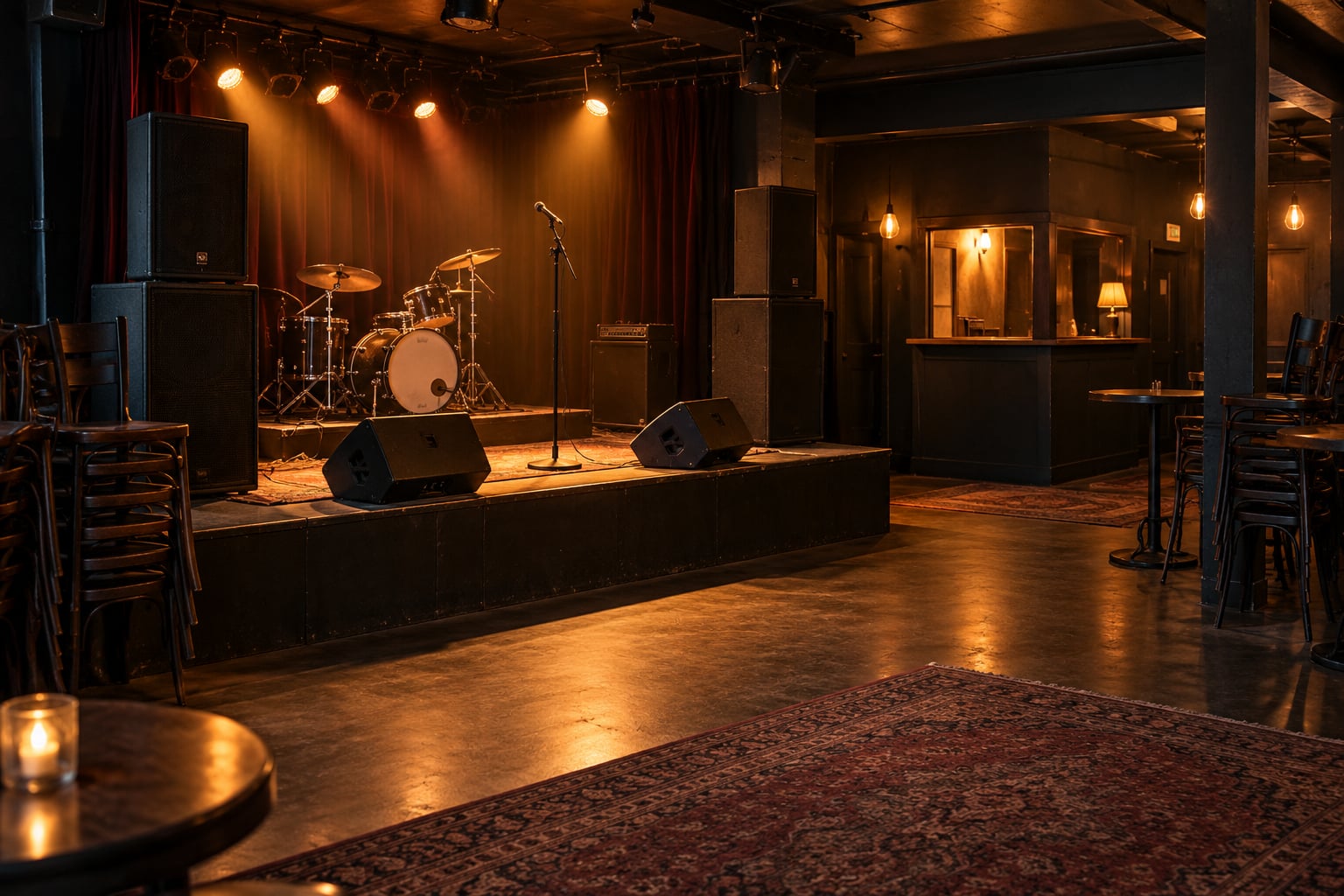
For a debut run, book a room that holds about one and a half to two times the crowd you can realistically sell in that city. In practice that means a 100- to 300-capacity club, not a theater. How to choose a venue size for a first tour comes down to one thing: work out your draw first, then let it pick the room.
This takes an afternoon of desk work plus a handful of phone calls, and it is less complicated than most first-timers expect. You will finish with one number per city, one room per date, and a promoter email that does not embarrass you.
Updated for October 2026.
Table of Contents
- What You Need
- How to Choose a Venue Size for a First Tour: Step-by-Step
- 1. Estimate Your Core Audience Before You Choose a Venue Size
- 2. Set the Show Format and Support Plan
- 3. Turn the Estimate Into a Venue-Size Range
- 4. Compare Capacity With the Room You Actually Get
- 5. Check the Full Performance and Business Requirements
- 6. Test the Venue Size Against a Realistic Sales Plan
- 7. Ask the Venue for Evidence, Then Confirm the Booking
- Common Mistakes
- Frequently Asked Questions
- Should a first tour play in bigger venues or smaller clubs?
- How full should a venue be before a first tour feels successful?
- Is a sold-out show always better than a nearly full room?
- How do I compare venues in different cities on the same tour?
- Should an independent artist book venues directly or use a promoter?
- What if ticket sales are slower than expected before the show?
- Where to Start
What You Need
You cannot size a room until eight pieces of information sit in front of you. Gather them in this order, because each one narrows the next.
- A realistic attendance estimate for each city on the route. A range is fine. A single confident number is not.
- Your ticket price and the band above or below you. Price sets expectations, and the bill sets who shows up.
- Your set length and genre. A 40-minute ambient set and a 75-minute noise show need different rooms.
- The routing itself. Which cities are realistic to drive or fly between without turning the run into a commuting exercise.
- The total budget, per show. Not just the room fee. Production, backline, travel, meals and crew come out of the same pot.
- Your technical requirements. Stage plot, backline needs, whether you carry your own engineer, and how much load-in time you need.
- Recent attendance at comparable shows. Check out a show in that market the same month the promoter is quoting you.
- The deal type you can live with. Guarantee, door deal or split point. It changes which rooms make sense.
If items five and seven are missing, stop there and get them first. A room quoted without production costs is not a quote.
How to Choose a Venue Size for a First Tour: Step-by-Step
Run these seven steps in sequence for every city on the route. Do them per city, because draw changes completely from one market to the next, and one national number is how first tours go wrong.
1. Estimate Your Core Audience Before You Choose a Venue Size
Start with what you can actually name, not what a platform reports. Count the mailing list subscribers in that metro area who have bought or clicked through, the local followers who interact rather than scroll past, and the people who came to your last show in that state.
Then look outward. Find an artist with a similar audience who played that city in the last six months and check the room they played and roughly what it held. That single data point beats any follower count you can produce. A r/TouringMusicians thread on how promoters size rooms in a new city makes the same point: promoters size off past ticket history in that market, the bill, and the health of the local scene.
The most useful rule of thumb anywhere in this niche is simple. If you can genuinely name 150 people in a town, target a room with 100 capacity. The heuristic surfaced in musician forums and it holds up because it already builds in your margin.
| Market tier | Realistic tickets for a first tour | Room to target |
|---|---|---|
| Tertiary | 50 to 1,000 | House shows, bars, 100 to 200 capacity clubs |
| Secondary | 200 to 5,000 | 200 to 500 capacity clubs, small music halls |
| Primary | Scalable to 50,000 in one market | Test with one 500 to 1,000 capacity room before scaling |
You know this step worked when you can state one low number and one high number per city, and you can explain where each came from.
2. Set the Show Format and Support Plan
How you are billed changes the math more than the city does. Headlining a 100-cap room means every ticket in that room is yours to win. Opening means the room is already sold on someone else’s name and your attendance is a fraction of the headline.
Co-billing with a local band is the underrated middle option. You borrow their crowd, they borrow yours, and a room that felt too big for you suddenly feels right. Forum consensus leans toward the sold-out small headline over the stadium support slot, largely because headlining builds an identity in a city while an opener inherits someone else’s room and someone else’s audience.
Support slots also come with a radius clause, which is a limit on how close to the headliner’s market you can book your own show. Read it before you plan a return trip.
You know this step worked when you can name the headliner or co-bill act, the ticket price, and the set time before you go looking at rooms.
3. Turn the Estimate Into a Venue-Size Range
Multiply your high estimate by one and a half to two. That gives you the capacity you want in the room. Then subtract the space and people you expect to add: walk-ups, comps, local friends of the support act, and anyone who bought at the door and needs a seat.
A worked example. Say your best estimate in city A is 90, in city B is 210, and in city C is 400. You would ask a promoter for a 150-cap room in A, a 300-cap room in B, and start conversations about 500 to 650 in C. The gap in each case is your margin.
Some margin is not waste. A room at 70 percent on a Tuesday can feel busier than a room at 100 percent on a Sunday, because the people who came came on purpose. The margin is what protects you on the one night it rains.
You know this step worked when every city has a target capacity number, not a target vibe.
4. Compare Capacity With the Room You Actually Get
Legal capacity is a fire code number. Usable capacity is what you can sell. They are rarely the same, and the gap is usually 20 to 30 percent in a small club with a seated section, a camera well, a merch table and a side-of-house mix position.
A 300-capacity room with 80 seats and a camera well might give you 210 usable standing bodies. A 300-capacity standing room might genuinely sell 250. Ask which one you are getting, and ask where the merch table sits, because a table in the walkway removes bodies from the floor as well as money from your cut.
| Venue type | Typical capacity | Best first-tour use | Main risk |
|---|---|---|---|
| House show / DIY space | 40 to 100 | Testing a new city at near-zero risk | No bar revenue, no PA, hard to promote |
| Bar with a stage | 100 to 200 | Acoustic sets, spoken word, low draw | Weak PA, fight for the microphone, noise curfew |
| Small club | 200 to 500 | The default first-tour room | Bad weeknights, thin local scene |
| Music hall or theater | 500 to 1,500 | Secondary markets once the 300 room sells out | Higher fixed costs, worse sightlines if too small |
| Arena and beyond | 5,000 and up | Supporting a headliner, not headlining one | Empty floor reads as a failure in every photo |
Square footage is a rough sanity check rather than a rule. A 2,000 square foot room usually lands somewhere around 150 to 200 people once you subtract the stage, the bar and the restrooms. Ask for the fire marshal number rather than measuring with a tape.
You know this step worked when you have the usable count for every shortlisted room, not the posted capacity.
5. Check the Full Performance and Business Requirements
Now the room has to survive contact with the show. Check stage width and depth against your stage plot, whether the backline is included or you are renting it, how many sound and lighting people the house provides, your load-in window, the soundcheck slot, the curfew, and whether there is parking for a van. A room with a great PA and a two-step loading dock will cost you hours every night.
Then the money, and this is where most first tours misjudge the room. Four deal structures cover almost everything:
- Guarantee. The promoter pays you a flat amount whether or not the room sells. Safe for you, risky for them, so they offer it in rooms where they expect a sell-out.
- Door deal. The promoter takes a percentage of tickets sold at the door and you take the rest, no floor. Fine in a small room, risky in a big one where the empty seats are your problem.
- Versus deal. You choose between a guarantee and a percentage of the gross. Often the best option in a 200 to 400 capacity room.
- Split point deal. The promoter takes expenses off the top, everyone covers the rest, then the remaining money splits. Watch what counts as an expense.
The expenses that quietly come off the top in a split point are called the nut. A hall fee is what the venue takes off the gross before anything else, which is sometimes a flat amount and sometimes a percentage. Comps are free tickets, and papering the house is handing out comps to fill the room so it does not look empty, which works once and gets you talked about badly later.
A merch cut is the venue’s percentage of your merch sales, and it is often steeper in nicer rooms. On a thin night in a mid-sized club it can be the difference between a small loss and a small profit.
One more piece of jargon worth knowing: an underplay is deliberately booking a room smaller than your draw so you sell out. Musicians debate it constantly. Community threads treat it as a legitimate scene-building move alongside small-format series like SoFar Sounds and Jam in the Van, even when it is not the strongest financial play.
Add it all up: room rental or deal, backline hire, sound and lights, engineer fees, travel, per diem, poster and photo costs, insurance. A cheap room with an expensive backline rental is not a cheap room.
You know this step worked when you have a total cost per show and a written deal, not a friendly email.
6. Test the Venue Size Against a Realistic Sales Plan
Build the sales plan in ticket counts, because that is what you can sanity check. Presale is usually the biggest block and it closes early. Early window sales follow. Door sales and walk-ups depend on the room being the right size, which is the whole point of this exercise.
Then find the break-even count. Take your total cost per show, subtract what you earn from merch and any guarantee, and divide what is left by your ticket price. That number is the least tickets you can sell and still break even.
Worked example. Suppose a show needs 140 paid tickets to break even. Your presale sells 60 and early window adds 30. You are 50 short, so you need 50 at the door. In a 200-cap room with a local opener that is achievable. In a 450-cap room, the same 140 people look like a canceled show, and the promoter will remember it when you come back.
Watch both failure directions. Under the room means wasted fixed costs and a weak night. Over the room means an empty floor, a bad photo, and a promoter in that market quietly marking you as a risk.
You know this step worked when you can say how many tickets break even and how many you expect to sell, per city.
7. Ask the Venue for Evidence, Then Confirm the Booking
Before you send numbers to a promoter, ask these ten questions:
- What is the fire code capacity, and what is the usable capacity on a show night?
- What did the last three comparable shows draw in this room?
- What has been the best and worst ticket sales night here in the last six months?
- Is the deal a guarantee, door, versus or split point, and what counts as an expense?
- What is the hall fee and the merch cut?
- What is included in the room fee: PA, lights, engineer, green room, backline?
- What is the stage size and the load-in window?
- What is the curfew and the sound limit?
- How many comps does the house expect, and who uses them?
- Is there an age restriction, and is there parking for a van?
If a promoter hedges on question two, treat it as a signal. The industry is small and promoters check the calendar and past ticket data. Inflating your numbers to land a bigger room gets you a one-show booking in that city and no second one.
Then use the standard sequence: hold the date, challenge the offer with your real numbers, confirm in writing. Settlement is the final step, where every expense and every ticket sold is counted out. Get the settlement sheet in writing too, even when you like the promoter.
You know this step worked when you have a signed performance contract listing capacity, deal, fees, curfew and settlement terms.
Common Mistakes
Choosing by follower count. Followers include everyone who liked a clip once. Use them as a ceiling signal at most, and weight real ticket history far higher.
Ignoring usable capacity. The number on the listing is not the number you can sell. Ask for the fire marshal number and subtract the seated section and any blocked floor.
Booking too large because it feels like progress. A full 200-cap room in a new city is worth more than a half-full 500 in the same city. Forum threads consistently favor the sell-out over the step up, and the reasoning is about perception, not money.
Failing to ask about comparable shows. One question about the last three comparable bills tells you more than ten pages of research about the venue’s reputation.
Overestimating your draw to promoters. It feels like negotiation, and it is the fastest way to lose a market. A small engaged audience that shows up is worth more than an inflated number that produces an empty room.
Calculating only the room fee. Backline, engineer, hall fee and merch cut turn a cheap night into a loss. Total cost per show is the only number that decides the room.
Ignoring production limits. A room with no permanent backline, a curfew at eleven and a two-step load-in costs you more in time and money than a slightly bigger room would.
A few tips that hold up. Book the same room type across the route so the show does not change character city to city. Scout a show in that market the same month you are quoted, so you know what the room looks like at your draw on a weeknight. And put a local opener on every date, since their audience is the cheapest fill you will ever get.
Frequently Asked Questions
Should a first tour play in bigger venues or smaller clubs?
Smaller clubs, nearly always. For a debut run a 100 to 300 capacity room gives you a realistic shot at a full floor, and a full small room reads better to promoters than a sparse large one. You can step up to a 300 or 500 capacity club once those dates have sold out twice. A bigger room only makes sense to support a headliner, where the crowd is already sold on someone else’s name.
How full should a venue be before a first tour feels successful?
Around 70 to 80 percent of usable capacity is a good night. It leaves money on the table, but the atmosphere stays right, the merch table still moves and nobody takes a bad photo into consideration. Track the percentage across the run rather than the head count, since you will be comparing different rooms in different cities.
Is a sold-out show always better than a nearly full room?
Not always financially. A sell-out in a small room usually nets you less than a strong night in a bigger one, because the fixed costs and the merch table scale with the room. Perceptually, though, the sell-out wins: promoters remember it, the room buzzes, and the photos work for you. On a first tour, buy the perception with the money.
How do I compare venues in different cities on the same tour?
Normalize everything to a percentage of usable capacity rather than head count. A 60 percent night in a 250 room and a 60 percent night in a 400 room tell you your draw scaled with the market. Also compare break-even ticket counts, so you know which dates covered production and which dates were a loss you are still paying off.
Should an independent artist book venues directly or use a promoter?
Go direct with venues for small rooms, since the person holding the keys usually also holds the calendar. Use a promoter when you want a local partner who already sells that room and can bring an audience. A booking agent is a third option that earns a percentage to handle outreach, contracts and settlement for you.
What if ticket sales are slower than expected before the show?
Do not cancel. Late cancellation costs you the market, even when the contract has no penalty, because the promoter will remember. Instead, add a local support act, push the presale extension, and work the door with street team and last-week announcements. Underplay on the next date in that region and keep going.
Where to Start
Write down one attendance number for each city tonight, before you look at a single room listing. That is the only step that has to happen first, and everything after it gets easier: the capacity range, the shortlist, the promoter email. When you have the numbers, remember the margin. Book one and a half to two times what you think you can sell, in a 100 to 300 capacity club, with a local opener on the bill.