Chunky sneakers make you look shorter when the shoe breaks your leg line into pieces, and the fix is almost never a smaller sneaker. It is a narrower hem, a matched colour, and one clear waist. Here is how to wear chunky sneakers without looking shorter, in five steps you can try with clothes you already own.
The complaint is specific. On a petite frame, a chunky midsole with a high-contrast outsole adds visual weight to the lowest, smallest part of the body, and the eye reads that weight as length lost. But people who wear chunky sneakers well are not all tall. They are just careful about where the breaks fall.
Before anything else, fit matters more than trend. A stylist on the YouLookFab footwear proportions thread put it plainly: chunky sneakers on smaller feet only work in a narrow, close-fitting shape, because they have to sit properly on the foot to look deliberate. That is worth saying before any styling rule, because a pair you can wiggle in will fight every trick below.
Table of Contents
- What You Need to Wear Chunky Sneakers Without Looking Shorter
- Step-by-Step
- Common Mistakes
- Frequently Asked Questions
- Can petite people wear chunky sneakers without looking shorter?
- What pants length looks best with chunky sneakers?
- How do you style chunky sneakers with wide-leg trousers?
- Do socks make chunky sneakers look better?
- Can you wear chunky sneakers with cropped pants?
- How do you balance chunky sneakers with an oversized outfit?
- Conclusion
What You Need to Wear Chunky Sneakers Without Looking Shorter
Nothing here is a specific product. You need four clothing variables and about five minutes.
A well-fitting chunky sneaker means the shoe sits close to your foot without your heel lifting, and the sole is not dramatically taller than the widest part of your foot. A top that can be tucked or deliberately left loose, so the waist is either visible or clearly absent on purpose. High- or mid-rise bottoms, which do most of the length work because they raise the line where your leg begins. And one simple layering piece, like a long open jacket or an overshirt, to control the upper body.
That is the full kit. No tools, no special equipment. If your jeans only fit right when they pool over the shoe, the tailoring job comes before the styling job.
Step-by-Step
These chunky sneakers proportion rules run in order because they build on each other. Fix the proportion first, then balance the volume, then the hem, then colour, then one finishing detail.
Choose a Proportion That Keeps Legs Visible
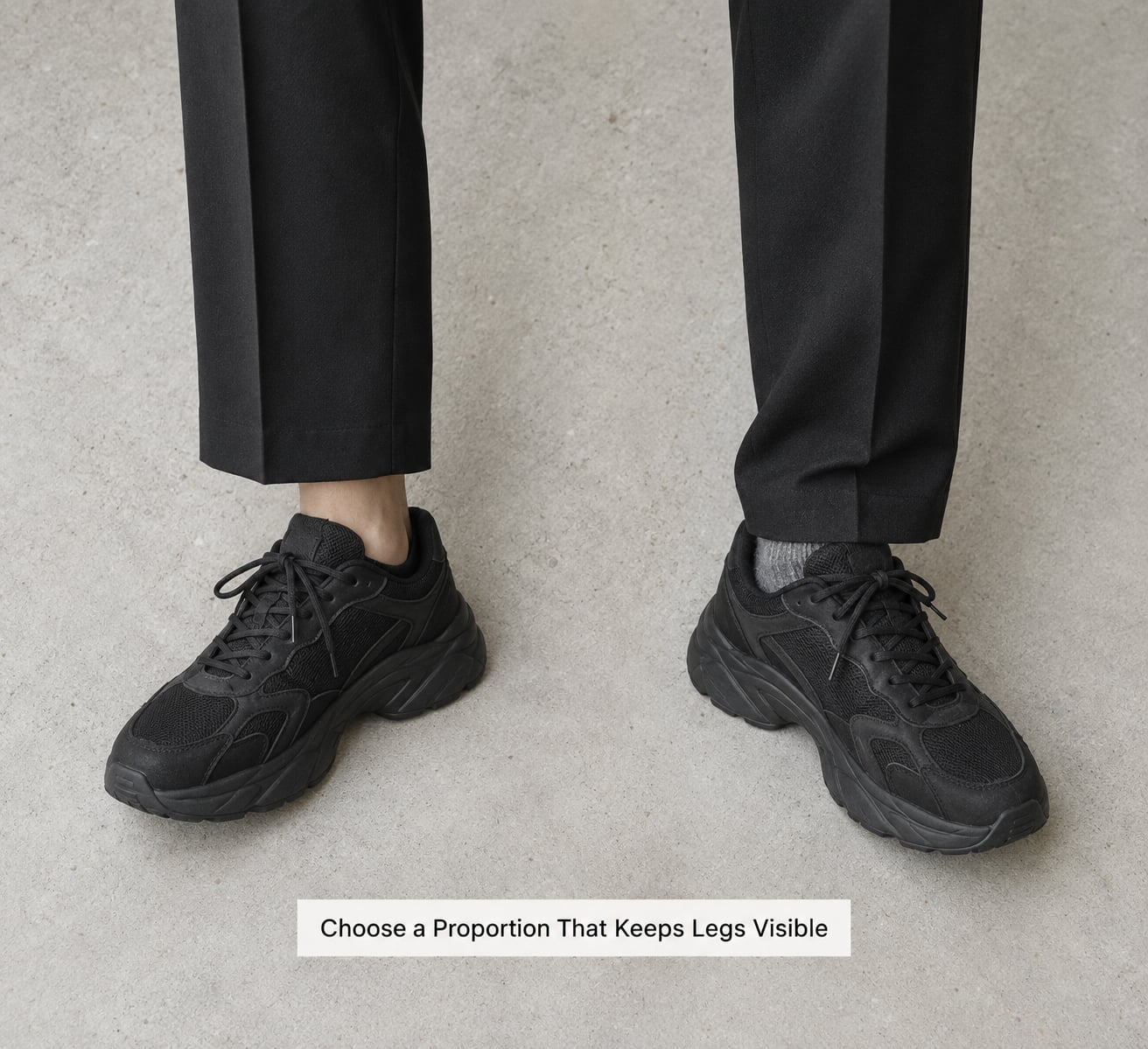
Cropped, straight, tapered and ankle-bare hems all elongate. Anything that buries your ankle in fabric and midsole at the same time does not.
With jeans, an ankle-length straight leg ending a couple of inches above the shoe opening gives you a visible slice of skin or sock that reads as extra leg. With tailored trousers, a slight ankle reveal beats a full break, because a break creates a horizontal line right where you want a vertical one. With shorts, the shorter the better: the gap between hem and shoe is the lengthening element, and chunky sneakers eat that gap faster than any other shoe.
How to check it: stand in front of a mirror in your normal stance and look at the inside line of your leg. If that line is interrupted by a cuff, a pool of denim or a shadow at the ankle, the proportion is not working yet.
Balance the Sneaker with the Rest of the Outfit
A chunky sneaker is a heavy object at one end of the body, so the top half either matches that weight or it deliberately does not. The most reliable formula is a chunky sneaker with slim or straight-leg bottoms and a fitted or tucked top.
When the shoe carries the volume, a fitted top keeps the silhouette narrow and lets the leg do the work. When you want volume up top too, do it with structure rather than size: a long open jacket creates two vertical lines that run past the hip, and those lines pull the eye down through the leg instead of stopping at the sole.
The untucked oversized tee is the one combination that reliably shortens, because it drops the waistline and widens the whole frame at once. If you love that shirt, a half tuck on one side gives you the volume without losing the waist.
Check: your silhouette should read as either top-heavy or bottom-heavy on purpose. What does not work is a wide top and a wide bottom with a chunky sole, because then nothing is carrying the eye anywhere.
Keep the Hem Close to the Right Point
The hem is the single biggest length lever you control, and the wrong placement is what turns a good outfit bottom-heavy. Aim for a clean break where the fabric meets the shoe collar with no fabric bunching and no skin gap.
You get three good positions. A slight ankle reveal, where the hem ends just above the shoe and the ankle is visible. A clean break, where the hem sits at the top of the shoe and the trouser falls straight without stacking. And a full crop, where the hem ends well above the ankle bone and the leg from knee to shoe is completely uninterrupted.
What does not work is extra-long fabric sitting over the chunky midsole. The sole already adds width, and fabric draping over it adds a third horizontal band at the foot.
| Pant type | Recommended hem with a chunky sneaker | Tuck? |
|---|---|---|
| Straight-leg jeans | Ankle-length, no stacking over the sole | No |
| Wide-leg trousers | Full crop or a slight ankle reveal | No |
| Slim trousers | Clean break at the shoe collar | Yes, a hidden or low tuck |
| Carpenter or utility pants | Cropped above the ankle | No |
| Shorts | Mid-thigh or above, never long | No |
| Cuffed joggers | Cuff width matched to the sole width | No |
One warning about cuffs. A narrow cuffed hem meeting a wide midsole splits your lower leg into three visible segments, a break people in styling circles call the caterpillar effect. It came up repeatedly in forum discussion about chunky footwear with joggers, and it is the reason a slim cuff on a thick sole looks worse than no cuff at all.
Use Color to Create a Continuous Line
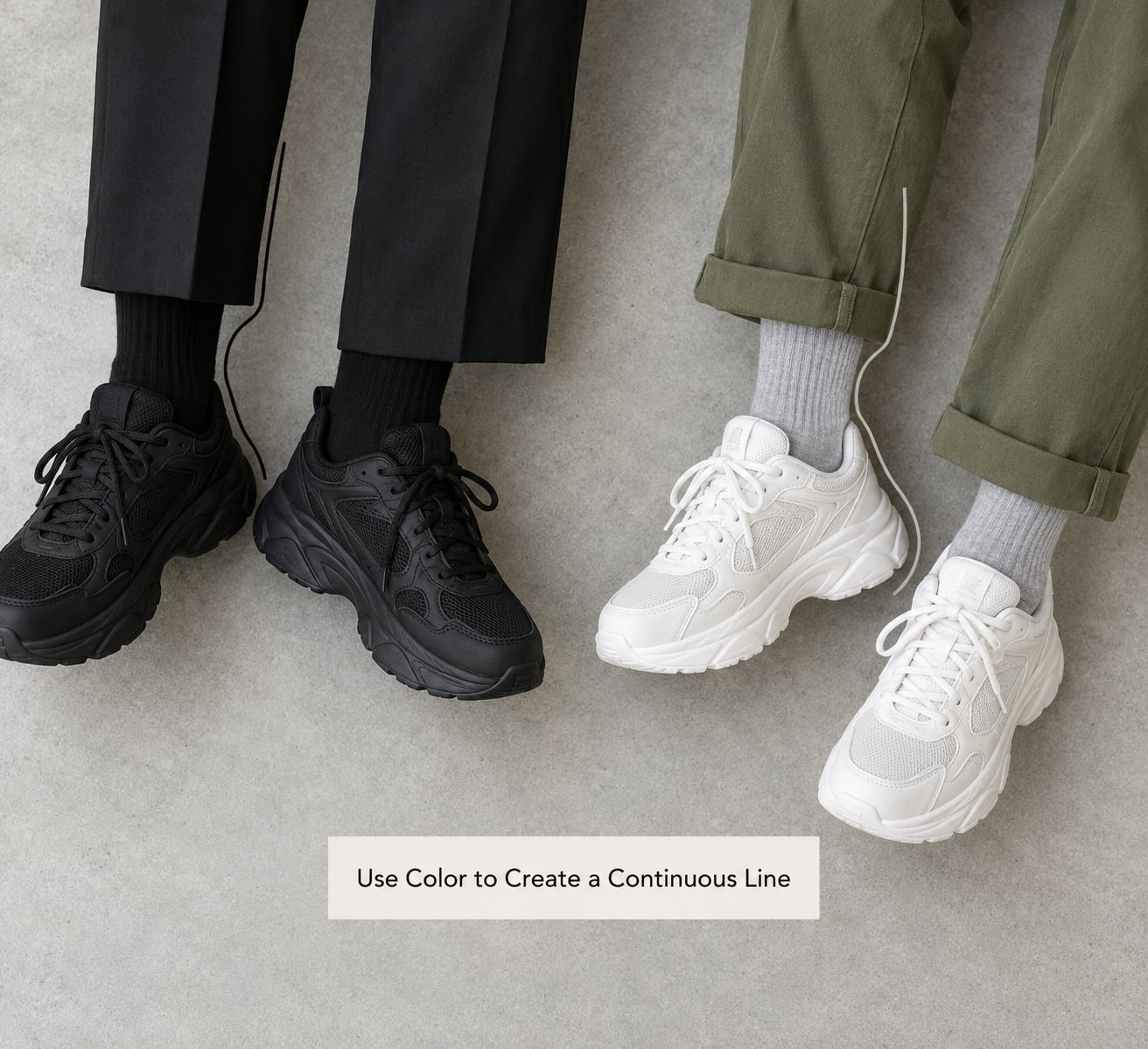
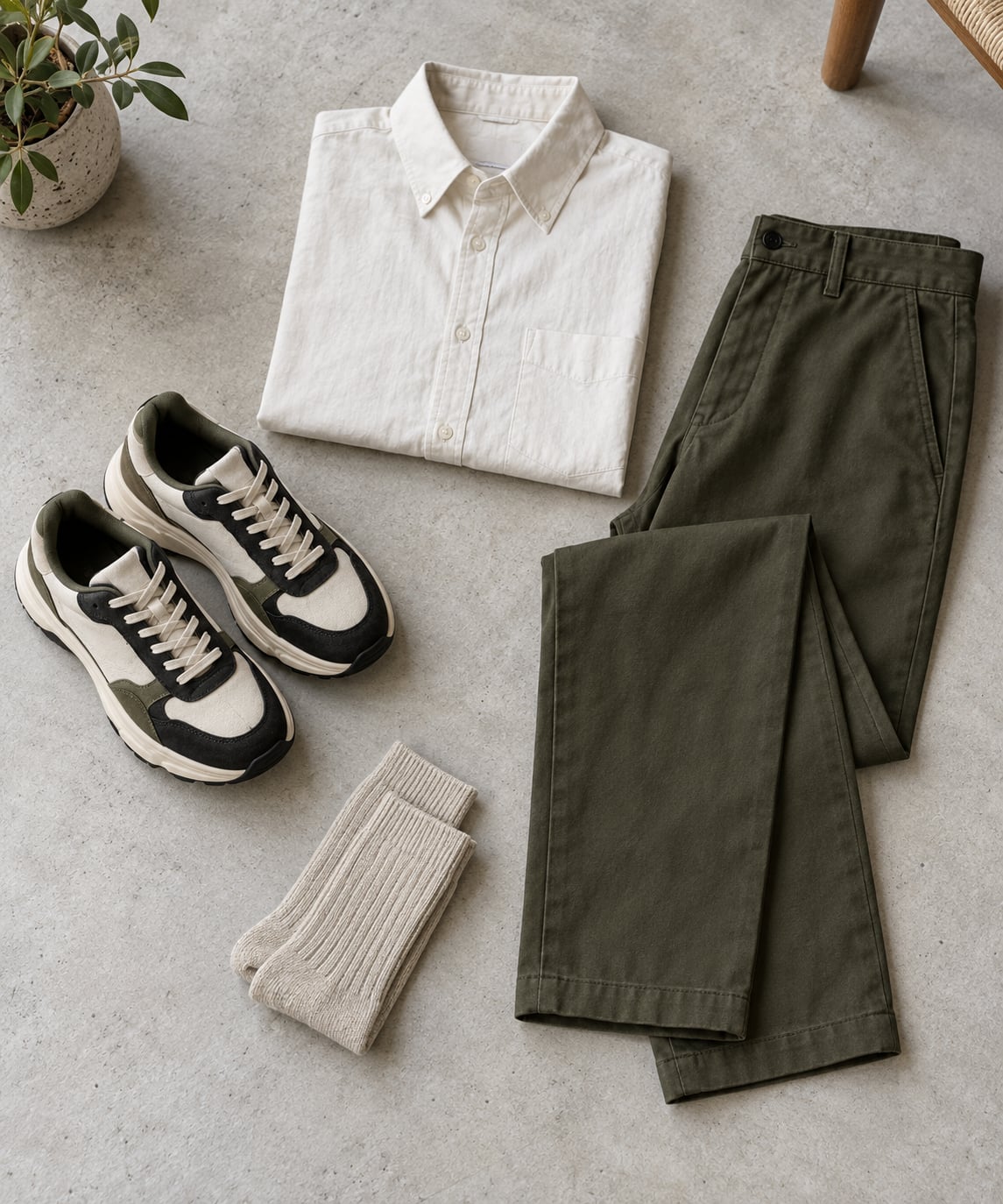
A continuous line of colour from trouser to sock to shoe tells the eye the leg runs to the floor without stopping.
Tonal does not have to mean identical. Matching your sock to your trouser, or matching your sock to the shoe and letting the trouser differ slightly in the same family, both keep the line clean. Low-contrast is the standard, not exact matching.
| Sneaker and bottom combination | Effect on perceived leg length | Verdict |
|---|---|---|
| Sneaker matches the trousers exactly | Longest line, foot merges into the leg | Works at any height |
| Sock matches the trouser, shoe contrasts | Line holds until the sole, then stops | Works if the sole is low contrast |
| Shoe matches the sock, trousers contrast | Breaks at the knee | Risky on petite frames |
| Bright shoe, dark trousers, bare ankle | Three breaks: hem, skin, colour | Avoid if height is the goal |
| Chunky sole in a lighter shade than the upper | Reads bulky, draws the eye down | Keep the sole tone close to the upper |
A contrasting sneaker can still work, but it has to sit inside one clear line rather than fight it. Someone on the YouLookFab thread noted that a lighter shoe colour, or even a lighter sole, reduces how bulky a chunky style looks, because the volume stops reading as a solid block. On shorter frames, I would keep the contrast above the ankle and make the shoe the calmest part of the outfit.
Add One Height-Lengthening Detail
Once the four basics hold, you add a single deliberate detail and stop.
A tucked shirt, a visible high waist, an open long jacket, a visible ankle, or compact accessory placement near the waist each work. Pick one. Two or three competing details start fighting and the eye has nowhere to land.
For dresses and skirts, the same logic applies but the tool changes. With a midi or bodycon dress, the sneaker already sits at the lowest point, so the detail belongs at the waist or the hem of the skirt: define the waist, or choose a hem that ends well above the shoe. A mid-calf skirt ending right at the widest part of a chunky sole is the hardest combination to make look long.
Check: photograph the outfit from the waist down, straight on. If the leg looks shorter in the photo than it does in the mirror, the break is in the bottom half and one of the first four steps needs another pass.
Mistakes That Set You Up to Look Shorter
These five are the ones I see most, and each has a quick correction.
The extra-long hem draped over the sole. The trouser and the midsole form two stacked bands at the foot. Crop it or take it up to a clean break.
Bulky everywhere. A chunky sneaker, a wide-leg trouser, an oversized tee and a puffer jacket in the same volume register leaves no shape anywhere, so nothing reads as long. Slim one layer, usually the bottom.
Socks that break the line by accident. A white crew sock under a dark trouser adds a bright band exactly where you wanted continuity. Match or skip the socks.
An oversized top with no waist. Volume above the hip with nothing to stop it means the eye slides straight into the shoe. Half tuck, belt or a cropped hem.
A high-contrast toe or outsole. A bright rubber toe cap on an already chunky sole doubles the visual weight at the foot. A darker toe reads smaller, which is the same trick people with larger feet use on purpose.
Common Mistakes
Petite wearers hear that chunky sneakers do not work on them, and most of the time that is a proportion problem rather than a height problem. Forum regulars who are under 5 ft tall describe chunky platforms working well for them because the height gain happens without a heel, while very chunky open sandals looked out of place for the same reason.
Several corrections are worth repeating, because each has a clear fix attached.
Same extra-long hem on every pair of shoes. Chunky sneakers need a different hem length than flats, and that is not a tailoring failure. Have the hem shortened or buy the next size up and take it in.
Wide-leg trousers with a low-contrast sock and no ankle. The fabric pools into the midsole. Crop the trouser so the leg line ends in skin or matching sock instead.
Ankle straps or hardware sitting at the narrowest part of the ankle. A horizontal element there cuts the leg. Choose shoes without a mid-foot strap if you are trying to gain length.
Narrow ankles and small feet. One stylist’s rule was that chunky works on dainty feet only in a close, 1980s-style fit, and other wearers on that thread found the same thing: on small feet, too chunky is as bad as too flat, because the shoe slides outward instead of sitting on the foot.
Wider hips and heavier thighs. Here chunky is often the fix rather than the problem. Several people on that thread described chunky shoes as grounding an outfit and balancing a heavier lower half, which is the flip side of the usual advice. If that is your body, the goal shifts from minimising volume to placing it deliberately at the floor.
For taller frames, the same rules apply with more room to play. You can carry a wider leg, a longer hem and a higher-contrast shoe because you have extra vertical distance to lose. If you are over 5 ft 6, the crop and tonal rules still improve the look, they are just no longer doing all the work.
Frequently Asked Questions
Can petite people wear chunky sneakers without looking shorter?
Yes, and height is not the deciding factor, proportion is. Keep the hem narrow and either cropped or broken cleanly at the shoe collar, match sock and trouser so the leg line stays unbroken, and add one vertical detail above the waist such as an open long jacket. A chunky sneaker in a close-fitting shape on small feet also matters more than the silhouette you choose.
What pants length looks best with chunky sneakers?
Ankle-length straight jeans, a full crop on wide-leg trousers, or a clean break at the shoe collar on slim trousers all work. Avoid extra-long fabric pooling over the midsole, since the trouser and the sole form two stacked bands at the foot. For a 5 ft frame, the slight ankle reveal usually gives more visible length than a full break.
How do you style chunky sneakers with wide-leg trousers?
Crop the trouser so it ends above the ankle bone, or wear it with a low-contrast sock in the same tone as the fabric so the line continues into the shoe. Keep the top fitted or tucked, because a wide leg plus a bulky sole leaves no room for a loose top. Skipping the tuck is usually better here, since the wide leg already carries the volume.
Do socks make chunky sneakers look better?
They change how tall you look, more than comfort. A sock matched to your trouser keeps the leg line continuous, while a mid-calf sock in a contrasting colour creates a break exactly where you wanted length. If you want visible ankle, go sockless or wear a low no-show sock. If you want the sock to disappear, match it to the trouser rather than to the shoe.
Can you wear chunky sneakers with cropped pants?
Cropped pants are the easiest pairing for adding height because the visible gap between hem and shoe extends the leg. The only caution is proportion: cropped trousers with a very wide leg and a very chunky sole can leave only a narrow slice of leg visible, which reads shorter than a mid-calf break. Keep the crop tight to the ankle and let one vertical line run from knee to shoe.
How do you balance chunky sneakers with an oversized outfit?
Add structure rather than more size. An open long jacket gives you two vertical lines running past the hip, and a half tuck or defined waist stops the eye sliding into the shoe. Avoid an oversized top with no waistline at the same time as a chunky sole, since the volume at both ends leaves no shape in the middle. One deliberate detail is usually enough.
Conclusion
Start with the shoe, not the outfit: pick a chunky sneaker that fits close to your foot, then build everything else around one clear hemline and one continuous colour line from hem to sole.
Everything after that is a detail: a tucked shirt, an open jacket, a visible ankle. Pick one, check it in a mirror, and you have solved how to wear chunky sneakers without looking shorter with clothes you already own.