Sneaker raffles are random draws that give you the right to buy one pair of a limited sneaker at retail price. Winners are picked after the entry window closes, they pay the normal tag, and everyone else walks away with nothing. If you have never gotten past a release queue, this guide walks through the whole process so you can enter one without making a rookie mistake.
The catch nobody mentions up front: winning a raffle does not mean the shoes are free. You are buying the pair at normal retail, and you have a short window to complete that purchase. Understanding that one sentence prevents most of the disappointment people describe afterward.
Raffles exist because demand for hyped releases is far higher than supply. Without a lottery, a launch becomes a first-come, first-served stampede that bots and resellers win every time. A raffle spreads a fixed number of pairs across a random pool, which gives genuine fans a real shot at buying at retail.
How Sneaker Raffles Work and How to Enter One
Every raffle follows the same five-stage timeline, whether it runs inside the Nike SNKRS app or on a scrap of paper handed out at a Foot Locker register. Knowing those stages makes the whole thing feel a lot less mysterious.
- Announcement. The brand or retailer posts the raffle, usually through a release calendar, a social account, or a push notification.
- Entry window. A start and end time, typically somewhere between 10 minutes and 24 hours. Entries outside the window are ignored.
- The draw. When the window shuts, the system picks winners at random, often separately for each shoe size and region.
- Notification. Selected winners get an email, an app push alert, a text, or a call from a store.
- Claim window. You have a limited number of hours or days to pay, then pick up in store or receive the pair in the mail. Miss it and the pair goes to the next name on the list.
What Is a Sneaker Raffle, and Is It Different From a Giveaway?
A raffle is a lottery for the right to purchase. A giveaway is a prize you receive for free. A contest is usually judged on a skill or creative standard, like a design submission or a photo. Sweepstakes are promotional draws with a prize that may be free or heavily discounted, and they usually fall under formal gambling and sweepstakes rules in the US.
Sneaker raffles sit firmly in the lottery column. Entry is almost always free, and the reward is the right to spend your own money at retail. The one variation worth knowing about is the charity raffle, where a small entry fee goes to a cause, and some retailers hand out loyalty points for extra entries. Those are the exceptions, not the norm.
There is also a legitimate draw that requires no purchase at all, and US rules generally require a no-purchase-entry method on any sweepstakes. A raffle that genuinely offers none is a yellow flag, not an automatic scam, but you should read the rules before entering.
Why Retailers Use Raffles Instead of First-Come, First-Served
Three reasons, and they are all practical. First, fairness. A raffle gives every eligible person a mathematically identical shot regardless of how fast your thumbs are or how many browser tabs you have open. Second, simplicity at scale. Handling 50,000 people through a checkout flow creates crashes, card failures, and a support inbox that never empties, while 50,000 raffle entries is just a list and a random number generator. Third, supply allocation. When a brand makes 30,000 pairs of a hyped release, the raffle decides who gets to buy those 30,000 pairs at retail rather than letting a resale market absorb them the same morning.
That third point is the reason raffles spread. A guaranteed, fair path to retail is worth entering even for someone who has no interest in reselling.
| Raffle type | How you enter | How you claim | Typical odds | Cost to enter |
|---|---|---|---|---|
| Brand app (SNKRS, adidas CONFIRMED) | Tap enter in the app during the window, pick your size | Pay in the app, then ship or store pickup | Often under 1% for high-demand pairs | Free |
| Retailer online (JD Sports, END., GOAT, Hibbett) | Register on the site, submit name, size, contact details | Payment link emailed, then shipping or pickup | Typically 1 in 500 to 1 in 5,000 for hyped releases | Free |
| Retailer app (Foot Locker, Finish Line family) | Same as online, run through the app | SMS or app alert, pickup in store or ship | Varies widely by store and region | Free |
| In-store | Register in person or get a paper ticket per size | Store calls or texts you, photo ID at pickup | Depends entirely on local demand | Free |
| Social media | Comment, DM, or a linked form | Varies wildly by brand, sometimes a gift card | Worse than app raffles, usually more entries | Free |
How to Enter a Sneaker Raffle
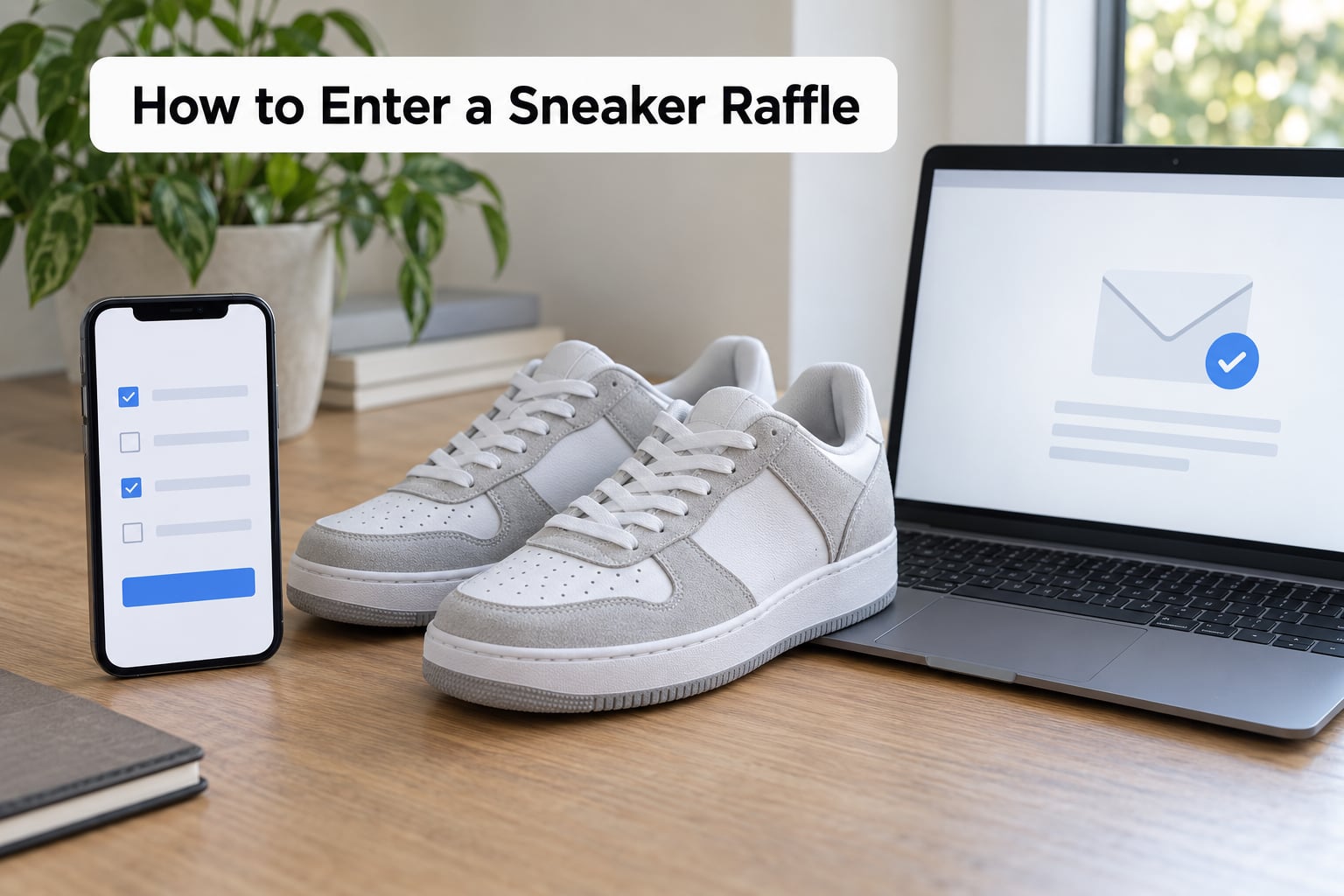
Seven steps cover almost every raffle you will come across, whether it is a national app draw or a sign-up sheet at your local store.
- Find the official announcement. Go to the brand or retailer’s own site, app, or verified social account. Not a link someone sent you in a comment.
- Read the rules before the window opens. Look for entry limits, region restrictions, age requirements, the draw date, and the claim window. Ten seconds here saves a wasted entry.
- Set your account up properly. Confirmed email, correct shipping address, and a current card on file. An expired card discovered during the claim window is the single most common reason a win gets refunded.
- Know your size. You usually select a size at entry, and you rarely get to change it. Enter the size you actually wear, not the size you wish you wore.
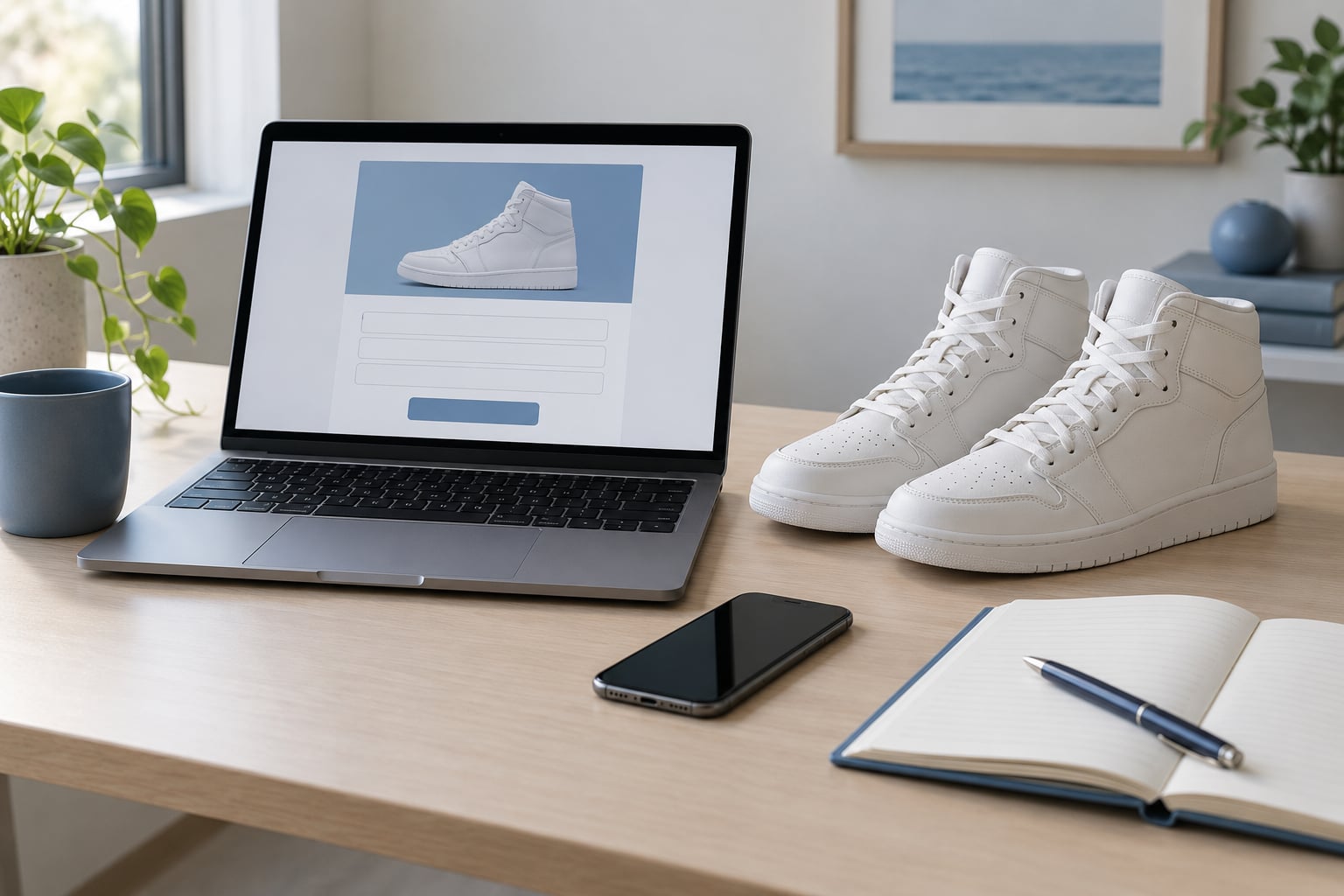
- Submit during the window. Open the entry page, select your size, and tap submit. Online raffles often use a virtual waiting room, so a slow load does not mean your entry failed.
- Save the confirmation. Screenshot the confirmation screen. If the system never emails you, that screenshot is your only proof the entry registered.
- Watch every channel for the draw. Email inbox, spam folder, app notifications, text messages, and store phone calls. This is where most people lose an actual win.
Users on r/Sneakers describe the in-store version with real precision: you get a ticket for your size, names get drawn, and if you win you present a photo ID at pickup. That last detail catches people who enter with a friend’s name or try to have someone else collect the pair.
How to Enter Raffles on Nike SNKRS
SNKRS draws live inside the Nike app and inside retailer apps that run Nike raffles, which is why you sometimes need an account with a partner store rather than Nike itself. Open the app, go to the entry for the release, select your size, and tap enter before the countdown finishes. Nike then emails selected winners, and the pair ships from the retailer or arrives for store pickup depending on the partner.
Two practical notes. A raffle on a retailer app runs on that retailer’s schedule, not Nike’s, so a Nike release date does not tell you when entries close. And entries on SNKRS-connected retailers are free, so any message offering you paid SNKRS entries is not from Nike.
How to Enter on adidas CONFIRMED and Other Retailer Apps
adidas CONFIRMED works the same way: pick the release, pick your size, submit during the window, wait for the draw. Confirmed entries typically use a rolling release calendar rather than a single global drop, so check back regularly instead of setting one alarm.
Foot Locker, Finish Line, JD Sports, END., GOAT, Hibbett, and Livestock all run their own versions. The mechanics are identical even when the interface is not. Some ask for payment details at entry and some only ask for them if you win, which surprises people who assume either way. Both are normal, so neither is a scam signal on its own.
Sole Retriever is not a retailer. It is a release calendar and notification tool, and it is genuinely useful for tracking dates across every platform instead of checking a dozen accounts.
What You Need to Enter
You need less than most people expect. Most raffles never ask for a card number, and a legitimate one never asks for a gift card, wire transfer, or cryptocurrency.
| What | Online raffles | App raffles | In-store raffles |
|---|---|---|---|
| Email address you actually check | Required | Required | Sometimes |
| Account in good standing | Usually | Always | No |
| Shoe size | Required | Required | Per ticket |
| Shipping address | Often | Often | No |
| Payment method | Only on a win, sometimes at entry | Usually required | Paid in store |
| Photo ID | Rarely | Rarely | Often at pickup |
| Region or age eligibility | Yes | Yes | Local residency sometimes |
Region eligibility catches a lot of people. Some raffles lock entries to a country, a state, or a single store’s catchment area, and an entry from an unsupported region is discarded without a refund because nothing was paid. Age limits matter too, and if you are under the stated age, do not enter with a parent’s details.
Account hygiene matters more than people think. One account per person is a rule almost everywhere, and systems compare addresses, phone numbers, card details, and device fingerprints. If a win is flagged for duplicate accounts, the whole family loses, not just the one entry.
Common Raffle Terms Explained
Raffle rules are written in shorthand, and that shorthand is where people get tripped up. Here is what the common phrases actually mean.
Entry limit. The number of entries allowed per person, often one, sometimes two for a household, and rarely more. Limits are usually per raffle, not per year, unless the terms say otherwise.
Draw date. When winners are selected. It is not the same as the announcement date, and it is not always the end of the entry window. Some draws happen days after entries close.
Claim window. The window after notification to pay and collect. Miss it and the pair is passed to the next selected entrant or simply released. This is the deadline that matters most.
Region eligibility. Which countries, states, or stores can participate. Entry from outside the region is void.
Bundle. Some raffles draw for a multi-item set, such as a sneaker plus matching apparel. A bundle counts as one prize and usually has one winner per bundle, not one per item.
Random selection. The standard method: a computer picks winners with no regard to entry order or speed. Speed matters only for getting an entry in before the window shuts.
Disqualification. The list of reasons an otherwise valid entry is thrown out, typically duplicate accounts, incorrect information, a declined card during the claim window, or a failure to collect in store.
No purchase necessary. A statement that entry is free and does not require buying anything. Where it exists, there must be an alternative entry method.
One more distinction worth internalizing, because people mix these up constantly. A raffle is a random draw. A waitlist is a queue that gives you a purchase window in the order people signed up. A launch queue is a timed holding pen for a digital drop, where you check out before anyone else. A restock is additional inventory released later. If you joined a queue and never got a purchase window, that was never a raffle.
Do Raffle Entries Improve Your Chances?
Only within limits, and the limits are usually tight. Most raffles cap you at one entry per person, so two entries double nothing because the second one is either ignored or voids the first.
Where odds do move, it is in these places. A raffle split by shoe size gives you a smaller pool than a raffle where one winner takes the only pair. A raffle limited to one store beats a national raffle with tens of thousands of entries. Region-locked raffles behave the same way. And some retailers genuinely award extra entries for loyalty points or for completing a profile, which is the one legitimate way to increase your number of chances.
The formula is simple: your odds equal the number of pairs available in your size and region, divided by the number of eligible entries. Work an example. A store runs an in-store raffle for 40 pairs in your size, and 3,200 people enter. One chance in 80, which is 1.25 percent. Now picture a national app raffle drawing 500 pairs against 26,000 entries: 1.9 percent. Neither number is unreasonable on its own, and a more hyped release can push it under half a percent.
Buying extra entries is where people get hurt. Many rules cap entries, so a paid second entry is simply discarded. Others void every entry from that account. And a payment to a third party claiming to sell you raffle entries is both a likely refund situation and a direct route to a banned account. The honest version: you cannot buy your way into a raffle, and anyone who tells you otherwise is selling something.
What does work is entering the raffles you actually care about, with accurate information, and accepting that each entry is an independent ticket. As one r/Sneakers user put it, every raffle is separate and in theory you could win every one you enter. That is also why the losses add up, as people on r/SNKRS describe losing four or five in a row and wondering why they keep bothering.
How to Spot a Legitimate Sneaker Raffle
Scam raffles arrive as direct messages, comments, and emails, and the trick is always the same: get you off the official site and onto a form they control. Five checks catch nearly all of them.
- Check the sender. Real notifications come from the brand or retailer’s own domain. A lookalike domain with one extra character is the oldest trick there is.
- Type the address yourself. Never tap the link in a message. Open the app or type the retailer URL, then find the raffle yourself. If the raffle is real, it will still be there.
- Expect no upfront payment. Legitimate raffles are free, and a win costs retail plus shipping. Any demand for a fee, a verification payment, gift cards, or cryptocurrency is a scam by definition.
- Read the terms. A real raffle publishes entry limits, draw dates, eligibility, and contact information. Scam pages have a button and no rules.
- Be skeptical of guaranteed wins. Nobody wins a raffle by DM, and no raffle is rigged in your favor. Any message saying your entry is confirmed as a winner is an attempt to get payment or card details.
One extra safeguard: turn on two-factor authentication on your email and on any account that holds payment details. A lot of raffle fraud starts with a stolen email account, not a clever form.
What Happens After You Enter?
Most of the anxiety people feel comes from the silence afterward. Nobody emails you a losing slip, so an entry feels unconfirmed for the whole draw. That is normal, and it is not a sign that anything went wrong.
When winners are selected, notification arrives through one of four channels, depending on the raffle. You get an email with a payment link, an app push notification, a text message, or a phone call from a store for in-store entries. In-store entries are the ones people most often miss, because the call goes to the number you left at the register and the store rarely leaves a voicemail.
After you are notified, the sequence is short. You have a set window, often 24 to 48 hours online or two to three days for store pickup. You pay the retail price, sometimes with shipping added separately. For in-store pickup you show photo ID and the card you used, and you collect inside the deadline. Online winners get a tracking email.
If you win online, sales tax is charged based on your shipping address, and international orders can attract duties that the retailer collects at checkout. Regions with high tax rates can cost more than the tag, so check before you commit to shipping abroad.
Why You Might Win and Then Get Refunded
This one stings, and it is the most common complaint on r/Sneakers, where people describe finally winning a pair and then being refunded and assuming they had simply been unlucky the whole time. It is usually a technical failure, not a judgment on you.
The usual reasons: the card on file expired or hit its limit, the shipping address would not validate, the bank declined the transaction, the account was flagged as a duplicate, or you were in a region the raffle did not actually cover. Occasionally the retailer finds a data error after the draw. Once the claim window closes without a completed purchase, the pair goes back into the pool.
There is a second category, which is rarer and less forgiving: collecting in store with someone else’s name, or trying to pick up more pairs than the rules allow. A store that asks for photo ID is checking identity on purpose, and one pair per person is treated as a hard limit, not a suggestion.
Frequently Asked Questions
Can you win a sneaker raffle without buying anything?
Yes, entering is free and requires no purchase. But winning is not free. You get the right to buy the pair at retail, and you have to complete that purchase inside the claim window or the pair goes to the next name. A raffle win is a purchase opportunity, not a prize.
How many sneaker raffle entries can I submit?
Usually one per person, sometimes two per household, and the rules page is the only place that settles it. A second entry in a one-entry raffle is typically ignored or cancels the first. Some retailers award extra entries for loyalty points, which is the legitimate way to improve your odds. Accounts with duplicate entries risk disqualification of every entry.
Are sneaker raffles legal?
Yes. Because you pay retail for a prize you have not won on skill, sneaker raffles are lotteries rather than gambling, and they are legal in most places as promotional draws. Where formal sweepstakes rules apply, the raffle must offer a no-purchase entry method. Rules vary by country and state, so a raffle restricted to a specific region is normal and not a legal problem.
Do sneaker raffles send pairs internationally?
Many do, but plenty are region-locked, so check the eligibility rules before you enter. International winners usually pay shipping at checkout and may be charged import duties or local sales tax based on the delivery address. A few retailers ship only within one country. If a win comes with a large shipping charge, that is common, not a scam, though you are free to decline it and forfeit the pair.
How are sneaker raffle winners selected?
Randomly, by computer, after the entry window closes. Winners are usually drawn separately for each shoe size and each region, which is why some sizes feel more competitive than others. Entry speed does not improve your chances, it only affects whether you entered at all. Physical in-store raffles draw names, sometimes by pulling tickets, sometimes on a register system.
What should I do if a raffle asks for payment upfront?
Walk away. Legitimate raffle entry is free and the only payment happens after you win, at retail. Requests for entry fees, verification payments, gift cards, wire transfers, or cryptocurrency mean a scam, especially when they arrive by DM or in a comment section. Never enter card details on a page you reached from a message. Verify the raffle independently by opening the brand or retailer app yourself.
If you do one thing after reading this: set up your account properly before the next raffle goes live. Confirmed email, correct shipping address, current card, accurate shoe size. That preparation is the closest thing to an advantage any raffle offers.
Then enter the draws you genuinely want, understand that winning means paying retail, and let the numbers do the rest. Learning how sneaker raffles work protects you from the two things that actually hurt people, which are missed claim windows and phishing messages dressed up as entry confirmations.