If you want to know how to pick sneaker colors that match your wardrobe, start with the colors you already wear most and choose a shoe that shares one of them. Black, off-white, grey and beige cover nearly everything; a bolder colorway works when it repeats a color somewhere in your outfit.
The whole process takes about ten minutes. You are not trying to build a matching set — you are trying to make one pair earn its place in a rotation you already own.
Table of Contents
- What You Need
- How to Pick Sneaker Colors That Match Your Wardrobe: Step by Step
- Common Mistakes
- Frequently Asked Questions
- What sneaker colors go with almost everything?
- Are colorful sneakers easier to style than neutral sneakers?
- Should my sneakers match my jeans?
- How do I style bright sneakers without making an outfit look busy?
- Is it better to buy fewer, more versatile sneakers?
- Which sneaker colors work with business-casual clothes?
- Conclusion
What You Need
You need one plain outfit as a test case: dark jeans, a solid tee, nothing loud. Grab your phone for photos, because a color that looks right in the box looks different six feet away.
That is the whole kit. No color wheel, no apps, no special equipment. If you own fifteen pieces you actually wear, that is more than enough data.
- A neutral base outfit (jeans, tee, one layer)
- Phone photos of candidate colorways in daylight
- A rough list of the colors in your wardrobe
- Optional: a second opinion from whoever sees your outfits daily
How to Pick Sneaker Colors That Match Your Wardrobe: Step by Step
How to Pick Sneaker Colors That Match Your Wardrobe: Start With Neutrals
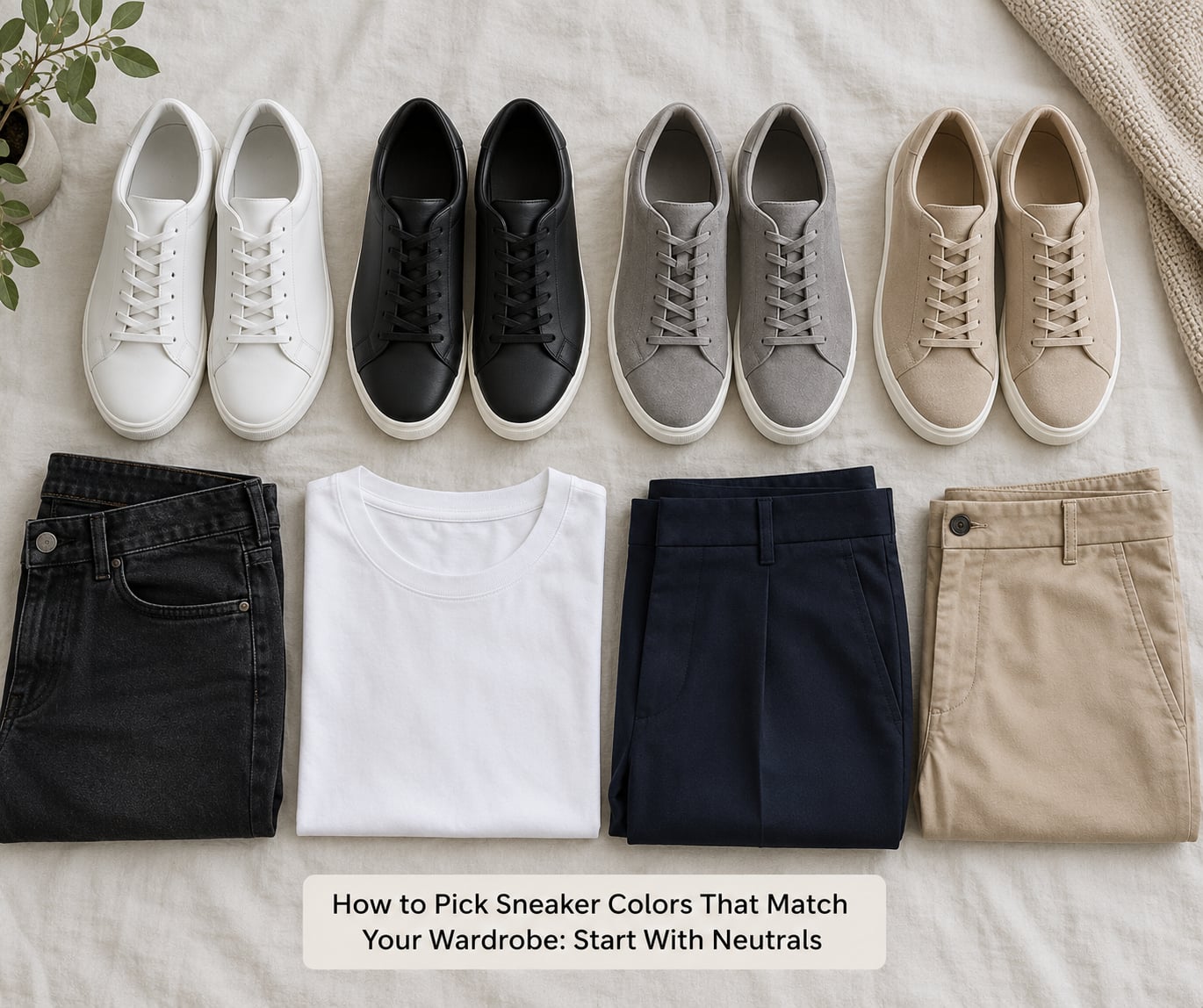
Black, white, grey, beige, navy and brown are the anchors. They have low saturation, so they sit behind everything else instead of competing with it.
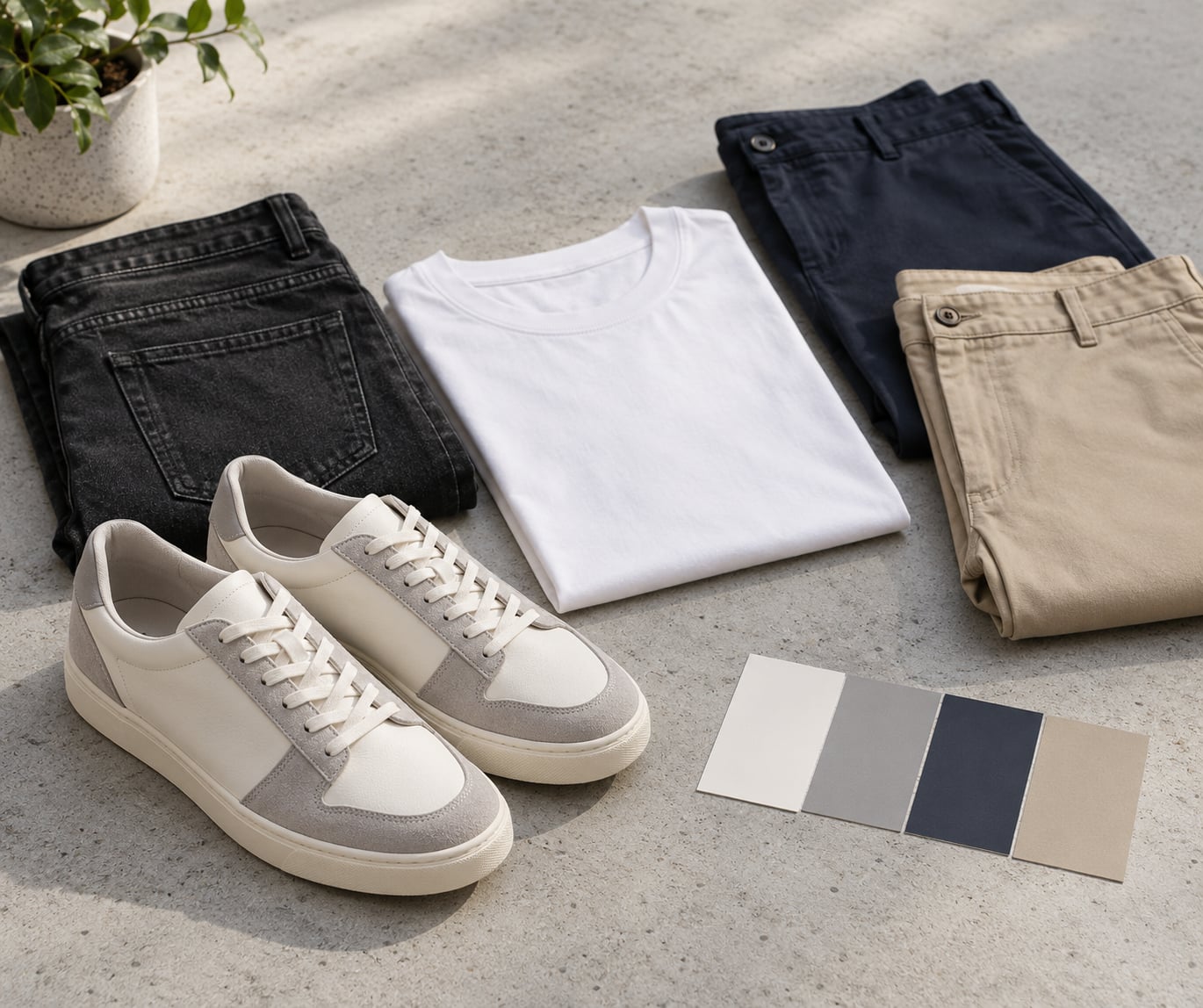
A colored sneaker can still work when it contains a grounding neutral. A pair with a cream midsole and a grey upper reads as two neutrals wearing a hat, not as a statement shoe.
People on styling boards keep landing on the same point: if cream, white, grey or beige shows up somewhere on the shoe, it is easier to wear than a fully saturated colorway.
Audit Your Most-Worn Clothes
Pull out the fifteen pieces you reach for most and sort them into three groups: neutrals, tonal colors, and accents.
Neutrals are your blacks, whites, greys, navies and tans. Tonal colors sit close to a neutral but carry a hue — olive, burgundy, dusty blue, camel. Accents are anything saturated.
Count what repeats. If four of those fifteen pieces are olive or forest green, olive is a legitimate sneaker choice even though it is not technically a neutral. The clothes decide, not the textbook.
Match Tones Before Contrasts
Tone means how light or dark a color is. Match the tone of your shoe to the tone of your outfit and the result looks deliberate even when the hues differ.
Warm tones are tan, rust, mustard and cream. Cool tones are grey, navy, blue and stark white. Mixing a warm shoe with a cool outfit is fine — it just needs one shared anchor, like beige chinos under a cool grey sneaker.
When a contrast feels wrong, it is usually a tone clash rather than a hue clash. A cream shoe with mid-blue jeans reads clean; a stark white shoe with the same jeans can look sharp and deliberate, or jarring, depending on the rest.
Repeat One Outfit Color
The simplest coordination trick is to echo one color. Let the shoe share a shade with a single garment and let the rest of the outfit stay quiet.
- Denim: repeat the denim wash in the heel or panel, or pick a shoe close to the wash tone
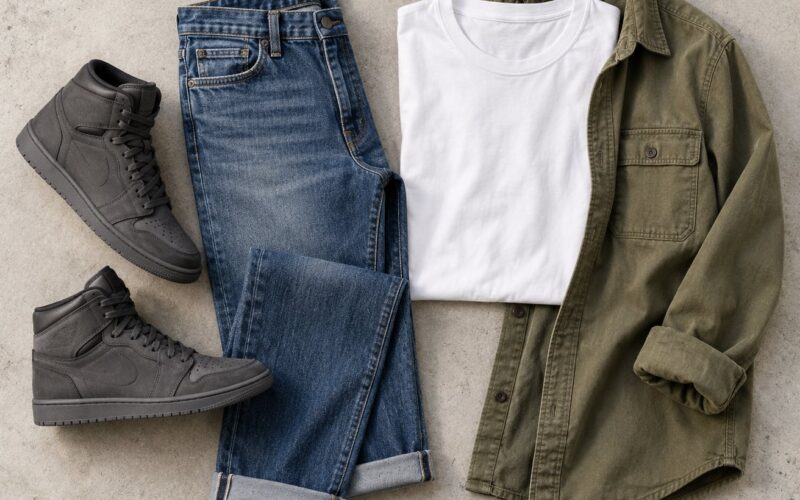
- Olive: army green shoe under an olive overshirt or cap
- Burgundy: oxblood shoe with a burgundy beanie or a maroon layer
- Monochrome: same shade top and bottom, shoe one step lighter or darker
- Earth tones: clay, sand, olive and tan stacked in that order
One of the more convincing arguments for a red sneaker is exactly this kind of reasoning — it cuts against the blue in jeans and picks up the tan in khakis, so one shoe covers two different outfits.
Balance Bright Colors With Simpler Clothing
Let the shoe lead and quiet everything else. When a bright pair is in the outfit, the rest of the clothing should read as solid, plain and slightly darker or lighter than the shoe.
Think of it as roughly 60 percent neutral, 30 percent secondary, 10 percent accent. The bright sneaker can be the accent, which means the other pieces stop competing.
Then echo it once more, small. A cap, a sock, a bag strap, a lining peeking out of a jacket. Two touches of the same color read as a decision; five start reading as noise.
Test the Sneaker With Three Outfits
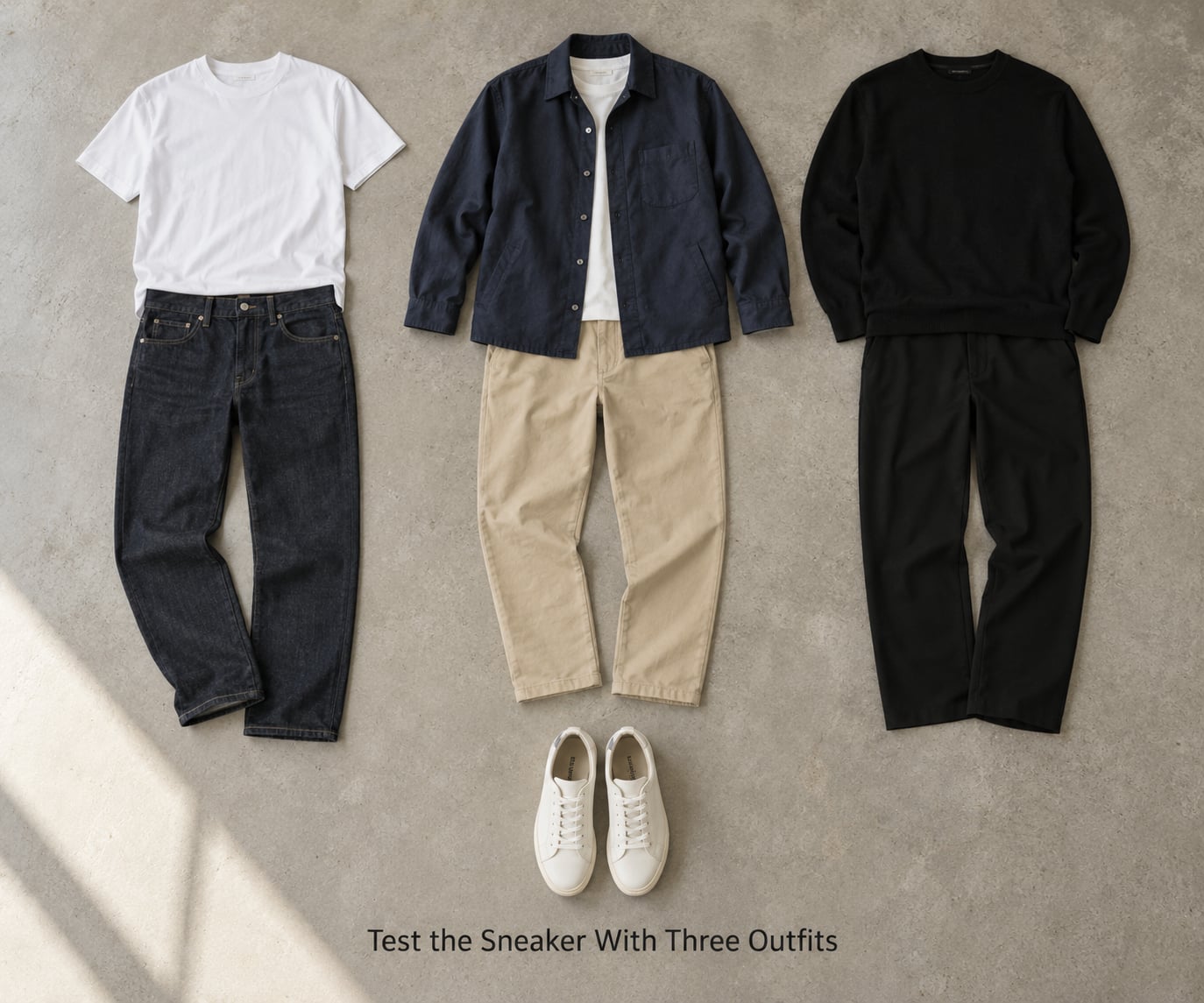
Before you commit, try the shoe against three looks you already own. Dark jeans with a plain tee is the baseline. Tailored or chino trousers with a shirt is the smarter test. An all-black or all-light look is the stress test.
Photograph all three in daylight, not under warm indoor bulbs. If the shoe disappears into two of the three and looks deliberate in the third, you have a winner.
Then wear it for two minutes. Photos flatten depth; real depth tells you whether the color sits with the outfit or floats above it.
Check Versatility Before Buying
Ask a plain question: how many outfits could this pair plausibly join? If the honest answer is two, you are buying a special-occasion shoe, and that is fine — just know which one it is.
Then check it against clothes you plan to buy next. A neutral in your core palette keeps working as your wardrobe changes. A narrow seasonal colorway may need the rest of the outfit built around it.
Limited-release colorways are worth buying on impulse for reasons that have nothing to do with coordination. Buy the shoe for the release and the styling comes second. Just do not expect that pair to carry your everyday rotation.
Common Mistakes
Matching everything exactly. Head-to-toe monochrome can work, but it removes all contrast and reads flat in daylight. Fix: keep the outfit tonal and let the shoe sit one step lighter or darker.
Matching only the shoes to the trousers. The shoe has to sit with the whole outfit, including the top half. Fix: repeat the shoe color somewhere on the upper body, even if it is only a sock.
Ignoring undertone. A cool grey sneaker next to warm camel and rust can look stained rather than coordinated. Fix: keep one warm or one cool anchor in the outfit.
Buying a shoe for one outfit. Popular advice pushes back hard on this, and they are right. Fix: pass the three-outfit test before you buy anything.
Overcrowding with bright colors. Two saturated pieces plus a bold shoe is three focal points competing. Fix: pick one loud element and drop the other two a step quieter.
Assuming a trend color suits your wardrobe. A color being everywhere does not mean it belongs in your closet. Fix: check it against your audit list first, not against the feed.
A few quick tips: match textures when the colors differ — suede with denim, leather with tailored cloth. Keep socks simple unless they are your deliberate echo. And buy your second pair in a different neutral from your first, so both actually get worn.
Frequently Asked Questions
What sneaker colors go with almost everything?
Off-white, black, grey and beige cover the widest range of wardrobes. They work with denim, chinos, tailored trousers, joggers and dresses, and they do not compete with a saturated top. Navy is a close fourth when your wardrobe leans blue or grey. If you own one pair of everyday sneakers, pick a neutral with a simple upper and minimal branding rather than a multi-panel colorway.
Are colorful sneakers easier to style than neutral sneakers?
Neutrals are easier. A bright pair needs a quiet outfit around it, which means you are making choices rather than just putting clothes on. That is not a reason to avoid color — plenty of people get more wear out of a burgundy or olive shoe than a plain white one. It just takes two minutes of planning instead of none.
Should my sneakers match my jeans?
No. Matching the denim wash is one reliable option, but near-matching is enough — you are matching tone, not shade. A cream shoe with mid-blue jeans or a grey shoe with black jeans both read as coordinated. Exact matching is only worth it when the shoe is the same tone and finish as the denim.
How do I style bright sneakers without making an outfit look busy?
Let the shoe be the only loud piece. Keep the clothing solid and close in tone, then echo the shoe color once somewhere small, such as a cap, sock or bag strap. Roughly 60 percent neutral, 30 percent secondary and 10 percent accent keeps the balance. If two other items are already saturated, take one of them down a step.
Is it better to buy fewer, more versatile sneakers?
Usually, yes. Most people own several pairs and wear the same two constantly, because nothing else coordinates. A small rotation of two or three sneakers in different neutrals, plus one statement pair for when you want it, covers nearly every outfit and saves shelf space and money over time.
Which sneaker colors work with business-casual clothes?
Black, dark brown, burgundy and clean off-white all work with chinos, tailored trousers and loafers-adjacent outfits. All-black and tonal cream sneakers read the most polished, and a low profile with minimal branding keeps them from looking like gym shoes. Skip high-contrast color-blocking and anything with heavy logos in a dress code.
Conclusion
Start tonight. Pull out the clothes you actually wear, list their colors, and see which one repeats most. That is your palette.
Buy sneakers in that color family for your everyday pair, or add one controlled accent that echoes something you already own. Everything else in the color aisle is optional.