How resale ticket pricing works comes down to one thing: a resale price is whatever a buyer will pay for that seat, at that moment, on that platform. The original face value matters mostly as a starting reference. Demand, remaining inventory, fees, and the date of the event do most of the moving.
Below are the quick answers most people are looking for.
- A resale price is a live market result, not a markup on face value. It moves with demand and available supply.
- Headline listing price and checkout total are different numbers. Fees usually sit between 10% and 30% of the ask on large marketplaces.
- Resale prices often fall in the last 48 to 72 hours before an event, because sellers cut losses rather than eat unsold inventory.
- The curve is not a straight line. A lineup change, a schedule shift, or a new primary release can push prices back up days before showtime.
- Official resale through the original ticketing platform is usually safer for the buyer and usually pays the seller less than an open marketplace.
- A general-admission floor ticket can list above a VIP ticket for the same show, because section labels are a weak proxy for what fans actually want.
Table of Contents
- What Is Resale Ticket Pricing?
- How Resale Ticket Pricing Works: The Core Factors
- How Demand and Scarcity Change the Price
- How Fees Affect What Buyers Actually Pay
- Why Ticket Prices Change Before an Event
- How Seat Location and Ticket Type Affect Value
- A Simple Resale Pricing Example
- How Buyers Can Read a Resale Listing
- Frequently Asked Questions
- Start With the Total Price
What Is Resale Ticket Pricing?
Resale ticket pricing is the price asked and paid for a ticket after its first sale. The primary market is the original on-sale, where the promoter or artist sets a face value. The secondary market is everything after that: fans listing tickets they cannot use, marketplaces hosting those listings, and buyers paying for them.
Face value is the printed or listed price from the first sale. It sets a reference point, and sometimes a floor, but it does not set the resale price.
On-selling means a fan returns a ticket to the official channel at face value or below. Scalping means buying with the intent to resell higher, sometimes using software to hold many tickets at once. The same listing screen can contain both, and nothing on the ticket itself tells you which one you are looking at.
How Resale Ticket Pricing Works: The Core Factors
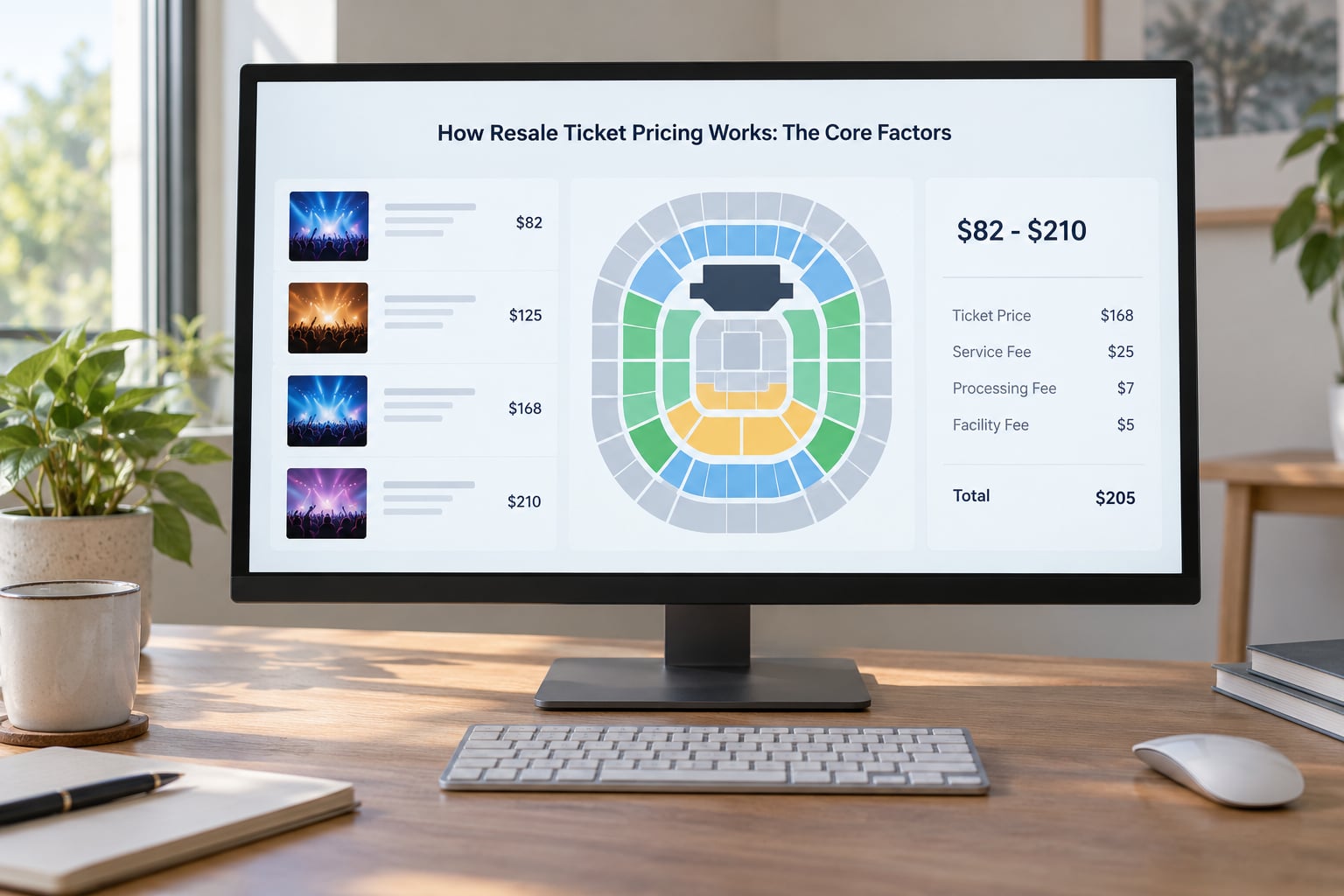
Five inputs do nearly all the work. If you can read these on any listing, you can estimate whether the ask is realistic.
| Input | What it means | Typical effect |
|---|---|---|
| Original ticket price | The face value set at the primary on-sale | Anchors expectations and sets the official resale cap where one exists |
| Demand | How badly fans want this specific show | High demand with low supply pushes prices well above face value |
| Inventory volume | How many comparable tickets are listed right now | A sudden flood of listings pushes prices down fast |
| Seat and ticket type | Section, row, tier, and what perks come attached | Sets the price band a listing competes in |
| Time to event | Days or hours remaining | Shifts the whole curve, usually downward as the date nears |
The order a price gets set runs roughly like this.
- The primary on-sale establishes face value and, in some cases, a dynamic pricing range by section and demand level.
- Unsold or unwanted inventory flows to resale, either officially or onto open marketplaces.
- Sellers post an asking price, and the platform layers on a selling fee plus whatever it charges the buyer.
- Buyers sort by whatever price the platform displays, which pulls demand toward the cheapest visible listing in each section.
- Transactions settle at the price buyers actually agree to pay, which is usually lower than the highest listed ask.
That last point is the one most people miss. A listing is an ask, not a sale, and marketplaces tend to show plenty of asks that never transact at all.
How Demand and Scarcity Change the Price
Demand is specific, not general. A city with two shows that week has far less demand for each one than a market with none.
Scarcity works the same way. When a show sells out instantly, resale supply starts near zero, so the first listings set a high price. When a promoter adds a second production or releases more inventory, that scarcity disappears and the price can fall within days.
Resale market activity itself moves prices. Industry trackers note that a large share of resale activity, often cited at 30% to 60%, happens in the first 48 hours after tickets go on sale. That burst creates plenty of supply very quickly, which is why early listings often sit well above what the market settles at.
Buyer urgency pushes in the other direction. Someone who needs Saturday and cannot wait for a drop will pay whatever is available, and sellers know it. Last-minute inventory priced for desperate buyers behaves nothing like inventory priced six weeks out.
News is the sharpest mover of all. A support act change, a cancellation rumor, a schedule conflict with another tour, or a sudden spike in streaming numbers can reprice a whole event in a day.
How Fees Affect What Buyers Actually Pay
The listing price is not the price. A marketplace typically charges the seller a selling fee, may charge a listing or payment fee, and adds a buyer-side service fee. On top of that sit delivery charges, facility fees set by the venue, and per-ticket fees.
Here is where a typical stack lands. Figures are illustrative US ranges and they change over time, so treat them as shapes rather than promises.
| Charge | Who pays | Typical range |
|---|---|---|
| Seller commission | Seller, deducted from payout | About 10% to 25% of the sale |
| Buyer service fee | Buyer, added at checkout | About 10% to 30% of the listing |
| Delivery or digital transfer fee | Buyer, sometimes per ticket | A few dollars per order up to about 10% |
| Facility fee | Buyer, set by the venue | Several dollars per ticket |
Worked in reverse, a seller who lists at 99 dollars and pays a 15% commission keeps about 84 dollars before anything else. The buyer who finds that same listing might see a total near 120 to 135 dollars after the buyer-side fee and delivery charge. Two listings that look like 99 and 110 can end up closer together than the raw numbers suggest.
That is why all-in display changed how people shop. When fees are folded into the headline number, comparing a listing on one marketplace against a listing on another finally means something. Where fees are still hidden until checkout, the cheapest-looking listing is often the most expensive one.
Why Ticket Prices Change Before an Event
The resale price curve is lumpy, not smooth. Two moments reliably produce drops: right after seat maps and upgraded inventory unlock in the primary sale, and inside the final 48 to 72 hours before showtime.
| Stage | What is happening | Typical price behaviour |
|---|---|---|
| On-sale | Most fans buy directly, little reaches resale | High and narrow, driven by scarcity |
| First 48 hours | Heavy listing activity as fans reassess | Wide spread, many asks that never sell |
| Run-up | Comps settle and duplicate inventory thins out | Steadier, easier to read |
| Final 48 to 72 hours | Sellers cut losses on what is left | Often the cheapest point of the run |
Automated repricing makes this less predictable than the old model. Platforms now adjust asks as competing inventory appears or disappears, sometimes several times a day. A seller chasing the algorithm can end up repricing against themselves and talking a price down without meaning to.
Dynamic pricing, on the primary side, works the opposite direction from a price drop. Promoters build a range by section and by demand level, then adjust within it as sales data comes in. A hot act can see a top tier rise while lower sections barely move.
None of this is guaranteed to fall. Forum sellers and buyers alike describe the same pattern: prices usually drift down near the event, but a single news cycle can reverse that a day out. Treat a dip as an opportunity to look, not as a rule.
How Seat Location and Ticket Type Affect Value
One event produces several price bands because fans pay for different things in the same room.
- Floor and front-of-stage tickets compete on proximity and sightline, and they carry the highest expectations.
- Lower-bowl seats balance view and price and are usually the first band to move once dates approach.
- Upper-bowl and nosebleed inventory behaves more like a commodity, with more listings and thinner margins.
- VIP packages bundle perks such as early entry, a lounge, or a bar credit, and those perks are what buyers are paying for.
- General admission has no seat, so its value is set purely by supply, and supply is set by how many tickets were released into the floor pool.
Restricted-view listings exist because a seat may be behind a support column or under an overhang. They are priced at a discount to the section average and are usually labeled as such, though not always clearly.
The inversion surprises people: forum discussion of the same shows often shows a general-admission floor listing priced above a VIP listing. That happens when VIP packages come with obligations and fewer buyers want them, while floor tickets are unrestricted and everybody wants them. Section labels carry reputation, not guaranteed value.
Perks are worth checking before a transfer. Upgrades, bar credits, and promo codes attached to a VIP package are frequently stripped when a ticket changes hands, which turns a VIP resale into a much plainer ticket than the listing implied.
A Simple Resale Pricing Example
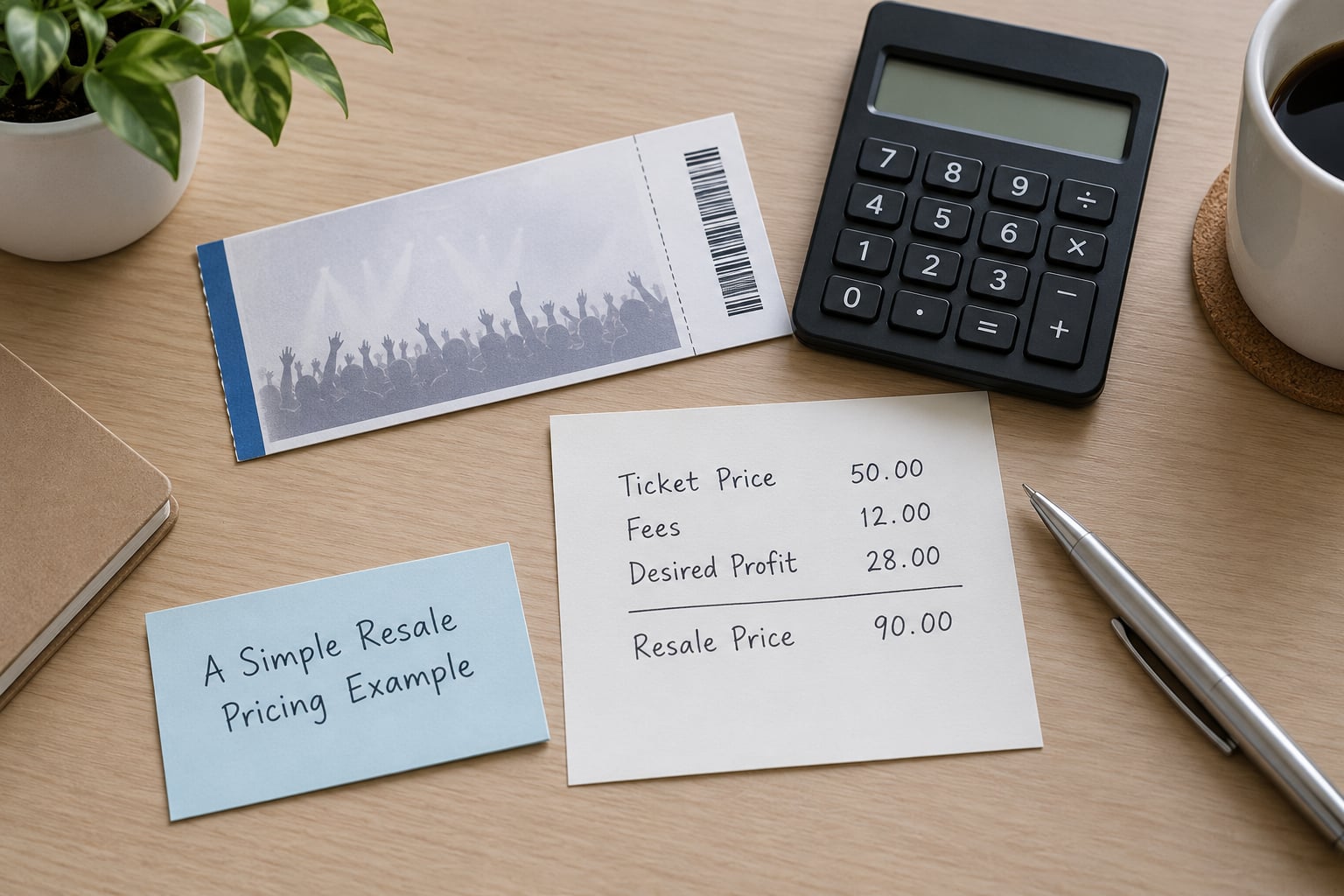
Here is the whole mechanics in one example, using round numbers so the arithmetic is easy to follow.
A fan holds two unsold lower-bowl tickets with a face value of 85 dollars each. Comparable sold listings in the same section, after fees, sit around 120 dollars per ticket, so the seller lists a pair at 235 dollars.
- Seller commission at 15% takes roughly 35 dollars off the top.
- That leaves close to 200 dollars before payment processing.
- The buyer sees a service fee of about 25% added at checkout, pushing the visible total past 290 dollars for the pair.
- Per ticket, the buyer is now paying about 145 dollars against an 85 dollar face value, a 71% markup before anyone leaves the city.
Now the same fan lists at 180 dollars to move quickly. The buyer-facing total drops to roughly 235 for the pair, which is about 118 per ticket, and the comparison against comps becomes much easier.
That spread between two plausible listing prices on identical seats is the whole resale market in miniature. Nothing about the event changed. Only the ask did.
How Buyers Can Read a Resale Listing
Before paying anything, run this checklist.
- Confirm the event matches: date, venue, city, and doors time. Duplicate listings with a slightly wrong date are a known trick.
- Check the section and row, not just the tier name. Section 112 in one bowl can be worse than section 220 in another.
- Look for the ticket type in the description. General admission, floor, reserved, and VIP behave differently even on the same bill.
- Read the transfer method. Verified mobile transfer or app-based delivery is safer than a PDF or a screenshot.
- Compare the all-in total, not the headline number, against a sold comparable in the same section.
- Scan the seller’s history. A long track record of completed sales matters more than a large number of listings.
- Check the cancellation and refund terms, and note that some tours cancel orders or remove listings without warning.
Two habits do most of the work. Compare against sold prices rather than listed ones, since listed prices are aspirations and sold prices are the market. And revisit the listing the day before, because inventory often appears late.
Rules and fee structures differ by country and by platform, and they change. Check the current terms on the site you are buying from rather than trusting a general guide like this one.
Frequently Asked Questions
Why are resale tickets more expensive than face value?
Because face value was set months earlier, under different demand conditions, often before anyone knew how the event would sell. On the secondary market the price is set by fans competing for a fixed number of tickets. When demand is high and inventory is thin, buyers bid the price up well past the original figure. Fees at checkout widen that gap further, so a 99 dollar listing can read as 130 or more at the last step.
Do resale ticket prices include fees?
It depends on the platform. Some marketplaces now display an all-in price, folding the buyer service fee and delivery charge into the headline number. Others still show a pre-fee listing price and add charges at checkout. That difference is the reason two identical tickets can look far apart on screen and end up close at the till. Always check what the final total says before judging which listing is cheaper.
Why can ticket prices drop closer to the event?
Unsold inventory becomes a liability as showtime approaches. Sellers who paid face value and cannot use a ticket will usually cut the price rather than carry a loss, which adds supply at the exact moment some buyers stop looking. The final 48 to 72 hours is the most common window for this. It is a pattern, not a rule, and a schedule change or news in the lineup can push prices back up at the last minute.
Is a lower-priced ticket always a better deal?
No. A low price often signals a problem, such as a restricted view, an obstructed row, a ticket that arrives as a PDF, or a seller with no delivery record. Compare the total cost, the seat location, and the transfer method together. A slightly higher all-in price with a verified mobile transfer and a clear seat is usually the safer purchase than a cheap listing you cannot verify.
What is dynamic pricing for event tickets?
Dynamic pricing means the ticket price changes based on live signals rather than staying fixed by section. On the primary side, promoters adjust within a set range as sales data comes in, so a hot act can see a top tier rise while lower sections hold steady. On resale, platforms reprice listings automatically as competing inventory appears or disappears. The effect is a market that moves several times a day instead of once at the start.
How can I tell whether a resale listing is legitimate?
Check four things. The event details should match the official listing exactly, including date and venue. The delivery method should be verified transfer through an app or account, not a screenshot or emailed PDF. The seller should have a history of completed sales rather than a wall of listings that never moved. And the checkout page should show a breakdown of what you are paying for before you confirm anything.
Start With the Total Price
If you take one thing from this, compare the all-in checkout total against a sold comparable in the same section, and check that the delivery method is a verified transfer.
A cheap headline is often just a cheaper display. A listing that looks reasonable, matches the official event details, and lands close to what comparable seats actually sold for is the one worth taking.