To fade raw denim naturally, wear it hard, wash it gently in cold water, and let it dry in the air. Raw denim has never been washed or treated after weaving, so indigo still sits loosely on the surface of each yarn and rubs off wherever your body bends, sits and sweats. Fading is abrasion, and abrasion is the only honest way to get there.
The whole process takes patience rather than skill. Most people see their first visible change somewhere between 25 and 50 wear days, and a fade you can live with takes a full year. Here is the method I would follow, stage by stage, with the signs that tell you each one has worked.
What You Need
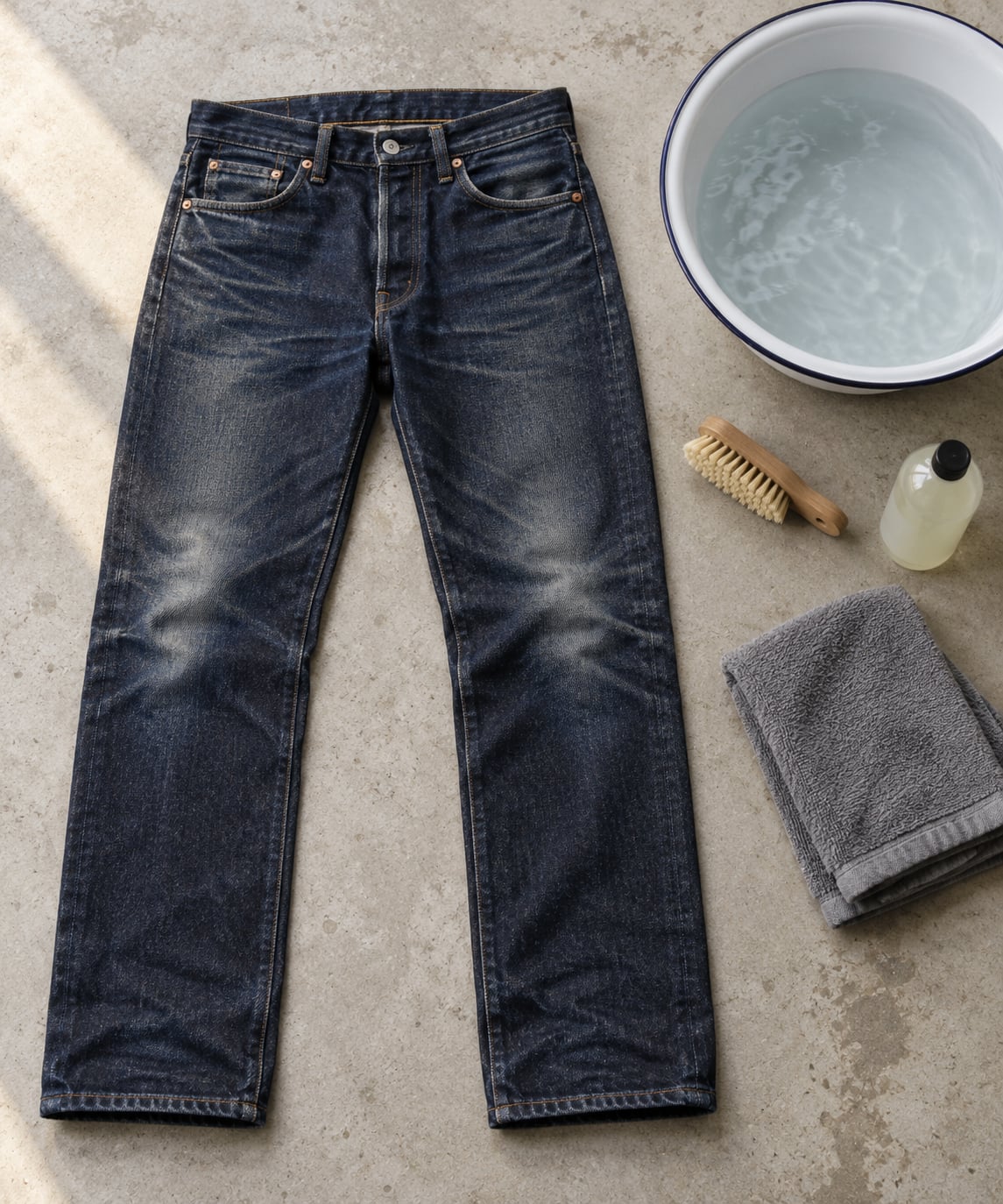
None of this is specialised equipment, and none of it is expensive. You need a tub or a large container that the jeans can sit in without being folded, and enough cold water to submerge them fully.
A mild, colour-safe liquid detergent is the only cleaning product you need. Anything with bleach, enzymes or optical brighteners strips indigo faster than you want and can leave the fabric thin and patchy. A soft-bristled brush, the kind used for shoes or laundry, is worth having on hand for stage four.
A clean towel and a wooden hanger round out the essentials. The towel is for rolling the wet denim to press out water before hanging, and the hanger keeps the waistband from stretching out of shape while it dries.
A few things are optional but useful. A mesh laundry bag protects the denim from snagging on a machine’s drum. A small cloth for spot cleaning lets you handle a mark without soaking the whole pair. Rubber bands or a length of sewing thread can be wrapped around the leg to pinch a controlled set of whiskers.
Step-by-Step: How to Fade Raw Denim Naturally in Six Stages
Six stages, in this order, and skipping one tends to undo the work of the one before it. The result depends on denim weight, weave, dye and how you wear them, so treat the times below as starting points rather than rules. You will know a stage has worked by what the denim looks and feels like, not by the clock.
How to Soak Raw Denim for an Even Base Fade
If you only take one thing from this guide, take this: how to fade raw denim naturally starts with a single controlled cold soak, not with scrubbing and not with the hot tap. A soak strips excess surface dye evenly across the whole garment, which gives you a softer, flatter starting point instead of the deep, sometimes uneven indigo of unworn denim.
Turn the jeans inside out, button them up, and lay them flat in the tub. Fill with cold water until the denim is completely submerged, then add a small amount of mild detergent and let it sit without moving it.
| Denim weight | Suggested cold soak | What you should see |
|---|---|---|
| Under 12 oz | 20 to 30 minutes | Water tints pale blue, fabric relaxes and softens noticeably |
| 12 to 14 oz | 45 to 60 minutes | Steady colour release, waistband relaxes, stiffness drops |
| 14 to 16 oz | 2 to 3 hours | Deep blue water, noticeable softening in the thick twill |
| Over 16 oz | 4 hours or overnight | Heavy denim finally begins to bend without creasing sharply |
Turn the jeans once halfway through if you are soaking longer than an hour. That is the entire amount of agitation a soak needs.
Colour in the water is your signal that the surface dye is releasing. Stop when the water runs clear enough that you can see the bottom of the tub, or when you reach the weight-based time, whichever comes first. Pour the water down a drain, rinse the denim under cold running water until it runs mostly clear, and press the water out without wringing.
Hot water is the single most damaging mistake here. It fixes more indigo onto the fibre, cuts shrinkage on unsanforized pairs, and can set a ring around the waistband. Scrubbing with a stiff brush does the same job chemically that soak time does chemically, but unevenly, which is how you get blotches.
How to Wash Denim Without Setting the Fade Too Early
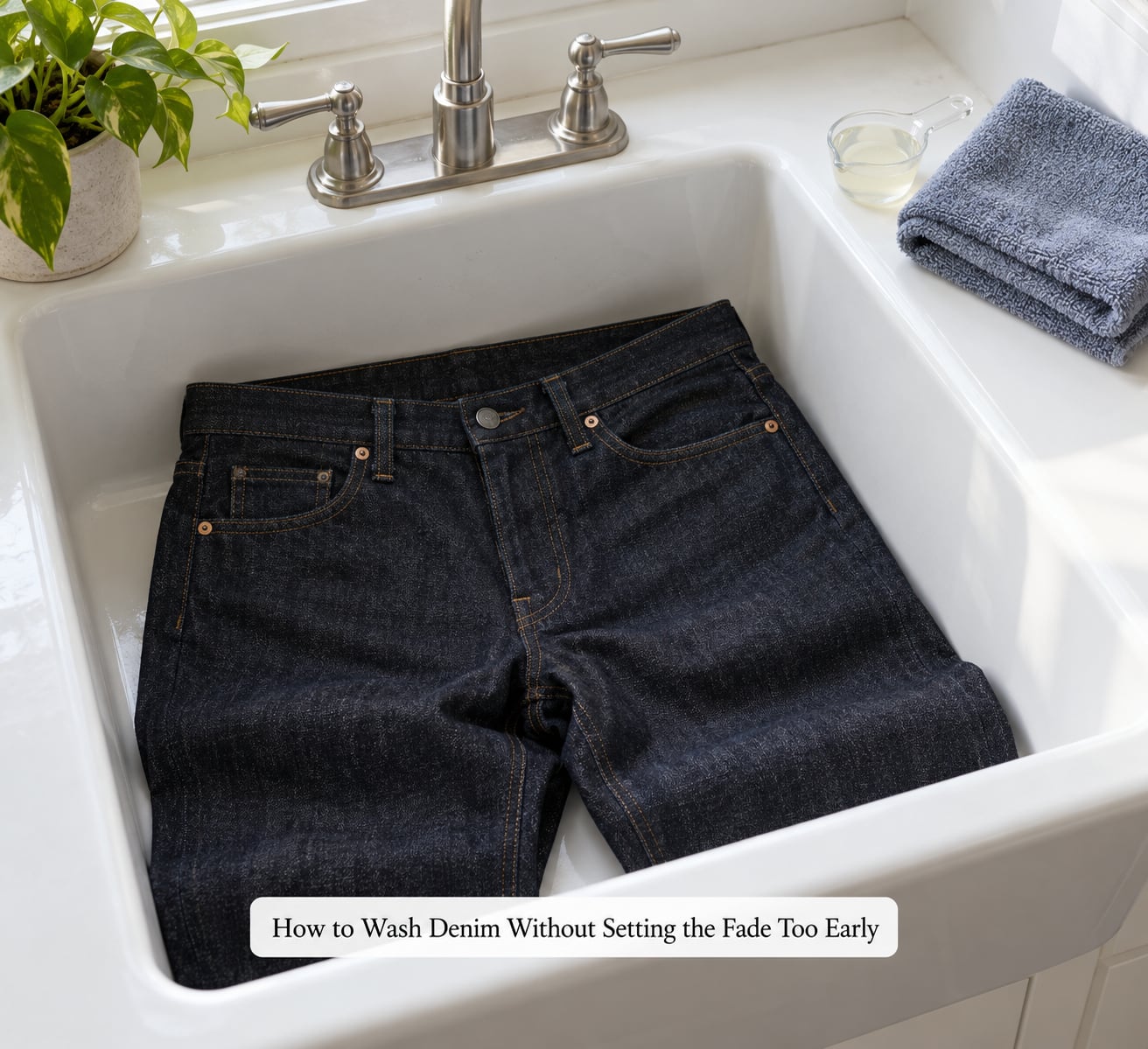
A wash after the soak is about removing what is left, not stripping the dye that makes fades possible. Fading means surface indigo leaving the high points of the fabric. Removing all the indigo means the jeans go grey-blue everywhere at once, and no wear pattern will ever show on them.
Turn them inside out, put them in the tub or on a delicate machine cycle with cold water only, and use about half the detergent you would normally use. Skip the spin cycle entirely if your machine allows it. When wet denim spins, the indigo that has just loosened collects in narrow bands and dries as vertical streaks down the leg, which no amount of later wear will blend out.
Rinse with cold water until it runs clear. Then press the water out with your hands, roll the jeans in a towel, and press again. Hang them on a wooden hanger and let them dry fully, right down to the cuffs, before you put them back on. Wearing damp denim folds the fabric into a set shape and cuts your effective wear time in half.
The whole wash should take under half an hour of active attention. If a pair is dirty at the hem or the seat, use a damp cloth and a drop of detergent on the spot instead of re-washing the whole garment.
How to Create High-Wear Fades by Hand
Hand fading is the stage people skip, and it is the one that answers the question of how to get good fades on denim without waiting two years. It works because the named fades form where denim is under repeated pressure, and you can put that pressure exactly where it belongs.
Work the knees, elbows, hips, seat, hems and the front pocket edges first. Those six areas produce the most recognizable fades. Use the soft brush in short, gentle strokes following the grain of the twill, or use your fingertips with a small amount of surface dye still on them. Twisting a section of denim between your palms for a minute is a good stand-in for the elbow of someone who leans on a desk all day.
Wrap a rubber band or sewing thread around the thigh just above the knee and leave it for a few hours to create a soft pinch of contrast that reads as whiskers. Do the same at the pocket edge for a coin-pocket fade. Take them off before they leave a permanent groove, because a groove is a cut, not a fade.
Match the work to how you actually move. Someone who cycles or climbs stairs gets knee and whisker fades from wear alone. Someone who sits for long hours gets seat and honeycomb fades. If you want a fade that your daily life will never produce on its own, hand work is the only way to place it.
Stop before the fabric feels thinner than the area around it, before the colour turns pale grey-blue instead of light blue, and before the brushing has left a flat, fuzzy patch rather than a set of lines. Once a section looks even and lighter than its neighbours, stop there.
How to Dry Denim for the Right Amount of Abrasion
Drying is where a lot of fading happens, and it is the stage most people rush. Heat and mechanical tumbling both add abrasion on top of everything the wear has already done.
| Method | What it does to the fade | Watch out for |
|---|---|---|
| Flat air drying | Slowest and gentlest; least extra abrasion | Turn the denim halfway so both faces dry evenly |
| Line drying on a hanger | Moderate; the weight of the wet denim pulls and creases the legs | Reshape the waistband and legs before you walk away |
| Tumble drying, high heat | Fastest extra abrasion; strips dye unevenly | Shrinkage, stiffness and a faded look that reads as fake |
| Tumble drying, low heat, short cycle | Gentle agitation for a softer result | Still pulls down leg length on unsanforized denim |
Whichever route you pick, the denim should end up completely dry before it goes back on your body. Damp denim folds along whatever creases it has at that moment, and those set creases can turn into permanent-looking lines that have nothing to do with wear.
My preference is flat air drying for the first wash and hanger drying afterwards. Hang them near a window rather than on a radiator, and take them down before the sun can bleach one panel lighter than the rest.
How to Wear and Maintain the Fade
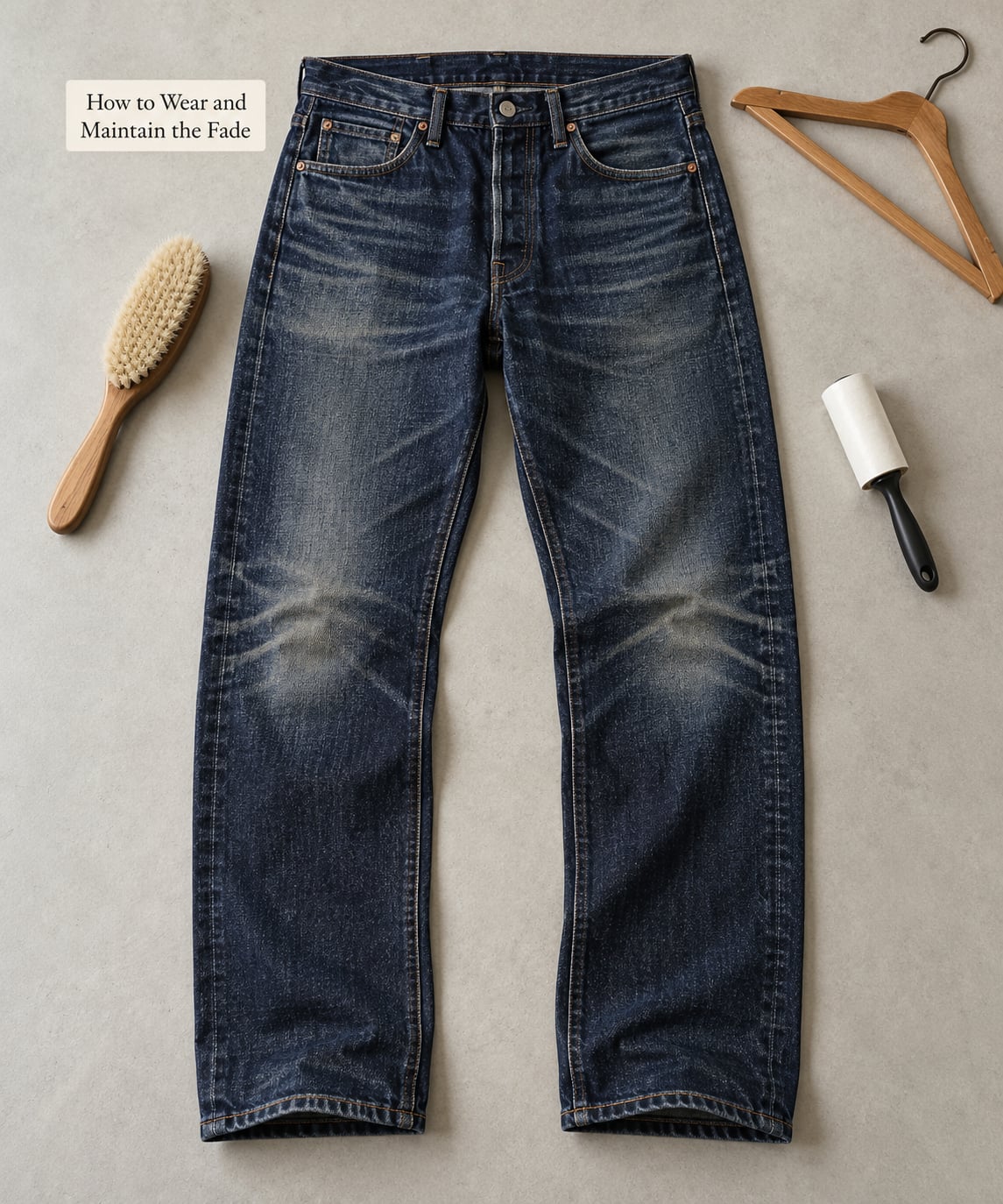
Everything after this is repetition. The fades you have read about, whiskers, honeycombs, stacks, all come from the same everyday motions happening often enough over months.
Movement beats time. Cycling, long walks, stairs, squats, kneeling and manual work all push dye off the high points of the denim. Sitting for eight hours a day produces a good seat fade and almost nothing at the knees. Heat and sweat speed up crocking, which is the colour transfer that leaves blue marks on a light shirt and loosens surface dye at the same time.
You do not need to wash often. Most people wear raw denim for six months between washes, then wash when the dirt gets uncomfortable, and the jeans keep fading the whole time. Spot clean a mark, brush off dried mud, or air the pair in daylight and sunlight instead of a full wash. Washing on a schedule rather than a trigger is what flattens a fade.
Reshape after every wash. Roll the waistband, smooth the legs, hang the pair flat rather than folding it into a drawer, and the twill keeps its texture. Check the crotch and the back of the knee every few months. When the fabric there thins before the fade reaches the point you wanted, a repair keeps the jeans wearable far longer than replacing them.
How Long Does It Take to Fade Raw Denim Naturally?
Longer than most fade-rating claims suggest. Denim weight, fabric composition, wash routine and daily wear all move the timeline, so the useful numbers are checkpoints you can look at rather than a rating anyone gives a pair.
Converting wears into months matters more than the wear count itself. Wear a pair three times a week and 100 wear days is roughly eight months. Wear it every day and 100 wear days is under four.
| Wear days | At 3 wears a week | At daily wear | What to expect |
|---|---|---|---|
| 0 to 30 | First 10 weeks | First month | Stiffness, faint whiskers at the hips, indigo transfer |
| 50 to 150 | 4 to 10 months | 2 to 5 months | Visible honeycombs, a faded seat and knees, softening |
| 150 to 250 | 10 to 18 months | 5 to 8 months | Strong whiskers, wallet fade, defined stacks and roping |
| 250 to 350 | 18 to 24 months | 8 to 12 months | Deep even contrast, pronounced honeycombs, patched fades |
| 350 and up | Over 2 years | Over a year | True vintage wear, thinning at seat and cuff |
The first wash is a checkpoint rather than a milestone. Some wearers see clear change after 20 to 30 active days plus two soaks. Others see almost nothing until month eight, and both are normal.
Fade-rating systems that promise a quick, uniform number are worth taking lightly. Contrast between faded and unfaded areas keeps developing for years, and a pair can look dramatic at month four and still be nowhere near finished at month thirty. The gradual version is the real one.
Common Mistakes
Bleach is the first one. It lifts indigo unevenly, kills the white cotton core underneath, and leaves the denim thin. If bleach has already gone through a pair, there is no reversing it. Stop treating it, wash it cold, and wear it until the damage is part of the history.
Hot water and hot washes are next. They set indigo, shrink unsanforized denim, and create a hard, flat, over-processed look. If a pair has been hot washed, the softness and the surface dye are gone; the fades from here on will be slow and subtle.
Excessive scrubbing with a stiff brush is the third. It thins the fibres and leaves fuzzy patches that read as damage rather than wear. The soft brush from the materials list will do everything you need.
Hard tumble drying on a high heat setting adds abrasion you did not choose and shrinks the inseam. Use the tumble route only on a short low cycle, and only when you want a faster result.
Over-washing is the quiet one. Washing on a fixed weekly schedule whether or not the denim needs it removes surface indigo evenly across the whole pair and produces the flat, low-contrast jeans a lot of new owners end up disliking. Wait for a real reason.
Uneven spot fading comes from concentrating on one area for too long or using too much detergent on a small patch. Work a whole section at once, keep the strokes consistent, and check progress every few minutes rather than every ten.
Two more that hurt later rather than early. Hemming before the first wash can cost you the extra inseam you paid for on unsanforized denim, once the shrink happens. And a crotch blowout at month four is nearly always a fit or dirt problem, not a fading problem, so spot clean more often than you wash.
A few habits protect the contrast you have earned. Air dry instead of sunning one panel, keep strong fades away from detergent, store folded jeans flat, and let the denim rest a few days between long wear days if you want sharper whiskers to develop.
Frequently Asked Questions
Does vinegar help fade raw denim naturally?
Vinegar does very little to denim. It softens slightly and can help with odour, but it removes indigo dye at roughly the same rate as plain water, so soaking in it buys you nothing that a cold soak does not already do. Some wearers add a splash to the rinse to neutralise detergent smell. Leave the fade to abrasion.
What is the fastest way to fade raw denim without bleach?
The fastest safe route is a cold soak, a gentle first wash, then daily wear with high-abrasion movement such as walking, cycling or manual work, followed by air drying. Add hand fading at the knees, seat, hips and hems to place contrast where your body does not create it. Skip the spin cycle to avoid streaks.
How often should I wash raw denim while fading it?
Rarely, if you want high-contrast fades. Most wearers go six months or more before the first wash, then wash when dirt or odour actually demands it rather than on a fixed schedule. Washing more often removes surface indigo evenly and produces a flatter, lower-contrast fade. Spot clean marks and air the pair in daylight in between.
What detergent is safest for fading raw denim?
A mild, colour-safe liquid detergent with no bleach, enzymes or optical brighteners. Use about half the amount you would normally use, on cold water, and rinse until the water runs clear. More detergent strips surface indigo faster than wear does, and it does so evenly, which flattens the contrast you are trying to build.
Can you reverse raw denim that has already faded too much?
Not really. Fading is the loss of indigo from the yarn surface, and that dye cannot be put back where wear removed it. There are re-dyeing services that add blue back to the whole garment, but they will not restore a whisker pattern, only the overall depth of colour. The next pair is the real fix.
Conclusion
Start with one controlled cold soak and one gentle first wash. Watch how much colour comes out, hang the pair dry, and then let daily wear do the work while you place a few fades by hand where your life will not put them.
That is how to fade raw denim naturally, and it is slower than the shortcuts online. It is also the only version of the process that gives you a fade you can wear for a decade.