Wide feet make a sneaker fit worse in exactly one place: across the forefoot. A standard shoe is moulded around an average foot, so the length and heel usually suit you while the ball of your foot gets pushed into the sides of the upper. Understanding how wide feet affect sneaker fit comes down to two numbers — your length and your ball-of-foot width.
Most sizing advice skips the second number entirely, which is why so many wide-footed people end up in shoes that feel right for ten minutes and wrong by lunchtime. This guide covers what width really changes, how to measure it in ten minutes at home, and how to test a pair before it becomes a bad habit.
The most common piece of bad advice out there is “just size up.” It adds length where you do not need it and barely adds the width that would have fixed the problem. Updated for 2026, here’s how the sizing actually works.
Table of Contents
- What Does Wide Feet Mean for Sneaker Fit?
- How Wide Feet Affect Sneaker Fit
- How to Measure Your Foot Width at Home
- Which Sneaker Silhouettes Fit Wide Feet Best?
- What to Look for in Wide-Fit Sneakers
- Wide Feet vs. Standard Sizing: What Changes?
- How to Test Sneakers Before You Buy Them
- Common Sneaker Fit Mistakes
- Frequently Asked Questions
- Conclusion
What Does Wide Feet Mean for Sneaker Fit?
Foot width is the measurement across the ball of your foot, the joint line where your big toe and pinky meet the rest of the foot. It is graded separately from length, using letters rather than numbers, and it is set by the shoe’s last — the moulded form the upper is built around.
A men’s D width shoe is standard, and a women’s B is standard. Wide starts at 2E, and extra wide runs through 4E and 6E. Because grading is not standardised across brands, the same size number in a D-width Nike and a D-width Brooks can measure differently on the same person’s foot.
| Width letter | Men’s ball width | Women’s ball width | Typical fit |
|---|---|---|---|
| A / AA | Under 3.8 in (9.6 cm) | Under 3.2 in (8.1 cm) | Narrow |
| B | 3.5-3.8 in (8.9-9.6 cm) | 3.2-3.5 in (8.1-8.9 cm) | Narrow to standard (women’s standard) |
| D | 3.9-4.2 in (9.9-10.7 cm) | 3.6-3.9 in (9.1-9.9 cm) | Standard (men’s standard) |
| 2E | 4.3-4.6 in (10.9-11.7 cm) | 4.0-4.3 in (10.2-10.9 cm) | Wide |
| 4E | 4.7-5.0 in (11.9-12.7 cm) | 4.4-4.7 in (11.2-11.9 cm) | Extra wide |
| 6E | 5.1 in+ (12.9 cm+) | 4.8 in+ (12.2 cm+) | Very extra wide |
Roughly four inches across the ball marks a wide foot in men, and about 3.5 inches does it in women. Treat those as starting points rather than a diagnosis — nobody’s feet are perfectly average, and what matters is the gap between your measurement and the shoe’s forefoot.
How Wide Feet Affect Sneaker Fit
A shoe that is too narrow for you will show it in four places, and they all trace back to the same pressure. First, the sides of the toe box. If your big toe and pinky touch or press against the upper, the shoe is narrow at the ball no matter what the label says.
Second, the ball of the foot itself. Squeezed there for a few hours, the joint area gets compressed and you get the blisters that form on the big-toe joint or the outer pinky after a long walk. Third, numbness. Blood flow gets restricted, so a shoe that felt fine at the start goes numb and cold by hour six.
Fourth, the upper tells on you. Take the shoe off after a day and look at it in profile: if the side panels bulge outward or the shape of the foot is printed into the material, it was too tight the whole time.
Why a shoe that fits in the morning fails by evening
Feet swell across a day. Runners in particular describe shoes that feel correct at the start becoming too narrow by the end of a session, and that is the single most repeated complaint in wide-foot communities. A shoe you try on at 11am in a cool shop is telling you very little about how it will feel at 6pm.
That is also why toe-box height matters as much as width. A tall toe box gives your toes vertical room to spread and lift as volume increases; a low, flat toe box has nowhere to go even when the shoe is technically wide enough.
When width is only part of the problem
Wide feet often arrive with other shapes. A high instep needs depth as much as width, and a flat foot needs a midfoot that holds without the upper collapsing inward. A bunion at the big-toe joint shifts the widest point of your foot toward the inside edge, which is why a square toe box sometimes helps where a plain wide 2E still pinches. If any of that is going on, a podiatrist can tell you which combination you are dealing with — it is a short appointment and worth far more than another pair of guesswork.
How to Measure Your Foot Width at Home
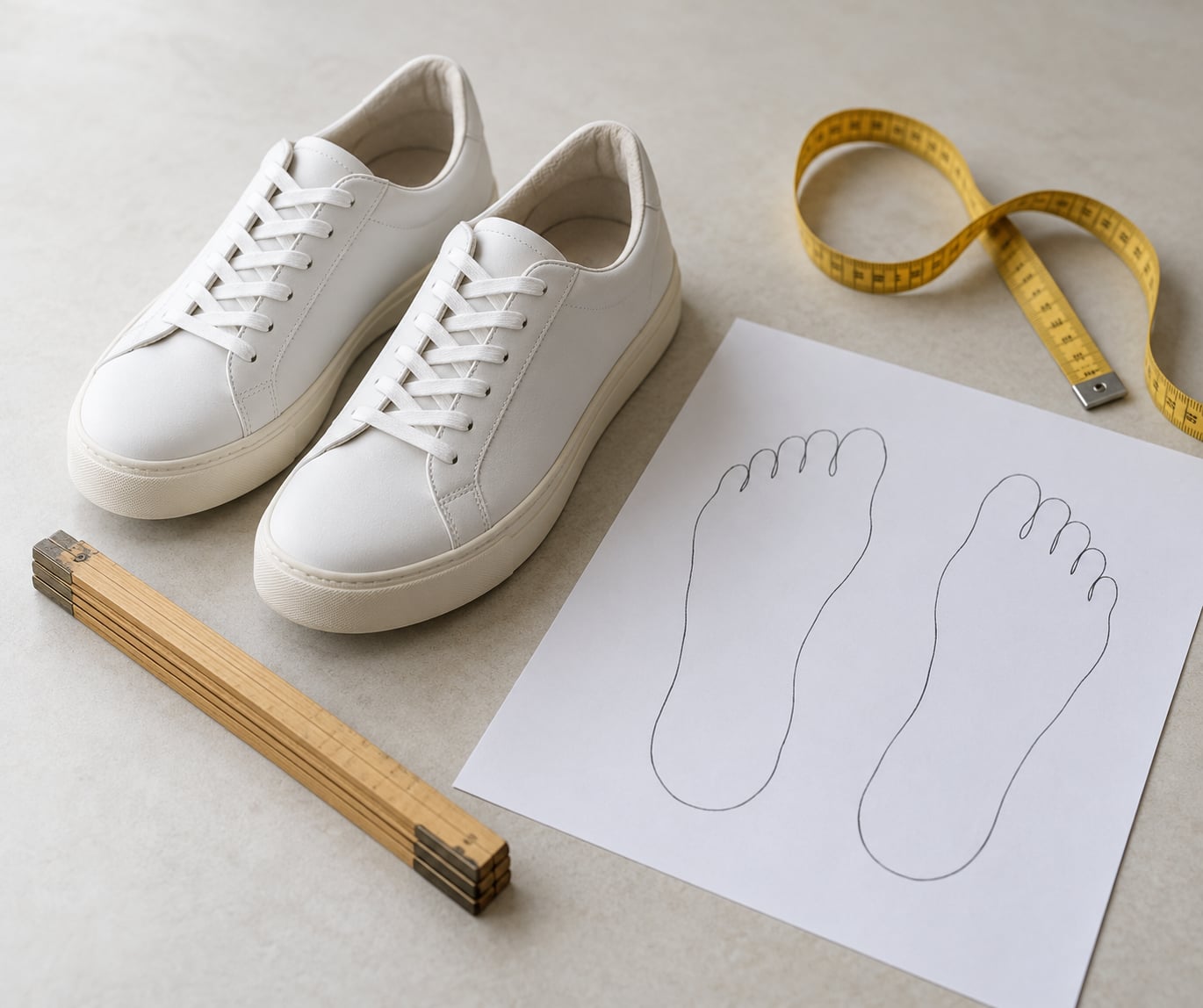
Ten minutes with paper, a pen and a ruler gives you the only number that reliably predicts your fit. Do it in the evening rather than the morning, because that is when your feet are at their largest. Eight steps, no special kit.
- Get two sheets of paper, tape them together so you have a long flat surface, and stand on them with your weight evenly spread.
- Wear the socks you would actually wear in the shoes. Thin for summer, thick for anything with a lined upper.
- Mark the heel and the longest toe on each foot. A helper helps; bracing against a wall works fine on your own.
- Find the widest point of each foot — roughly the line across the big-toe joint and the pinky — and mark both ends of it.
- Measure that line in inches and centimetres, and record it for both feet.
- Use the larger of the two measurements for every comparison. Most people have one foot a fraction wider, and shoes are not made asymmetrically.
- Compare your ball width against the width chart above, or send both numbers to a retailer that fits by measurement rather than by size label.
- Repeat in the other shoe type you care about. Sneaker uppers, boots and dress shoes are graded on different lasts, so a 4E in one is not a 4E in another.
For a professional read, a Brannock device measures length, width and arch in about a minute. Shoe retailers and podiatry clinics usually have one, and it is the same tool used to fill a prescription for orthotics.
Which Sneaker Silhouettes Fit Wide Feet Best?
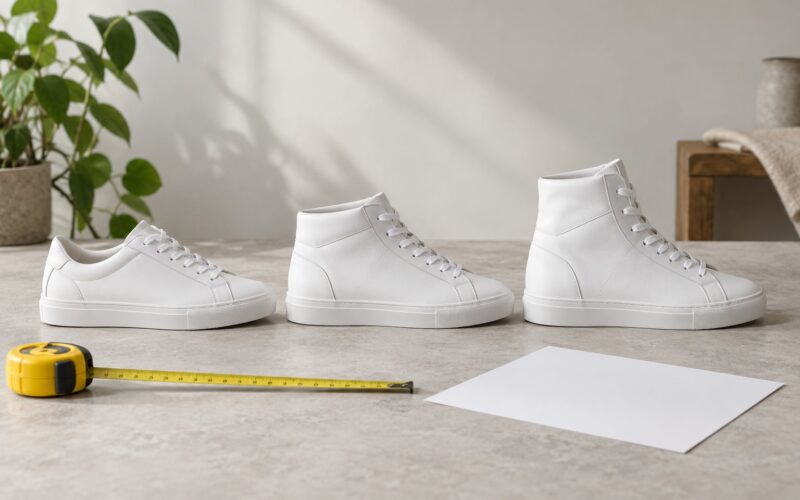
The shape of the last matters more than the width letter, and four constructions give wide feet noticeably more room than a standard tapered last. Square and flat toe boxes carry the widest footprint at the very front, exactly where a bunion sits. Flared lasts widen toward the toe instead of tapering, so the sides of the shoe follow the natural flare of your foot rather than cutting into it.
Wide-platform and bulky high-tops spread the base out under the ball of your foot, which spreads load instead of concentrating it. Running silhouettes, especially neutral trainers with a roomy forefoot, are usually the most forgiving category; retro basketball and skate shoes are the least, because their lasts are built narrow at the base for a planted court feel.
One trade-off worth knowing about: barefoot-style shoes solve width because they follow the foot’s own shape, but they give up lateral lockdown. Fine for walking, awkward for anything on court. If you need width and stability, an anatomically correct wide last is a better answer than a minimal trainer.
What to Look for in Wide-Fit Sneakers
Check the forefoot first. If the ball of your foot can spread without touching either side, most of the rest will follow. Then work through the midfoot, where the laces close, and the toe-box height, which needs enough vertical room for toes to lift. The heel should hold without you having to lace it tight, because tight laces pull the midfoot in and pinch the forefoot by proxy.
Upper material comes next. Knit, mesh and other stretch panels give with you; stiff leather or synthetic panels hold their moulded shape and fight you all day. A removable insole matters more than most people think, because a thin factory insole can be swapped for a thicker one to reclaim a few millimetres. Flexible forefoots bend where you bend, and a wide-fitting lace system gives you another half-size of adjustment at no cost.
Check the sizing guidance for the specific model rather than the brand. Fit changes between releases, and so does the width of the same size number. A generous return window is worth as much as a wide last when you are buying online.
Wide Feet vs. Standard Sizing: What Changes?
Sizing up and sizing wide solve different problems, and only one of them is yours if width is the issue. Length increments and width increments are graded separately, so a size up buys you most of a size in length and only a fraction of the girth you need.
| What changes | Size up one length | Go up one width (D to 2E) |
|---|---|---|
| Overall length | About 1/3 inch (8 mm) | Unchanged |
| Ball-of-foot width | Gains roughly 1/8 inch (3 mm) | Gains roughly 1/4 inch (6 mm) |
| Toe box length | Longer, so your toes slide forward | Same length, more room around them |
| Heel | Looser, and the heel lifts when you walk | Holds where it should |
| Best when | Your foot is long and narrow | Your foot is wide at the ball |
Because grading is not standardised, you cannot assume a 2E in one brand matches a 2E in another. Two sneakers in the same number can measure a quarter inch apart across the ball, which is the difference between a good day and a blister. That is why measuring beats guessing, and why the same size that works in one brand may need testing in the next.
How to Test Sneakers Before You Buy Them
Do your fitting in the afternoon, in the socks you will wear, after a normal day on your feet. Then run a short routine rather than standing on one foot and calling it good. Walk the length of the store a few times; heel slip of more than a few millimetres per step is real, and you will feel it as a sliding or slapping at the back.
Press down on the toe box and check you can get a thumb-width of space past your longest toe. Weight-bearing matters: width you feel while standing is width you actually have, so test on both feet and don’t let a well-meaning shop assistant skip a foot because the first one laced up fine.
Check the midfoot with the laces at their loosest. Then look at the shoe when you take it off. A good fit leaves the foot shape barely marked in the upper. Bulging side panels mean you have already been squeezing, and no amount of wearing in will change that — materials compress, they do not widen.
Online, treat the first pair as a measurement session. Wear the replacement indoors for an hour with the same socks, walk on carpet first, and keep the box until you are certain. Half sizes, wide pairs and second pairs sold together are much easier to justify for fit than a return window is.
Common Sneaker Fit Mistakes
Choosing the shoe by style first is the one that catches everyone. A silhouette that looks right will not change shape, and a pair of narrow shoes will not widen just because you like them. Buying at the wrong time of day is next: fit at 9am means you have not tested what you actually live in.
Ignoring that one foot is wider than the other costs people a whole size. Buying tight and hoping for a break-in is the old habit that causes most compression damage, because a shoe that fits tight on day one is a shoe shaped differently from your foot. Leaving no toe room is a symptom, not a style choice, and it is the reason numb feet get written about in running forums more than anywhere else.
Two smaller mistakes: assuming stretch fabric solves a narrow last, and skipping the heel entirely while obsessing over the toe. A shoe can be beautifully roomy at the front and still let your heel walk out of it all day.
Frequently Asked Questions
How do wide shoes fit?
Wide shoes are graded wider across the ball of the foot while keeping the same length, so your toes can spread without pressing the sides of the upper. They usually feel roomier at the forefoot and at the same time through the heel, and they often have extra depth to match. The fit should feel flat and stable rather than loose.
Are New Balance shoes wider than Nike?
In community consensus, yes. New Balance is repeatedly named as one of the more reliable choices for wide feet, and its 4E widths come up often, alongside ASICS models like the Kayano in 4E. Nike sizing has a reputation for running narrower at the forefoot, though it varies by model, so a specific pair still needs testing rather than trusting a brand name.
How wide is a D width shoe in inches?
For men, a D width shoe measures roughly 3.9 to 4.2 inches across the ball of the foot. For women, a D corresponds to about 3.6 to 3.9 inches, since women’s grading starts a letter narrower at B. Anything past about 4 inches in men or 3.5 inches in women is generally treated as wide.
Do feet get wider with age?
Usually yes, and it happens gradually over decades. Tendons and ligaments soften and feet flatten slightly, so the arch drops and the forefoot spreads. Some widening also follows weight gain or pregnancy. If your measurement has shifted noticeably, it is worth re-measuring rather than trusting a size you have worn for a decade.
Should I buy shoes a half size larger if I have wide feet?
Only if your foot is long and narrow. A half size up adds around a sixteenth of an inch of length and very little width, so a wide foot will still press against the toe box. If the ball of your foot is the problem, go up a width letter or choose a model with a wider last instead of adding length.
What is a European shoe size?
A European size, often called the continental or Paris point system, is based on a centimetre length rather than an inch measurement. The scale is much finer, so a European size jumps in small increments and a quarter size is a common step. It tells you length only, and carries no width information, so it cannot solve a wide-foot problem on its own.
Conclusion
Start with the number nobody gave you. Measure the ball of both feet in the evening, write it next to your length, and check the widest part of any shoe you are considering against it. From there, pick the shape that your foot recognises — square toe, flared last, roomy forefoot — rather than the size on the box.