Two pairs of sneakers can carry the same size tag and fit completely differently, because a number is only meaningful alongside the scale it came from and the shape it was built around. Sneaker sizing explained for different styles comes down to three things: which numbering system the brand uses, how much interior volume the last gives you, and how the upper is built. Get those right and picking your size for a low-top, a mid-top, or a high-top stops being guesswork.
Last updated: October 2026
Table of Contents
- Sneaker Sizing Explained for Different Styles: Quick Comparison
- How Do Sneaker Sizes Work?
- How Should Low-Top Sneakers Fit?
- How Should Mid-Top Sneakers Fit?
- How Should High-Top Sneakers Fit?
- Do Sneaker Styles Use Different Sizing Systems?
- What If You Have Wide or Narrow Feet?
- How to Check Your Sneaker Size Before Buying
- Frequently Asked Questions
- Conclusion
Sneaker Sizing Explained for Different Styles: Quick Comparison
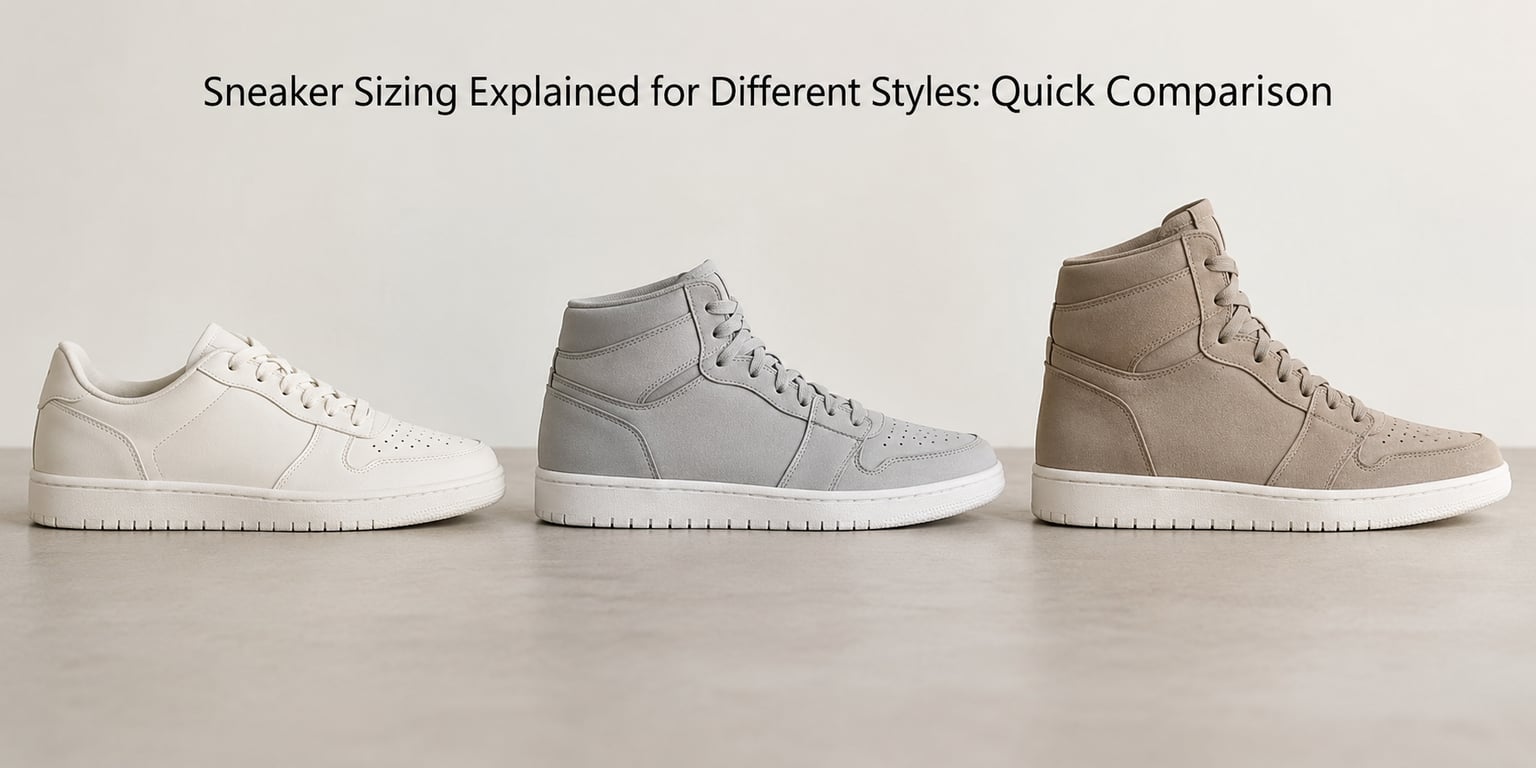
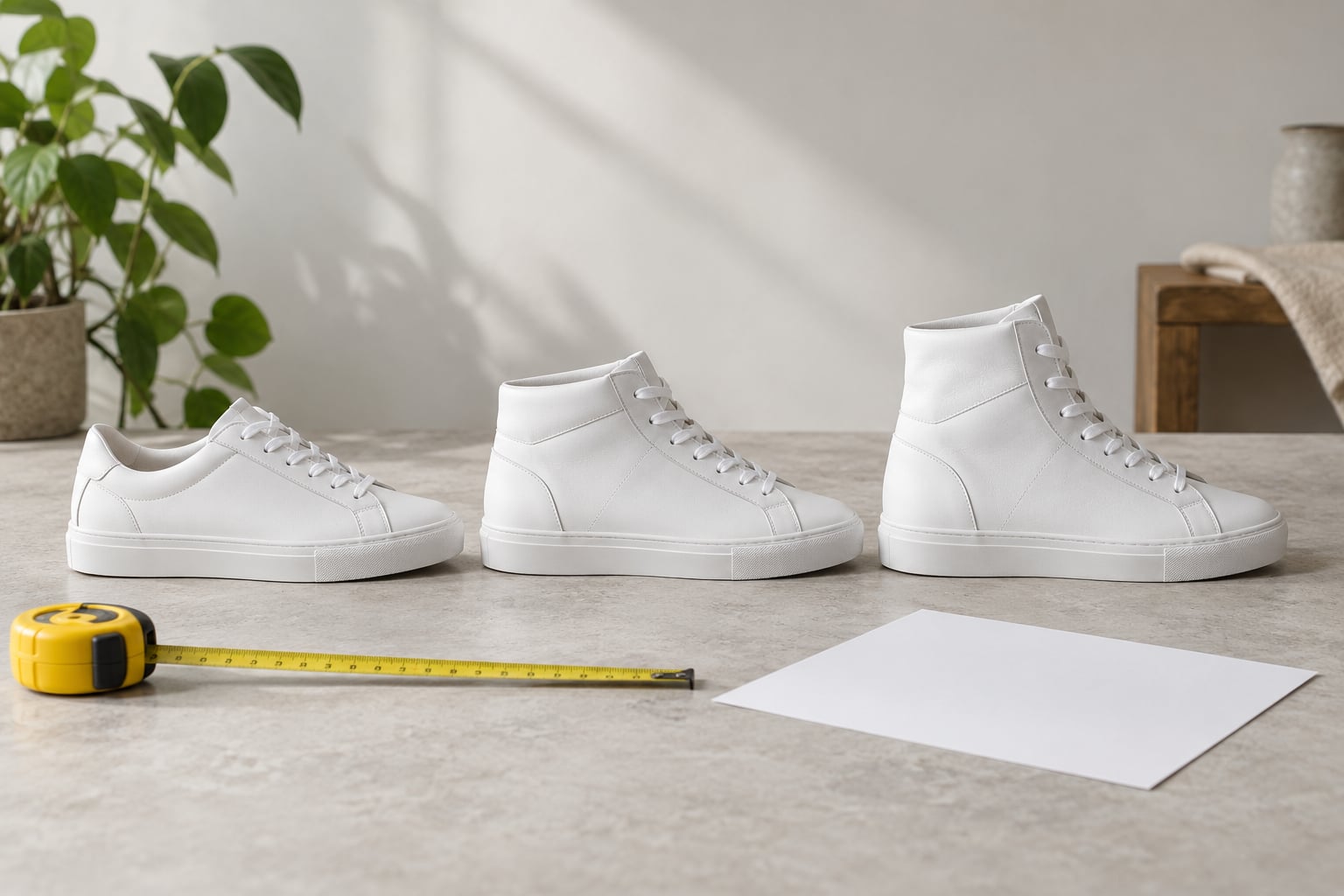
Here is the short version. Low-tops are the most predictable style and usually run close to true to size. Mid-tops sit in the middle, adding structure through the midfoot that can make your usual size feel narrow. High-tops wrap higher and often fit snugger through the collar, so a snug ankle is normal while a tight forefoot is not.
| Style | How it usually fits | Size up or down | What to watch |
|---|---|---|---|
| Low-top lifestyle | True to size for most feet | Stay at your usual size | Leather uppers start snug and ease after a break-in |
| Low-top runner | Firm through the midfoot | Half size up | Toe room for the foot as it lengthens mid-stride |
| Mid-top | Narrower through the instep | Half size up if you feel pinching | Ankle flex; a stiff collar resists the first few steps |
| High-top | Secure collar, snug forefoot | Stay true unless the toe box crowds | Collar pressure is normal, toe pressure is not |
| Basketball | Locked down and low to the ground | True to size | Deliberately tight fit for lateral movement |
| Skate | Flat, wide sole, roomy toe box | True to size | Durable uppers with stiff panels around the midfoot |
| Chunky dad shoe | Generous volume, tall upper | True to size or half down | The extra height of the upper adds visual and real bulk |
| Slide or slip-on | Shallow, moulded footbed | True to size, watch the strap | Open heel changes how the foot sits in the shoe |
| Trail | Wide toe box, secure midfoot | True to size | Rocker profile makes a roomy toe feel normal |
Every one of those rows is a starting point rather than a law. The variability inside a single brand is often larger than the variability between styles, and that is where most sizing mistakes actually happen.
How Do Sneaker Sizes Work?
Shoe sizes are based on the length of your foot measured in inches or centimetres, plus a small allowance of space in front of your longest toe. Brands add that allowance, then round up to the next number on whichever scale they sell in. The number on the box only matches your size when it comes from the same brand and the same last.
Three systems cover most of what you will run into:
- US numbering is used in the US and Canada for both men and women, but the scales are offset by roughly one and a half sizes. A US men’s 10 and a US women’s 11.5 are the same length of foot.
- UK numbering runs about one size above US men’s. UK 11 equals US men’s 10.
- EU numbering is the standard across continental Europe and usually adds about 33 to the US men’s size, with half sizes printed as .5.
So the answer to the question people ask most often, whether a US 6.5Y equals a US women’s 7, is no. The men’s scale runs smaller, so a women’s 7 is about the same foot length as a men’s 5.5.
Each full size step is roughly one third of an inch (about 8.5 mm), which means a half size is one sixth of an inch, or about 4 mm. That is small. Half sizes exist because a full step is often more change than a foot needs, but they are not a dramatic difference and plenty of people never notice one.
Foot length to US, UK and EU sizing
| Foot length | US men | US women | UK | EU |
|---|---|---|---|---|
| 24.1 cm / 9.5 in | 7.5 | 9 | 8.5 | 40.5 |
| 25.4 cm / 10 in | 8.5 | 10 | 9.5 | 42 |
| 26 cm / 10.25 in | 9 | 10.5 | 10 | 42 |
| 26.7 cm / 10.5 in | 9.5 | 11 | 10.5 | 42.5 |
| 27.9 cm / 11 in | 10.5 | 12 | 11.5 | 43.5 |
These numbers are approximate and they assume a standard width foot. Once width enters the picture, the letter attached to the size matters as much as the number itself.
What the width letters mean
Standard US width letters run from AA through D and on to 2E, 4E and 6E. Men’s standard is D, women’s standard is B, which is why a women’s 8 and a men’s 8 can share a length while differing by one width step. A Brannock measurement, the professional system used by shoe fitters, records length and width together as a single number.
| Width | Who it suits | Equivalent |
|---|---|---|
| AA | Narrow | Extra narrow |
| B | Standard for women | Narrow-to-standard |
| D | Standard for men | Average |
| 2E | Wide | One step wider than D |
| 4E | Extra wide | Two steps wider than D |
| 6E | Very wide | Three steps wider than D |
Most sneaker brands do not print a width letter at all. They build a single unisex width and rely on the last shape to do the work, which is why a brand’s own size chart matters more than any generic converter.
How Should Low-Top Sneakers Fit?
A good low-top fit starts with a thumb’s width of space in front of your longest toe, roughly half an inch or 1.3 cm. Your heel should sit secure without lifting when you walk, and the widest part of your forefoot should spread naturally rather than bulging over the midsole.
Low-tops are the style most people buy most often, and they are usually the least dramatic to size. Most low-top lifestyle sneakers run true to size, which is the phrase brands and wearers use when the labelled size matches your usual size. Skate shoes fall into this group too. A member of r/malefashionadvice described skate sizing as pretty much true to size, noting that their size 10 fit like their other size 10 skate shoes.
The exception is leather. A full-grain or tumbled leather low-top starts tight across the midfoot and loosens over roughly a week or two of regular wear. If you are between sizes and like the shape of a model, leather usually rewards going with your usual size rather than sizing up.
How Should Mid-Top Sneakers Fit?
Mid-tops should feel secure through the ankle and still let you bend your foot fully forward without the collar pushing back. The fit difference from a low-top shows up in the midfoot, where the extra material and stiffer panels narrow the space your instep has.
If a mid-top pinches across the top of your foot when you stand, a half size up or a wider model is a better fix than lacing it as tight as possible. That is the usual advice for runners too, where a half size up adds space for the foot as it lengthens and thickens through a stride. On r/RunningShoeGeeks the consensus is consistent and blunt: half a size up will resolve the issue, and one member keeps every pair of running shoes a half size above their usual size.
The one thing mid-tops do well is lateral stability. If you play pickup basketball or train on court, a mid-top or a purpose-built basketball shoe holds the foot more securely than a lifestyle low-top, which is exactly why that snug forefoot is often deliberate.
How Should High-Top Sneakers Fit?
A high-top should feel snug around the collar and firm under the laces, while leaving a thumb’s width in front of your toes. The confusion most people bring to high-tops is mixing up those two sensations. Secure at the ankle is the point of the design. Pressure on your toes is a sizing problem.
High-tops also tend to sit higher on the leg, so the collar contacts a wider part of your ankle than a low-top does. On r/Sneakers, wearers point out that the same model line can behave differently across versions, with the High OG, the 85 High and earlier retros all fitting differently at the same tagged size. Treat a high-top size you already know as a reference point, not a guarantee for the next pair.
If your heel slips out of a high-top, tighten the top two lace rows first. Only change the size if the toe box is crowding you, because the collar itself will never adjust more than a fraction of an inch.
Do Sneaker Styles Use Different Sizing Systems?
No. Every style uses one of the same three numbering systems, and most brands share a size label across their whole range. What changes between styles is the last, the mould the shoe is built around, and that mould determines both the volume inside the shoe and the way the upper is shaped.
Two shoes at the same length can hold very different amounts of volume. A tall upper can carry extra volume above your foot even when the footprint is identical, which is why chunky high-volume sneakers sometimes feel roomier than their tagged size suggests. A low-profile racing-style build strips that volume away and leaves you with less space than the number promises.
- Construction: a moulded or stitched upper holds its shape, while a knit or mesh upper stretches and adapts to the foot over the first wear.
- Upper height: taller uppers add volume without adding length.
- Lacing: a high throat with more eyelet rows lets you control the midfoot, or compress it, far more precisely.
- Last shape: the underlying mould decides whether the toe box is round and tall or flat and low.
This is the reason your size does not transfer cleanly from one brand to the next, and it is why community brand notes are only a starting point. One wearer in a casual footwear thread found their size 10 in another brand fit almost a full size big, while people buying Nike models often describe true-to-size as snug near the toes and needing a break-in. Check the chart for the exact model every time.
What If You Have Wide or Narrow Feet?
If your feet feel cramped across the ball of your foot but the length is fine, the problem is width rather than size. Measure the widest point of each foot while standing, compare it against the brand’s width guidance, and look for wide or extra-wide lasts rather than assuming a longer shoe is the fix. Sizing up when the length is correct just gives you a shoe that slides and rubs at the heel.
Sneaker brands rarely offer half-sizes past a 12 in men’s, so wide feet often need a different model rather than a bigger number. New Balance in particular publishes width options on many of its models, which makes it a straightforward first stop. For narrow feet, a snug lifestyle low-top usually works better than anything built with a roomy last.
Toe box height deserves its own mention. A tall toe box stops the big toe from pressing upward into the upper, which matters if you stand a lot or already deal with a bunion. If you feel pressure on the top of your toes rather than the sides, no width letter will help and you need a different shape.
How to Check Your Sneaker Size Before Buying
You can get a reliable answer in about ten minutes. Work through these steps in order rather than trusting a conversion site, because the converter cannot know the last.
- Start from a pair that fits. Take the sneaker you wear most and check the size on the tongue label or the box. That is your reference number for that brand.
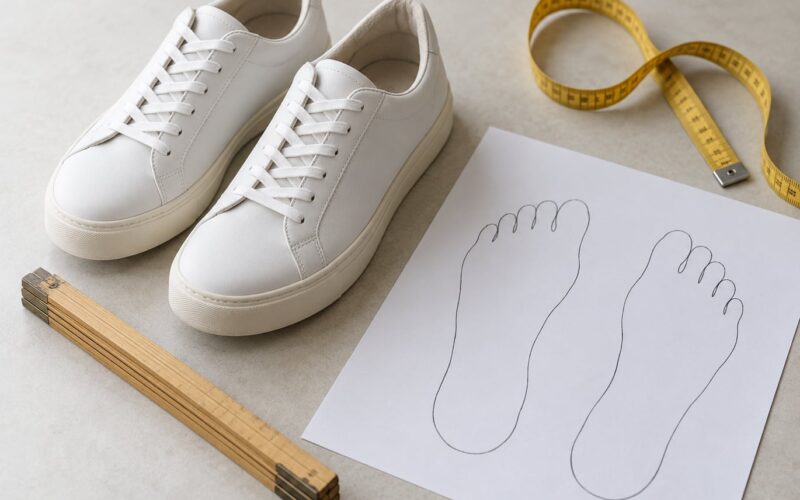
- Measure your feet. Stand on a sheet of paper in the socks you actually wear with sneakers. Mark your heel and your longest toe, measure the gap between marks in inches or centimetres, and subtract about a quarter inch for the width of the pen.
- Measure both feet, later in the day. Feet swell through the afternoon and one is often longer than the other. Measure at the end of a normal day and use the larger result.
- Read the brand’s chart for that model. Charts live on the product page, not just the site’s generic guide, and the foot length in inches is the number that matters most.
- Check the toe gap and the heel.** You want about half an inch in front of the longest toe and no lift at the heel. Walk a few steps rather than standing still.
- Use the return policy as a sizing tool. A generous exchange window means you can order two adjacent sizes, wear them indoors with socks, and send one back. Retailers and buyers both treat free returns as the single biggest way to de-risk sizing online.
Two more details worth knowing. First, if your measurement lands between two rows on the chart, take the larger one, especially for running shoes. Second, your size changes over a lifetime, and feet also get wider and flatter with age as the arch settles, so re-measure every year or two instead of trusting a number you wrote down a decade ago.
Frequently Asked Questions
Should I size up for high-top sneakers?
Only if the shoe feels tight across the widest part of your foot or the brand’s measurements call for it. A high-top collar is supposed to feel snug around the ankle, and that pressure is normal. Sizing up on reflex gives you a shoe that slides at the heel, which is worse than a firm collar. Keep your usual size and tighten the top lace rows instead.
Are low-top and high-top sneakers sized the same?
They usually carry the same US or EU number, but they can fit differently. High-tops add structure and coverage around the ankle while low-tops flex more freely across the instep. Last shape, upper height and lacing all shift the fit, so treat a size you know from a low-top as a reference point rather than a guarantee for the high-top version of the same line.
How much room should I have in a sneaker toe box?
Aim for roughly a thumb’s width, about half an inch or 1.3 cm, between your longest toe and the front of the shoe. Running shoes can carry a little more, closer to three quarters of an inch, since your foot lengthens mid-stride. A gap approaching a full inch usually means the model runs long or the size is wrong rather than that the shoe is unusually roomy.
How do I measure my feet for sneakers?
Stand on a sheet of paper wearing the socks you would normally wear with sneakers. Mark your heel and your longest toe, measure the distance in inches or centimetres, and subtract about a quarter inch for pen thickness. Repeat for both feet, measure at the end of the day when your feet are largest, and size from the longer foot.
Conclusion
Measure your feet once, write down the number in centimetres, and treat it as a starting point rather than an answer. Then pick your size per style: true to size for most low-tops and skate shoes, a half size up for running shoes and for mid-tops that pinch at the instep, and your usual size for high-tops unless the toe box crowds you. Re-check the brand’s chart for every new model, because the tag size is a label, not a guarantee.