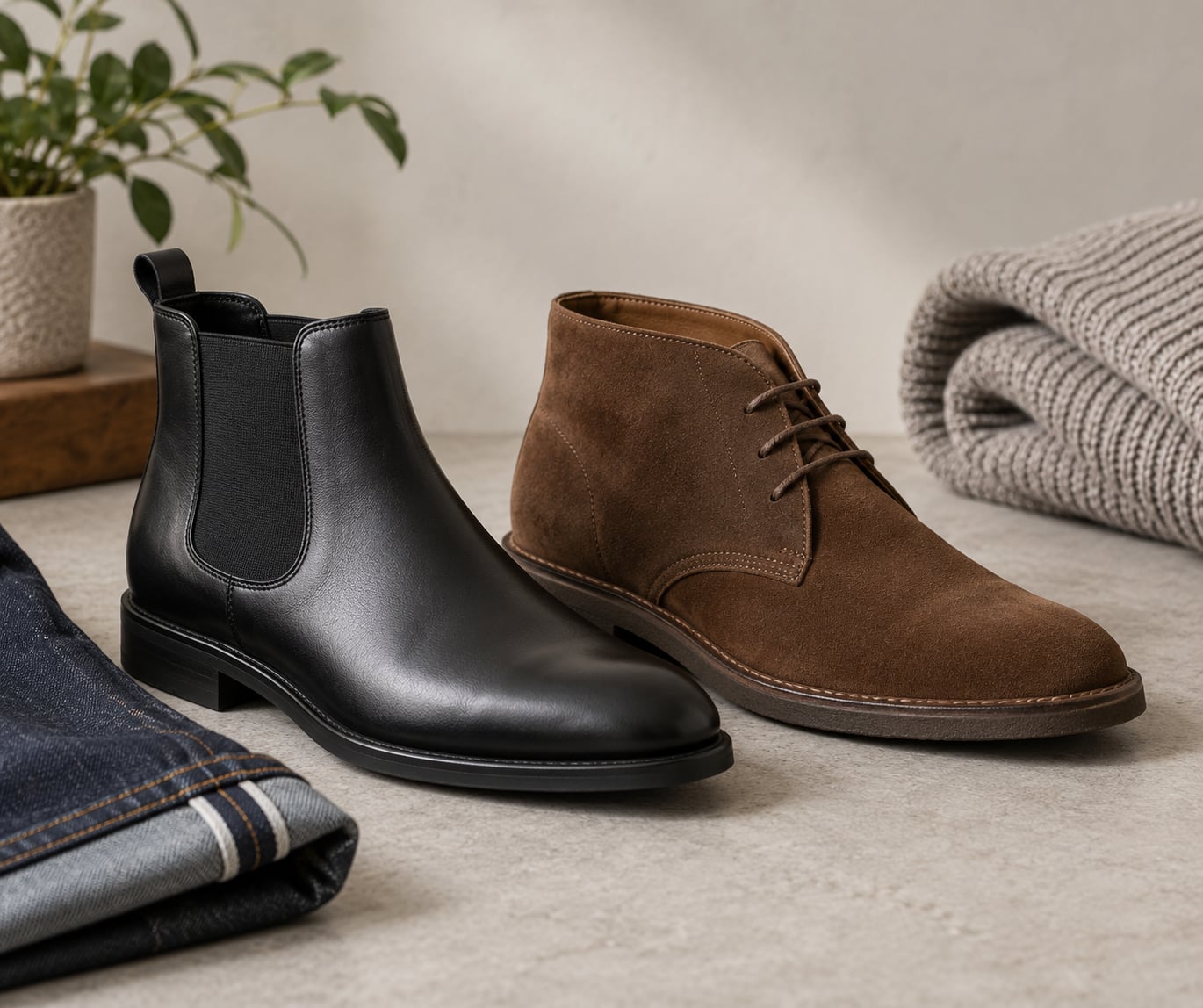
The chelsea boots vs chukka boots differences come down to one thing: closure. A Chelsea boot slips on through stretchy elastic gores on each side, a chukka boot laces up across the instep, and almost every other difference between the two — formality, silhouette, how they handle rain, what they suit — grows out of that single design choice.
Short version: reach for a Chelsea when you want one boot that moves between jeans and office tailoring without thinking about it. Reach for a chukka when you want a laced, textured, deliberately casual boot that reads as part of the outfit rather than a smart finish to it.
Both are ankle boots, both take roughly the same space in a wardrobe, and both cost about the same at a given construction tier. Choosing badly between them is what makes people disappointed with a boot, so the next few sections break each one down on its own terms before the decision comes up.
Table of Contents
- Chelsea Boots vs Chukka Boots at a Glance
- What Is the Difference Between Chelsea and Chukka Boots?
- How Chelsea Boots and Chukka Boots Compare in Shape and Height
- Chelsea Boots vs Chukka Boots: Which One Is More Comfortable?
- Which Boot Works Better for Rain, Snow, and Daily Wear?
- Chelsea Boots vs Chukka Boots for Street Style and Workwear
- How to Choose Chelsea Boots or Chukka Boots
- Which Should You Choose?
- Frequently Asked Questions
- Start With the Outfit You Wear Most
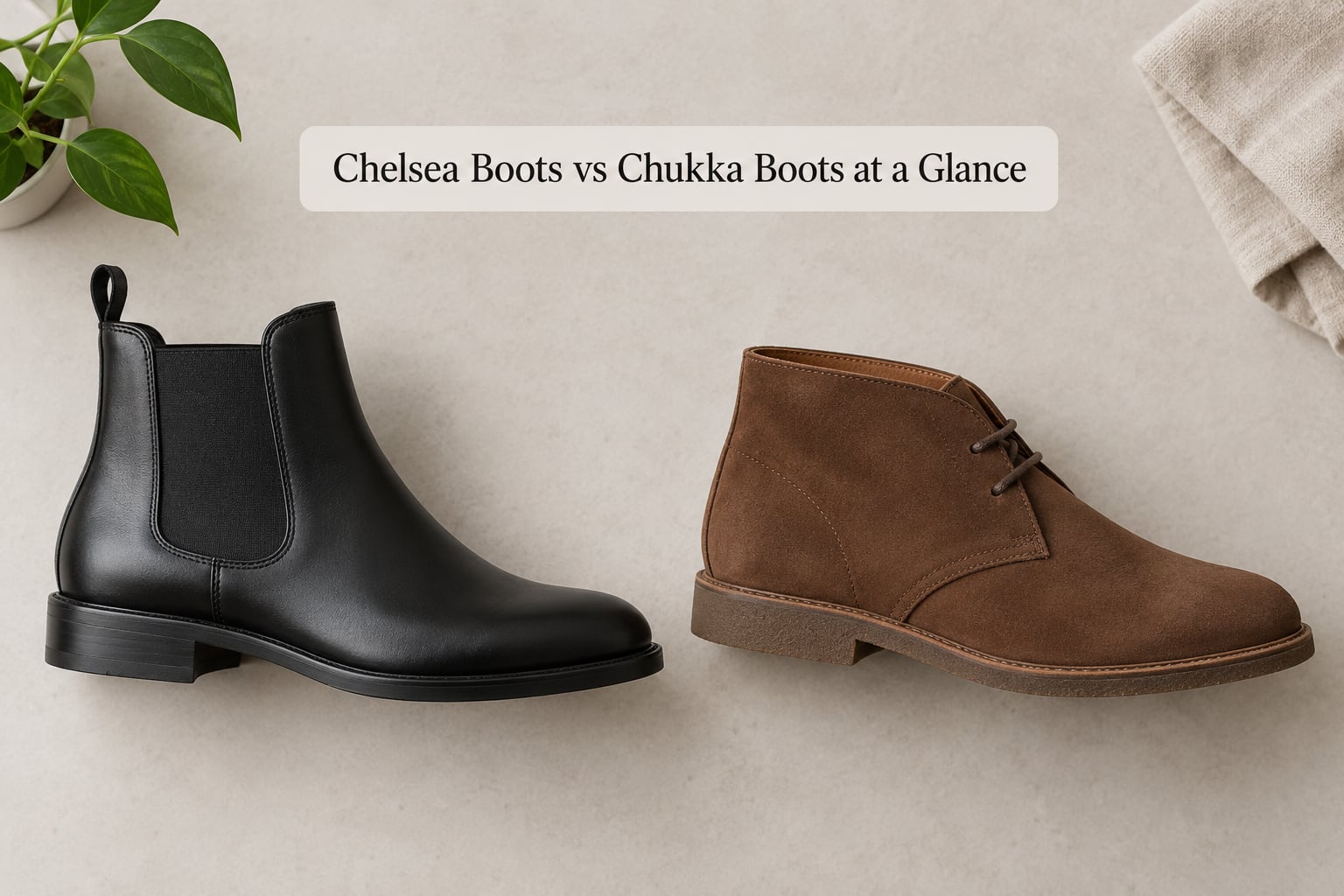
Chelsea Boots vs Chukka Boots at a Glance
| Category | Chelsea boot | Chukka boot |
|---|---|---|
| Closure | Elastic gores, slip-on, pull tab at the heel | Open lacing, usually two to four eyelets |
| Shaft height | Just above the ankle bone, often a touch taller | Sits at or just below the ankle bone |
| Silhouette | Clean, unbroken, minimal decoration | Relaxed, layered, more visible detail |
| Formality | Smart casual to business casual | Casual to smart casual |
| Typical materials | Smooth leather, calfskin, suede, patent | Suede, nubuck, smooth leather, canvas |
| Best colour | Black or dark brown smooth leather | Suede in tan, stone or mid brown |
| Trousers it flatters | Slim tailored trousers, chinos, dark denim | Slim or straight chinos, dark denim, cargos |
| Best season | Autumn, winter, cool spring days | Spring, autumn, mild winter days |
| Wet weather | Smooth leather handles drizzle; gores soak | Suede soaks fastest; laces let water in |
| Care effort | Low to medium with smooth leather | High if suede, low if smooth leather |
| Construction cue | Thin sole and fine stitching read dressier | Thicker sole and visible stitching read rugged |
| Resoleability | Good if welted, poor if cemented | Good if welted, poor if cemented |
One row in that table matters more than the rest: sole thickness. A slim sole with tidy stitching makes almost any boot look closer to a dress shoe, while a chunky sole and rougher finishing pull a boot toward workwear. It is why the same silhouette in two materials can read as completely different shoes.
What Is the Difference Between Chelsea and Chukka Boots?
What a chukka boot actually is
A chukka is an ankle-height boot with an open lacing system across the front, usually two to four pairs of eyelets, a plain toe and a relatively low collar. The name comes from the chukka shirt of the same name, which polo players wore in the 1920s because it took about seven minutes to button up.
From there the design moved into military use as the desert boot, also called the turf boot, and came back down to civilian wardrobes lighter and softer. Those names still float around, which is half the reason people get confused when shopping: a desert boot is usually a chukka with a crepe or rubber sole, and a service boot is a tougher, plain-toe cousin built for actual work.
What a Chelsea boot actually is
A Chelsea is an ankle boot with no laces at all. Stretchy woven elastic gores sit on both sides of the ankle, usually framed by a pull tab at the back, so the whole upper reads as one unbroken panel of leather from the front view.
The design is generally traced to the Victorian shoemaker J. Sparkes-Hall, and the name comes from the Chelsea side of London’s King’s Road, where the style took off with the 1960s mod scene. That unbroken upper is the whole point: it looks like a dress shoe’s upper with a boot’s sole under it.
Why people mix up the two names
Because both sit at the same height, both come in leather and suede, and both are sold in the same part of the shop. The taxonomy gets murkier once broguing appears — a Chelsea with a toe cap and decorative perforations is usually called a dealer boot, and a gusseted, reinforced chukka is a service boot. Ask Andy About Clothes, one of the long-running forums this question keeps turning up on, puts it plainly: chukka, desert, Chelsea and dealer are four specific short boots, not two.
How Chelsea Boots and Chukka Boots Compare in Shape and Height
Chelsea shafts usually sit a little higher, covering the ankle bone and often the bottom of the trouser leg. That extra coverage gives the boot more visual weight and more of a clean vertical line, which is why it works so well with a tapered trouser that breaks once, neatly, over the instep.
Chukkas sit lower and wider. The lacing panel breaks up the front of the boot, the collar often folds or creases with wear, and the whole shape relaxes as the leather softens. On the foot it looks less structured and more like a piece of clothing than an accessory.
Toe profiles differ too. Chelseas skew toward a rounded or slightly squared plain toe, occasionally a cap toe, and usually a low block or stacked heel. Chukkas come with rounded, moc, or cap toes and sit on anything from a thin leather sole to a lugged rubber one.
Here is the trouser rule that catches people out. With slim or tapered trousers, both boots work and the Chelsea looks sharper. With wide or baggy trousers, a short chukka gets swallowed by the fabric while a taller Chelsea shaft keeps a visible line — though if the trouser is properly tapered, a chukka handles it well too.
Chelsea Boots vs Chukka Boots: Which One Is More Comfortable?
Neither name decides comfort. A thin-soled welted Chelsea can be harder on a long walk than a cushioned chukka, and a cheap cemented chukka can be worse than a good Chelsea in every way. What decides it is the last, weight, heel height, lining and the fit around your particular foot.
Chelseas do have one structural advantage. The elastic gores stretch over the instep, so a well-made pair gives across the top of the foot where many lace-ups press. The fit clue people use is simple: the flex should happen in the side panels, not across the instep. If the vamp folds when you walk, the boot is too long or the toe box is too shallow.
Why Chelsea boots are often reported as too narrow
This is the single most repeated complaint about Chelseas in the places this question gets asked, and the cause is usually a last, not the elastic. A narrow last plus stiff new leather means the boot grips your foot and never gives. If you know your foot is narrow, half a size up is usually the right first move, and any conditioner applied before the first wear will soften the leather a little.
When a chukka feels better on the foot
A chukka wins when you need adjustability. Laces let you tighten the midfoot, loosen over a swelling, or pull the boot off without fighting the heel counter — which is the reason many people who moved from chukkas to Chelseas cite convenience as the deciding factor, since the pull-on is fast going on and awkward coming off. Laces also let a worn chukka be tied tighter across the top for a fit that a Chelsea cannot be adjusted into at all.
Break-in behaves differently too. Suede chukkas soften within a week or two. A smooth leather Chelsea can stay stiff for weeks, and during that period it is the boot most likely to rub at the heel and instep.
Which Boot Works Better for Rain, Snow, and Daily Wear?
Neither boot is a winter boot, and both fail in the same two places. On a Chelsea it is the elastic gores — exposed stretch panels hold water and dry slowly, so a pair with a full leather lining and a storm welt handles rain far better than a cheaper cemented one. On a chukka it is the open lacing, which lets water straight down onto the tongue and into the boot.
Material is the bigger variable. Smooth or polished leather sheds drizzle and wipes clean. Suede and nubuck absorb water almost immediately, darken unevenly, and can hold a salt stain long after the boot is dry. That is why suede chukkas get ruined in a single wet season, and why the most common advice from wearers is to keep suede for dry months and treat it before the rain arrives rather than after.
For snow and slush, neither is the right tool. A lugged rubber sole gives more grip than a leather one, but a low ankle and an unsealed upper still let meltwater in from the top. If you live somewhere with real winter, a proper insulated boot with a sealed waterproof membrane does the job, and the Chelsea or chukka becomes the pair you reach for on the dry, milder days.
For everyday wear, the deciding factor is maintenance tolerance. A polished leather Chelsea wiped with a cloth after a commute will look good for years. Suede chukkas need a brush, a protector spray, and acceptance that they will never look the same again after heavy rain. Buy honestly about which of those two weekends you want.
Chelsea Boots vs Chukka Boots for Street Style and Workwear
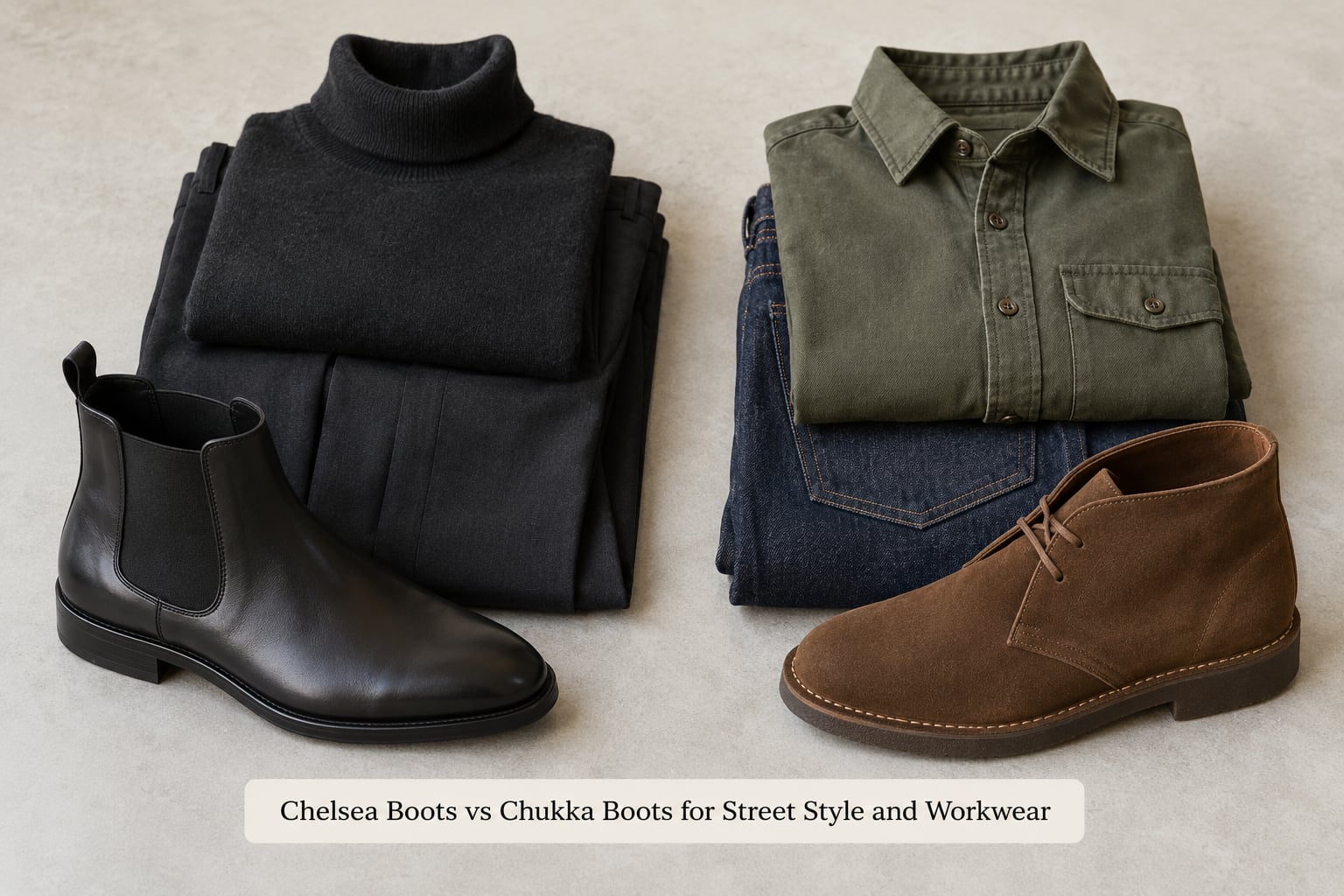
The two boots split the outfit space almost perfectly, which is why most wardrobes end up with one of each rather than two of the same.
Chelsea boots with trousers
A clean Chelsea sharpens a tailored trouser more than almost anything else you can put on a leg. It handles slim wool trousers, chinos, corduroy and dark denim equally well, and it works with a button-down, a knit, or a roll neck in the way a chukka cannot quite manage.
Black or dark brown smooth leather is the most versatile configuration, which is the most common recommendation that comes out of community discussions about this choice. On colour: black reads sharper with tailoring and denim alike, brown sits more comfortably with olive, navy and sand tones, and suede Chelseas in grey or stone are the version to buy if you mostly wear light trousers.
Chukka boots with trousers
A chukka works naturally with chinos, dark denim, cargos and relaxed tailoring, and it is the more convincing choice with a t-shirt, a work shirt, or a heavier layer over the top. Wearers describe it as the boot equivalent of a good trainer — a sneaker in boot form — and that framing is why it disappears into an outfit instead of finishing it.
Slim and straight trousers are the strongest pairing, and that point comes up more than any other in the styling discussions. Chunky or wide trousers tend to swamp a short boot, which is the mirror image of the Chelsea problem.
On colour, mid brown suede is the safest first chukka because it works with denim, chinos and olive, and because scuffs show on it less than they do on a pale stone. Black chukkas are the risky option: dark leather on a low lace-up boot hides the whole silhouette and reads shapeless, which is why regulars tend to reserve black for a higher lace-up boot instead.
The mistakes that date either boot
- Chelsea with skinny distressed jeans and a graphic tee, which pushes the look towards a costume.
- Suede chukkas in a wet season, when the boots look tired long before they wear out.
- Chukka with full tailored trousers, which reads underdressed rather than relaxed.
- A hem that breaks in a random fold instead of once across the instep, on either boot.
- Matching the boot colour to the trouser exactly, which flattens the whole outfit.
How to Choose Chelsea Boots or Chukka Boots
Six questions settle it faster than any amount of browsing.
- What is your most-worn outfit? If it is tailoring, chinos with a knit, or anything office-adjacent, start with a Chelsea. If it is denim, cargos and tees, start with a chukka.
- How formal is your week? Chelsea clears most business-casual rules. Chukkas are fine in relaxed offices and fail the moment a suit jacket appears.
- What is your climate like? Lots of rain and mud argues for smooth leather and laces you can tighten. Dry summers and mild winters suit suede chukkas.
- How much care do you want to do? Smooth leather is a wipe and a buff. Suede is a routine, and the routine has to actually happen.
- Do you want the boot to be noticed or to disappear? A Chelsea is a finishing detail. A chukka is part of the outfit.
- What construction can you get? Check the sole, not the logo. A stitched welt or a visible welt line means the boot can be resoled. Cemented construction cannot, and that difference decides how long your first pair lasts.
On that last point, the three tiers worth knowing are entry unsealed, mid-tier Blake stitch, and premium Goodyear welt. They sit at different price bands and the jump between them is the jump from a first practice boot to a boot you keep for a decade.
Which Should You Choose?
| If you mainly wear… | Buy the Chelsea | Buy the chukka |
|---|---|---|
| Tailored trousers and office-casual outfits | Yes | Only with a relaxed suit |
| Dark denim, cargos, joggers | Works, looks sharper | Yes |
| Knitwear and roll necks | Yes | Only if the knit is heavy |
| Wet, muddy city streets | Smooth leather only | Smooth leather only |
| Hot, dry summer days | Too heavy | Yes, especially suede |
| You want one boot to do the most | Yes | No |
Community opinion on this is genuinely split, which is the honest outcome rather than a hedge. People who moved from chukkas to Chelseas usually cite the ease of a pull-on, and people who moved back usually cite the lace-up adjustability and the way a good pair of chukkas handles a wider trouser. Both arguments are real.
Frequently Asked Questions
Are Chelsea boots still in style?
No, they are not out. The Chelsea has been a fixture in British menswear since the Victorian era and came back hard through the 1960s mod scene, and the current version of it — plain toe, slim sole, clean leather — is the same version that has stayed in circulation ever since. What has changed is the styling around it. A Chelsea worn with tapered trousers and a knit looks current; the same boot with skinny jeans and a band tee looks borrowed from someone else’s wardrobe. The boot is not the dated part.
Are chukka boots dress shoes?
No. A chukka is a casual boot, usually sitting one or two steps below a dress shoe on any formality ladder. It works with chinos, dark denim, cargos and knitwear, and it can accompany a relaxed or unstructured suit in a warm climate. It does not work with a tailored suit in a traditional office, and no amount of good leather changes that.
Can you wear chukka boots in summer?
Yes, and a brown or stone suede chukka is arguably at its best in the warmer months. Pair it with slim chinos, a short-sleeve shirt, or dark denim and you have an outfit that needs no coat to look finished. The two caveats are that suede and canvas versions are best kept out of heavy rain, and that the boot should be a lighter colour or a lighter construction in summer so it does not read as heavy against bare ankles.
Do Chelsea boots and chukka boots fit the same?
Not reliably. A Chelsea is often built on a narrower last with a stiff upper, so wearers frequently size up half a size or return the first pair. A chukka is usually fitted with laces, so you can adjust it, and most chukkas are slightly roomier through the midfoot. Check the stated width on each product, and if you are between sizes on a Chelsea, take the larger one. Break both in indoors with a sock before wearing them out for a full day.
What is the best colour for Chelsea and chukka boots?
For Chelsea, black or dark brown smooth leather covers the most outfits and pairs with tailoring and denim alike. For chukka, mid brown suede is the safest first pair because it works with denim, chinos and olive tones, and it hides scuffs better than a pale stone. Avoid black chukkas in particular — the dark colour swallows the lace-up silhouette and the boot reads shapeless rather than intentional.
Start With the Outfit You Wear Most
Pick the boot that matches the clothes you already reach for, not the one you imagine buying more clothes to justify. If that rotation is tailoring, chinos and knitwear, a smooth leather Chelsea in black or dark brown will do more work per pair than anything else at ankle height.
If it is denim, cargos and heavier layers, buy the chukka in mid brown suede, take a half size up if the last runs narrow, and spray it before the first autumn rain rather than after the first downpour.
Whichever you choose, check the sole before you pay. A stitched welt means it can be resoled, and a resoleable boot is the one that still looks good when the soles on the cheap version have separated.