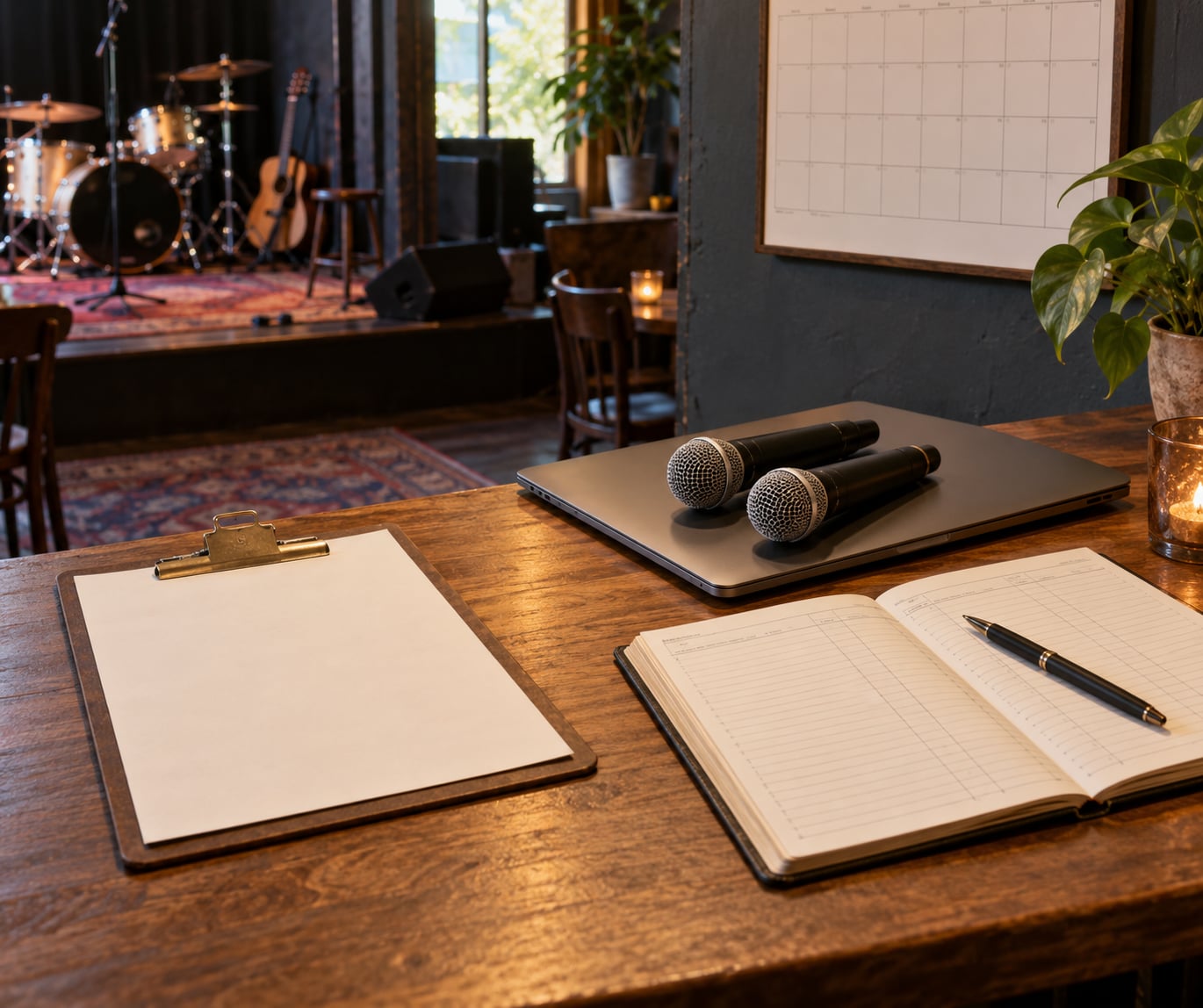
How small venues book local openers is mostly a sourcing and trust problem, not a negotiation problem. A booker pulls names from open mics, past bookings, referrals and the local scene, watches a recent live clip to see whether an act can hold a room, then agrees a fee or a split of the door and puts it in writing. The headliner usually picks the opener, but the venue signs the deal and pays it.
That last sentence clears up the question that shows up again and again on music forums: who actually decides? Almost nobody outside the industry is sure, and artists regularly pitch the wrong person asking for a support slot they cannot grant.
This guide is written for the venue side first, with notes for artists along the way. A show works when both halves understand who holds each decision.
What You Need
Before you contact a single act, get five things straight. Venues that skip this step end up negotiating from scratch in email threads three weeks before show day.
- A booking plan for the night. What is this date doing? A weeknight that needs a crowd, a showcase for a new band, or a support slot the headliner is allowed to fill.
- A budget line and the structure you prefer. Deciding flat guarantee versus percentage of cover beforehand removes most of the back-and-forth later.
- Real dates, load-in times and set length. Room capacity, stage dimensions, curfew and curfew-adjacent sound limits.
- The decision-makers. The booker’s name, the promoter’s name, and whether the headliner or their manager has approval rights over the opener.
- Artist information in one place. Press photos, a bio, billing details, and whatever insurance or tax paperwork your venue requires before confirming.
- A written agreement or booking confirmation. Even a one-page confirmation avoids most disputes. Most arguments you hear about venues come down to terms nobody wrote down.
If a certificate of insurance is required, say so in the first email. Chasing it after the act has driven two hours is a poor use of everyone’s night.
How Small Venues Book Local Openers Step by Step
Seven stages, and each one has a check that tells you whether it worked. If a stage fails, you loop back rather than pushing forward and hoping.
How Small Venues Book Local Openers Without a Broker
You do not need a broker for local talent. Small rooms run on a shortlist you build and keep, usually in a spreadsheet with notes on every act you have ever put on.
The sources that actually produce reliable openers, in rough order of usefulness: acts you have already worked with and would book again, referrals from other bands and from sound engineers, open mics and showcases you attend regularly, community and college radio, music schools and local recording engineers who know who plays well in a small room, and genre-specific social accounts where the local scene argues about who is worth booking.
Two more sources quietly outperform everything else. First, ticketing history: ask the box office which support acts on past bills pulled the biggest walk-up. Second, the acts themselves. Most bands already know three local openers who are reliable, and they will tell you who if you ask while booking them.
How to know a source worked: every name on your list should come with a date you watched them play or a person you trust who did. If you cannot answer that, the name is a guess.
Choose an Opener That Fits the Room
The right opener fills the weak part of the night and sells drinks. Musical fit matters, but it is a filter, not the deciding factor.
Work through five things in order. Audience fit: will the people who come for the headliner actually stay for the opener, or leave at the bar mid-set? Draw: what has this act pulled into comparable rooms, honestly, on a comparable weeknight. Genre and tempo: an opener who plays faster and louder than the headliner burns the energy you are trying to build, and one who plays slower can lose a room before the headline set starts. Technical fit: do they need a backline the house does not have, and how long will it take to get them on and off stage? Local relevance: a name the room recognises is worth more than a larger name nobody has heard of.
Follower counts tell you almost nothing. A recent live clip of a real room tells you most of what you need. Watch how the act holds attention when nothing is happening, how they handle a late start, and whether they talk more than they play.
The check: if you had to describe the opener in one line on the poster, would the description make sense next to the headliner’s?
Set the Fee and Deal Structure
Small rooms usually pick one of four structures. Use the one that fits how much you believe the opener will bring, not the one that sounds generous.
Flat guarantee. The venue pays a fixed amount regardless of attendance. Simple, and the opener can plan around it. Use it when the act has a track record in your room or the date is important.
Percentage of cover. The opener takes a share of the door take after tax and card fees. Rarely used alone; usually a small guarantee plus a percentage.
Door deal. The opener receives a percentage of everything the door takes, sometimes after expenses, sometimes before. It costs the venue little on a bad night and rewards a good one.
Door split. The night is divided between all acts on the bill, often after the headliner’s guarantee is covered. Best used when two or three acts share a small room.
Whatever you choose, write down the rest too: how many guest-list comps and who gets them, whether the opener keeps their own merchandise income or splits it, whether the venue covers travel and meals, when payment happens, and whether a deposit is required. Say how settlement is calculated and when it is paid. Complaints about short pay are almost always about an unstated expense, not about money owed.
One practical note for artists: an opener who accepts almost nothing to play is not being generous, they are telling the whole town what the going rate is. Scenes learn that number fast, and most acts only notice months later.
The check: can you calculate the opener’s payment from a single page of numbers without asking anyone a question?
Send a Clear, Professional Offer
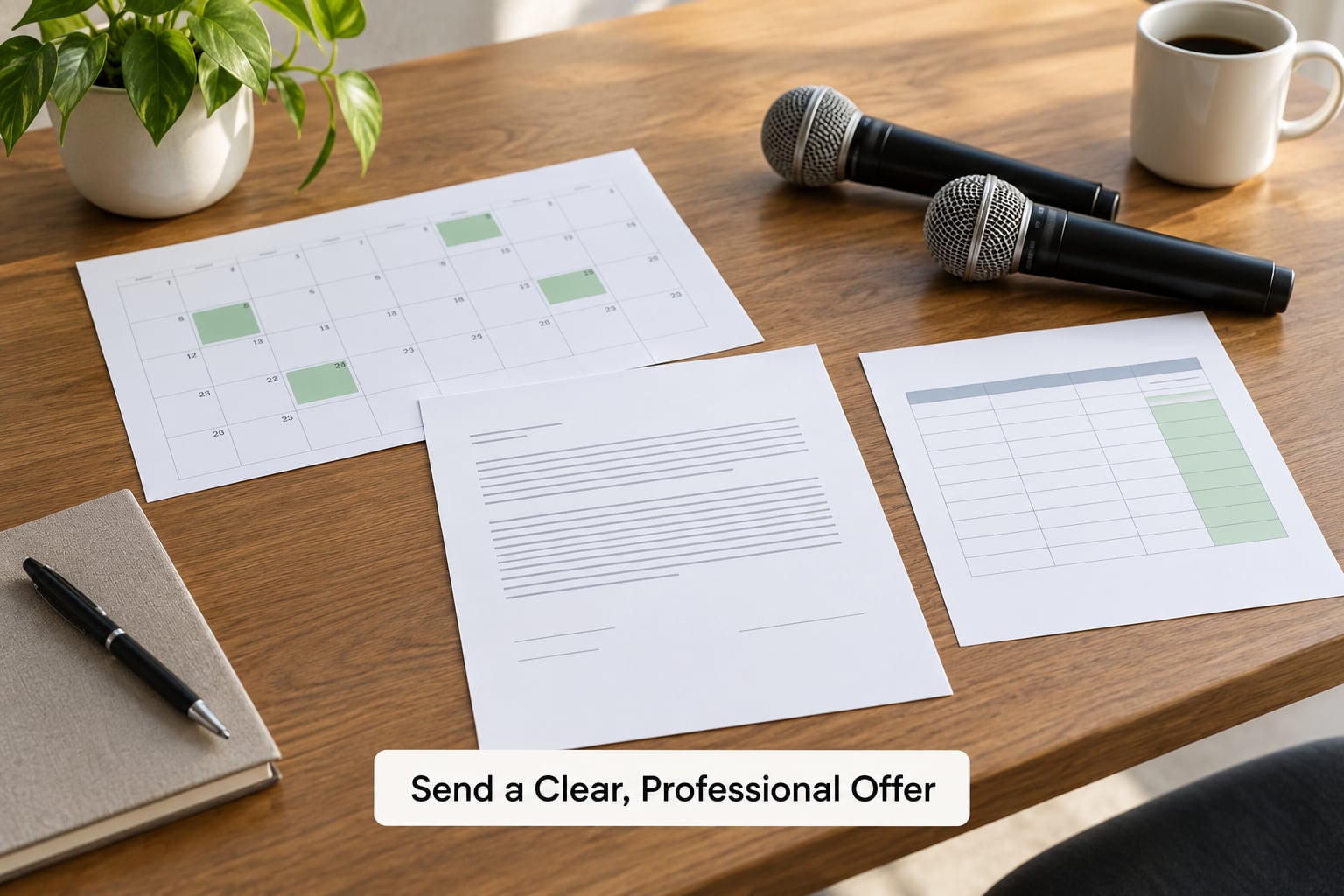
A written offer removes most of the back-and-forth that turns a friendly email into a bad week. Send it to a named person, not to a general enquiry inbox, and keep it to one page.
Include the date, doors and curfew, performance length and exact call time, billing position, payment amount or split and when it is paid, promotion expectations on both sides, hospitality, technical requirements and what the house provides, load-in and stage access, and a deadline for confirming. Add the venue’s insurance and paperwork requirements in the same message.
Understanding how small venues book local openers is mostly about this document. The acts who read it and reply clearly are the ones who end up on the next bill and the one after that.
The check: the act can read the offer once and tell you whether they are playing, without asking a follow-up question.
Confirm the Booking in Writing
Once terms are agreed, restate them as a short confirmation and get an acknowledgement. A one-page confirmation beats a long contract for a local support slot, as long as the page actually covers the terms.
Put in writing: date, call time, set length, billing, fee or split, guest-list allocation, merch terms, promotion commitments, hospitality, technical requirements, recording and photography permission, and cancellation terms. Then collect the missing details in one request: invoice or payment details, press photo, stage plot or technical rider, set list if you need it for the door, and any insurance documentation.
Name one contact per side and one channel for that contact. Mixed threads with a booker, a promoter and a band member are how billing order changes between the announcement and the poster.
The check: one person on each side can look at a single message and describe the deal accurately to a third person.
Promote the Show and Support the Artist

Promotion is a shared job, and the split should be written down before the show is announced. The venue covers the poster, the listing, the ticket link and the email list. The opener posts the date repeatedly, brings a handful of people who actually buy, and shares the venue’s posts.
Give the act assets they can use without asking: a horizontal and a vertical image, a short written blurb, the ticket link, and the correct handle. Ask them to tag the venue and use the same date every time. Small venues live and die on people reading one post and showing up two hours later, so the venue should post more than once too.
Do not leave all promotion to the opener. An opener who brings nobody makes the room feel empty for the headliner too.
The check: three days out, both sides have posted the event more than once and the ticket link works.
Run a Final Show-Day Check
The day itself rewards preparation and punishes improvisation. Most problems come from the same four places: timing, money, access and cancellation.
- Settlement. Know before doors what the opener earns and how it gets calculated. Reconcile the count and the take after the headliner clears the stage, pay or confirm payment on the agreed timeline, and give the act the numbers in writing.
- Arrival and soundcheck. Give a real call time and tell them where to park and load in. A local act unfamiliar with your room needs a walkthrough, not a text saying ask for the engineer.
- Set length and stage discipline. Openers who overrun steal the headliner’s set and the room’s patience. Put the cut-off in the run of show and have someone enforce it.
- Hospitality and access. Decide what a green room means in your venue: a meal and a quiet place, or a table in the corner. Both are fine, but ambiguity causes arguments.
- Recording and merch. Say whether the venue or anyone filming needs permission, and confirm merch is sold from the merch table and reconciled afterwards.
- Contingency. If an opener cancels late, the usual options are promoting the empty slot, billing a house act from your roster, or billing a solo fill. Decide the rule before you need it.
The check: everyone involved can answer the question “what happens if you are not here in two hours?”
Common Mistakes
These six come up constantly, and each has a straightforward fix.
Offers with no numbers. Vague emails produce long threads and no decision. Fix: every offer states date, time, length, billing, money and promotion in writing.
Unrealistic guarantees. Promising an opener a fixed figure that assumes a full room on a Tuesday teaches everyone involved that you do not do the math. Fix: base guarantees on what comparable support acts have actually drawn in your room.
One-sided promotion. Assuming the venue will handle it. Fix: split the checklist in the confirmation and confirm posts three days out.
No cancellation terms. The most common cause of a bad night. Fix: state the notice period and what happens in each case, including who pays a replacement fee if you are the one cancelling.
Unclear billing. Ambiguity about billing order, set length and emcee duties causes the opener to be announced as a co-headliner, which is a fast way to lose the band’s trust. Fix: one line in writing, repeated on the poster.
Skipping technical checks. Discovering at soundcheck that the opener needs a backline you do not have. Fix: ask for the stage plot and input list with the offer and answer it in writing.
One habit worth keeping: after every show, write down how the opener performed, whether you would book them again, and what they drew. That note is the entire shortlist for next month.
Frequently Asked Questions
How do small venues find local artists who are actually available?
Small venues keep a standing list built from acts they have already worked with, referrals from other bands and sound engineers, open mics they attend regularly, community and college radio, and music schools. Checking box office history on past bills shows which support acts actually pulled a crowd. Keeping a few acts warm with occasional outreach matters more than finding new names, because a known act usually has fewer conflicts on a given week.
Should a venue guarantee an opener a fixed fee or use a door split?
Use a flat guarantee when the act has drawn well in your room before or the date matters. Use a door deal or split when you are not sure, since it costs the venue little on a slow night and pays more on a good one. Many rooms pair a small guarantee with a percentage of the door. Whichever you pick, write down how the figure is calculated and when it gets paid.
How much should a venue pay a local opener?
There is no single rate, and prices vary by market, room size and night. Benchmarks differ sharply by city, so ask two or three comparable rooms in your own market rather than relying on national figures. The more useful rule is internal consistency: paying one local act a token amount teaches every other act in town what the going rate is. Base the number on what that act has drawn for you before.
What details belong in a written opener agreement?
Date, call time, set length, billing position, fee or split and how it is calculated, guest-list allocation, merchandise terms, promotion commitments from both sides, hospitality, technical requirements, recording permission, cancellation notice and who to contact. A one-page confirmation works well for a local support slot as long as it covers all of these and both sides acknowledge it in writing.
Who should handle promotion when a local artist opens a show?
The venue takes the poster, the listings, the ticket link and the email list. The opener posts the date several times, tags the venue, shares the venue posts and brings people who actually buy. Set this out in the confirmation rather than assuming it. Venues that leave promotion to the opener end up with empty first halves of the night, and openers who bring nobody rarely get invited back.
Conclusion
Start by writing down the date, the budget, the audience you expect and the deal terms before you contact anyone. Build a shortlist from acts you have seen play, check a recent live clip, send one clear written offer and confirm it in a page. Understanding how small venues book local openers comes down to three habits: pick the act that fits the room, put every term in writing, and pay promptly. Artists who do those three things get asked back, and bookers who expect them find the process takes an afternoon instead of a month.