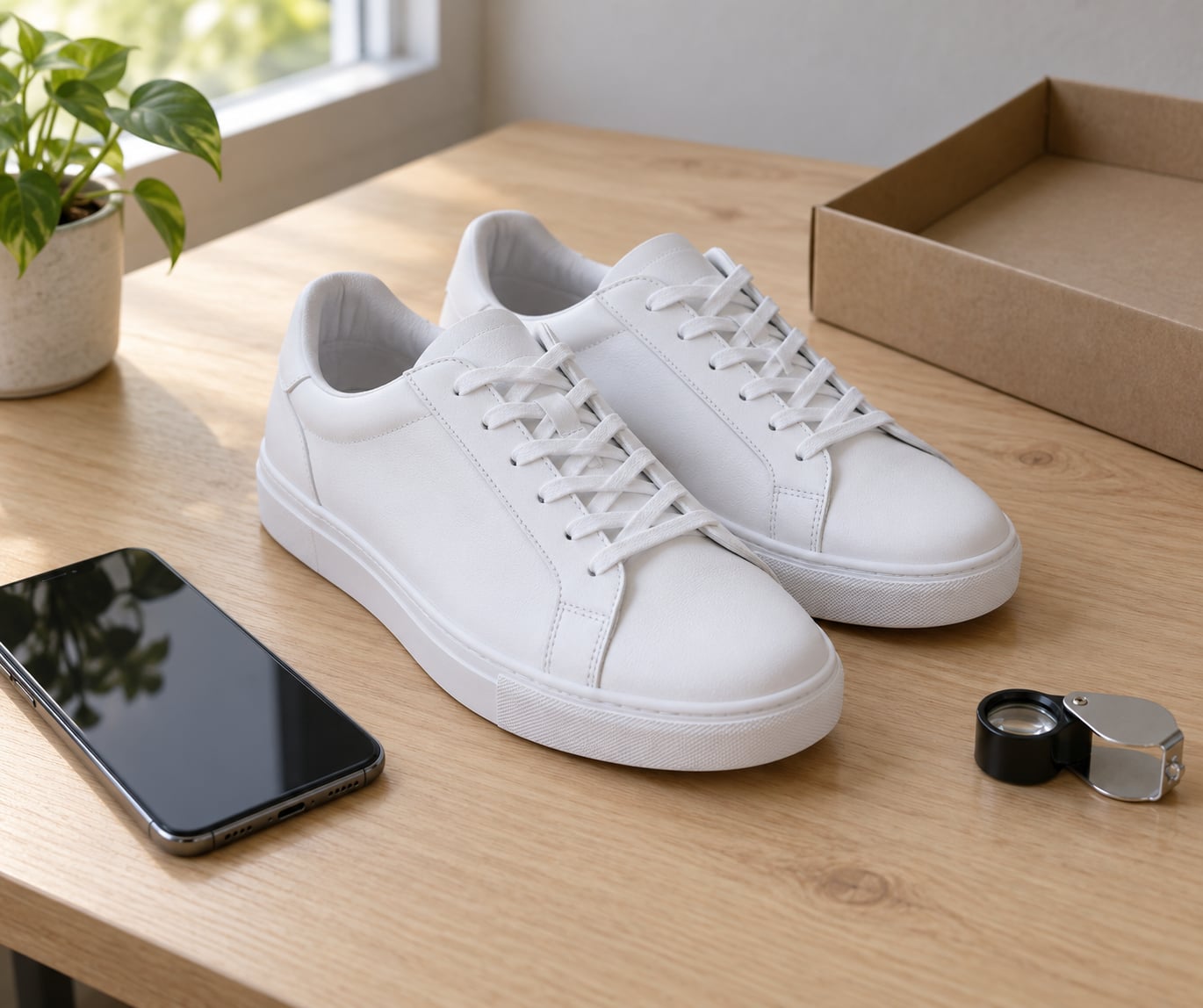
To avoid fake sneakers when buying secondhand, run four checks in a fixed order: the sold-listing price baseline, the seller’s account age and history, the style code and size tag against the box label, then the physical build. Most fakes fall apart at the first or second check, and the whole process takes about fifteen minutes before you send money.
The reason replicas survive casual inspection is that the silhouette is easy to copy. The small production details are not. Typography on the size tag, thread shade, glue residue at the toe-cap junction, the density of the midsole foam, the spacing of the outsole tread, and the print alignment on the box label are all things a factory shortcut skips or approximates.
What you end up with is a real problem for a second look. The shape looks close, the logo is on there, and every visible surface looks like the listing photo. The problems show up in the places listings never photograph. Work through the steps below in order and the inspection becomes something you do the same way every time, regardless of who the seller is.
Table of Contents
- What You Need
- Step-by-Step: How to Avoid Fake Sneakers When Buying Secondhand
- 1. Confirm the Exact Model, Colorway and Size
- 2. Ask for Clear Photos of Every Important Detail
- 3. Check the Shape, Materials and Construction
- 4. Inspect the Branding and Small Identity Details
- 5. Examine the Packaging and Supporting Documents
- 6. Compare the Soles and Wear Patterns
- 7. Use a Second Opinion Before You Pay
- Common Mistakes That Lead to Counterfeit Purchases
- Frequently Asked Questions
- Can you tell if sneakers are real from photos alone?
- What is the most faked sneaker?
- Is there a free app that can check if sneakers are authentic?
- Is it safe and sanitary to buy secondhand sneakers?
- Do receipts prove a pair of sneakers is authentic?
- How do I get a refund when secondhand sneakers turn out to be fake?
- Conclusion
What You Need
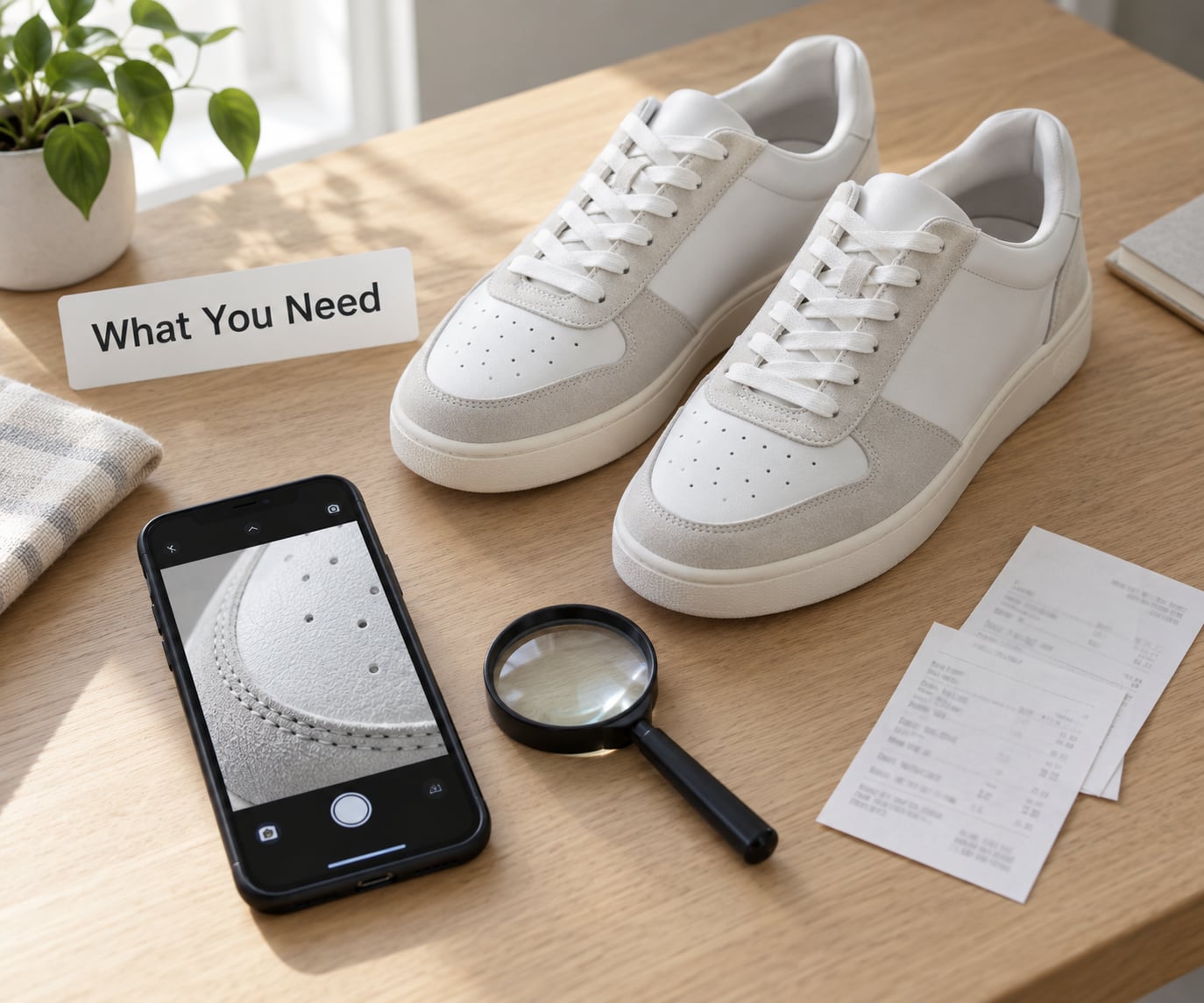
Most of this runs on your phone. The rest is a desk, some light and about ten minutes of uninterrupted attention.
- Daylight, ideally indirect. A window beats a ceiling lamp. Overhead light flattens stitching and hides color drift in the panel materials.
- A smartphone camera with macro or close-focus capability, plus the built-in zoom. The close focus matters more than the zoom.
- A magnifier or loupe. A ten-dollar jeweler’s loupe is enough to resolve the size tag font and the stitch count on a heel tab.
- The original box, if the seller has it, plus any tissue paper, hang tags, spare laces or accessories that shipped with the pair.
- Purchase confirmation email from the original retailer’s app, if the seller claims new. A receipt can be printed by anyone. An order confirmation from a brand app is much harder to fake.
- The official product page for that exact model and colorway, open on your phone. This is the reference you check everything against.
- Access to sold listings on the same platform where the pair is listed, not just active listings.
Step-by-Step: How to Avoid Fake Sneakers When Buying Secondhand
1. Confirm the Exact Model, Colorway and Size
Start with the listing against the brand’s official product page. Match the model name, the colorway code, the release window and the listed size. If the listing says one thing and the official page says another, you have your answer without opening a single image.
Then get the style code. It is a six-to-ten character number and letter combination printed on the box label, usually near the barcode. Search the style code plus the colorway and confirm it points back to the same shoe in the listing. A replica can print a real style code, so a matching code clears the box label only. It does not clear the shoe itself.
One more thing to sort out here: production year and factory. A 1985 Korea-made Jordan 1 and a pair made last year do not have identical materials, and comparing details between eras is how honest buyers end up arguing with each other in comment sections. Know the era before you decide something looks wrong.
2. Ask for Clear Photos of Every Important Detail
Request exactly these shots in daylight, and do it in the conversation rather than accepting whatever the listing has:
- Both shoes side by side, outer side, on a plain background.
- Both tongues, flat, with the label square to the camera.
- Both size tags, one photo each, sharp enough to read every line.
- Both insoles, lifted out if removable, with the insole logo centered.
- The toe-cap junction and the midsole stitching up close.
- Both outsoles, flat, in focus.
- The heel tab, the lateral logo and the lace tips.
- The box label, the box corners and anything packed inside.
- The order confirmation email, with the order number covered if the seller wants.
Add one request for a short video: the seller picks up one shoe, turns it slowly, and runs a finger along the midsole seam. Most genuine sellers will do this without hesitating. Refusal is a signal on its own, and it is a stronger signal than a low-quality photo.
Forum buyers say the same thing over and over in sneaker communities: the photo request is the real test. A seller with a genuine pair can produce any angle you ask for. A seller with a fake has a fixed set of flattering images and nothing behind them.
3. Check the Shape, Materials and Construction
This is where replicas get found, and it only works if you have something real to compare against. The box label is a filename. You need the shoe itself in hand, or a trusted reference pair on the other screen.
Work down this list:
- Panel alignment. Stitch lines should run parallel to the edge of the panel they sit on. Counterfeit seams drift and curve near the ends.
- Stitch density. Zoom in on a hemmed edge. Stitches should be even, tight and terminated cleanly rather than trailing off.
- Glue lines. Look at the junction where the upper meets the midsole. Excess glue squeezed out in an uneven bead, or none at all where there should be a clean cement line, both show up under a loupe.
- Leather versus synthetic. Real leather creases in soft, rounded folds and shows natural grain variation. Synthetic panels crease in sharp, repeating ridges.
- Suede and nubuck. Run a thumb against the nap. It should shift direction and leave a temporary light trail. Faux suede and synthetic nubuck do not behave that way, and they are a common substitution on models that ship with real suede.
- Perforations and mesh. Holes should be round and evenly spaced. Cheap mesh shows a visible grid and frays at the edge.
- Weight. Hold both shoes in one hand. A noticeably light pair, or a left and right that do not weigh the same, is worth a question.
A blacklight is worth having. Genuine pairs vary in how their stitching and adhesives react, and a lot of counterfeit adhesives fluoresce differently from the real thing. Treat it as a supporting signal rather than a verdict.
4. Inspect the Branding and Small Identity Details
Logos get the attention, but the small identifiers carry the evidence. Put a loupe on the size tag first.
Check the font weight, letter spacing, the alignment of the numbers and the print quality of the barcode. Barcodes on replicas are frequently blurred, broken or reprinted. Then check the production date and factory code on that tag, and compare the two tags on the pair against each other. Genuine pairs do not always carry identical production codes, but two tags with exactly the same production ID on the left and right is a documented tell in secondhand running shoe communities, and it deserves a hard look.
Next, the tongue label. If it carries a QR code, the code should scan to the brand’s own site. Replica QR codes either point nowhere, fail to resolve, or land on a lookalike domain. Check the spacing around the code and the print registration on the label itself.
Look at the insole logo, the heel tab embroidery, the lace tips and the stitching inside the logo. Embossed logos on real pairs have depth with clean edges. Flat, shallow or slightly misregistered embossing is a clue. Keep the wording honest, though. Details vary by production run, so a difference from your reference pair is a reason to check further, not a verdict on its own.
5. Examine the Packaging and Supporting Documents
Packaging supports a decision; it never makes one. Genuine boxes have crisp print registration, correct color, sturdy board and an accurate size run on the label. Replica boxes are frequently thinner, with faded colors, kerning errors and font substitutions on the side panel.
Check the size run on the box label against your size. An American 9.5 and a UK 8 sitting on the same shoe is a mismatch, and it shows up constantly on fakes.
On documents, treat receipts as decoration. Counterfeiters produce convincing receipts and can copy retailer-style order confirmation emails. The version worth asking for is the confirmation email that came from the retailer’s own app, opened on a device where the buyer was logged in, or an order number the seller can look up. For a used pair that has been in a collection for years, there simply is no receipt, and that is normal.
Accessories count too. Spare laces, hang tags and tissue paper should match the colorway and the model. A missing accessory is a prompt for a question, not a rejection.
6. Compare the Soles and Wear Patterns
Flip both shoes over. Outsole tread on genuine pairs is cleanly molded, with crisp edges and consistent spacing between the traction elements. Fakes show soft edges, filled-in grooves and a mold line that wanders.
Press the midsole. Foam on a real pair compresses and springs back. Foam that stays compressed, or that feels noticeably denser or softer than expected, is a mismatch worth asking about. On midsole models with a visible pellet pattern, the pellets should be evenly distributed and pressed at consistent depth.
Then look at the wear, because this is the one step that only makes sense for a used pair. Tread should be worn in a way that matches the claimed history. Heel wear concentrated on the outside edge fits a pair that has walked in a lot. A nearly crisp outsole on a pair described as worn every day is a story that does not add up. Vintage pairs are different again: rubber oxidizes, yellows and hardens with age, and that is normal on old stock. A thirty-year-old pair should not be judged against a pair that came out last year.
7. Use a Second Opinion Before You Pay
Stop and get a fresh set of eyes before money moves. There are three routes, in increasing order of certainty.
Recompare from scratch. Go back to the official product page and the detail photos with your notes from steps three through six out of view, so you are not just confirming what you already decided.
Post the photos to a community. Sneaker subreddits will give you a lot of opinions, some of them confident and wrong. A community is useful for surfacing something you missed, not for handing you a verdict. For that reason, ignore the post that comes back with a one-word reply and read the specific ones that name a feature.
Pay for authentication. Multi-brand authentication services and apps examine the pair before it ships and report back with a pass or fail, and marketplaces like StockX and GOAT run their own verification on every sale. That is worth it when the pair is a grail, when the seller is young or the price is far below the sold average. For a common pair from an established seller, a thorough photo inspection usually tells you enough.
Before you send payment, keep the listing, the full photo set, the seller’s replies and the price comparison you ran. If something goes wrong later, that saved thread is the difference between a return and an argument with no evidence.
Common Mistakes That Lead to Counterfeit Purchases
Almost every counterfeit purchase traces back to one of a handful of skipped steps. Here is what goes wrong and what to do instead.
- Trusting active listings instead of sold ones. Active asking prices tell you what a seller hopes to get, not what the market pays. Filter the platform to completed sales for the same size and compare against that average.
- Ignoring seller account age. Accounts with a few months of history and no visible feedback carry most of the risk. Months of activity and a transaction trail mean more than a handful of five-star reviews on a young account.
- Accepting the listing photos. They were chosen to sell, not to inform. Ask for your own angles. Stock photography, or photos that show a different pair than the one in the listing, ends the conversation for me.
- Treating the box as proof. A replica box is cheap to produce and sometimes comes from a real overstock run. The box can support a decision. It cannot make one.
- Believing the receipt. Counterfeit receipts and copied order confirmation emails both exist in quantity. Ask for the confirmation from the retailer’s app instead.
- Skipping the video request. A seller who will not turn the shoe over for fifteen seconds of video is telling you something about the other side of that phone.
- Paying outside the platform. Payment methods with buyer protection are the reason a return is possible. Gift cards, wire transfers and friends-and-family payments remove your recourse when the pair arrives wrong.
- Rushing a good deal. Urgency is the oldest lever in this trade. A seller who needs an answer tonight, today, before the offer expires, is usually running the same message to five other people.
When a listing is genuinely unclear, the honest options are to pass, or to pay only through a method and platform that can reverse the transaction. Fixing an unclear pair after it arrives is far more expensive than losing the deal.
One health note, since secondhand shoes come off other people’s feet. Athlete’s foot and similar fungal infections live in damp shoes, so wash and fully dry the pair before you wear it, and swap out the insoles. If you have a cut on your foot, a red or peeling patch, or itching between the toes, see a doctor or a pharmacist rather than treating it yourself.
Frequently Asked Questions
Can you tell if sneakers are real from photos alone?
Sometimes, but only for the cheap fakes. Photos expose bad stitching, wrong fonts on the size tag, blurred barcodes, uneven glue lines and mismatched panel alignment. They do not reliably expose a well-made replica, because good lighting and a tight crop hide exactly the details that give it away. Photo checks are a filter, not a verdict. For a high-value pair, get the pair inspected in hand or run it through a paid authentication service before paying.
What is the most faked sneaker?
The most counterfeited shapes are the ones with high resale value and simple construction. Basketball silhouettes in the Jordan line, low-top skate and lifestyle models with thick midsoles, and any collaboration with a long waiting list sit at the top, because buyers recognize the silhouette and pay almost any number. Fakes concentrate in the sizes people actually want, usually US 8 to US 11, so an odd size in an odd colorway is worth a closer look.
Is there a free app that can check if sneakers are authentic?
Free apps exist and they are useful for one thing: getting a second opinion after you have already done the physical inspection yourself. They compare your photos against reference images, so they inherit every limitation of photo-based checking and they sometimes return a confident wrong answer. A photo comparison caught a bad pair for one secondhand buyer, but the same reader warned that community legitchecks on grainy photos are unreliable. Treat free tools as a second set of eyes, not as the check.
Is it safe and sanitary to buy secondhand sneakers?
It is reasonable with a few precautions. Fungal infections such as athlete’s foot thrive in damp, dark shoes, and bacteria can survive in lining and insoles. Wash the whole pair in a washing bag on a warm cycle, dry it completely at room temperature rather than on a radiator, and replace the insoles if they smell. If you have any open cut on your foot, or you develop itching, peeling or redness, see a doctor or pharmacist rather than treating it yourself.
Do receipts prove a pair of sneakers is authentic?
No. Counterfeiters print convincing receipts and can copy retailer order confirmation emails closely enough to fool a glance. If a seller claims the pair came from a brand app, ask for the order confirmation email from that app, or for an order number the seller can look up in their own account. For a pair that has been worn for years, the absence of any receipt is completely normal and is not itself a warning sign.
How do I get a refund when secondhand sneakers turn out to be fake?
Save everything before the return window closes: the listing, the full photo set, the seller’s replies, and dated photos and video of the pair’s labels, stitching and sole once it arrives. Then file the report through the platform’s dispute process, describing the specific failures you found rather than calling it fake in general terms. Peer-to-peer windows are short, often only a few days, so a buyer who waits past the deadline usually has nothing left to appeal with.
Conclusion
If you only remember one thing, make the first action a verification, not a purchase. Pull the sold-listing average for that size, read the seller’s account history, and match the style code and size tag against the official product page. Then request your own photos, inspect the build and branding in daylight with a loupe, and get a second opinion before you send a cent.
Most fakes never survive the first three steps, and the ones that do will not survive the build inspection. Take the fifteen minutes, keep the screenshots, and pay only through a method that can reverse the transaction if something is off.