How to care for faux leather jackets comes down to restraint: wipe gently with mild soap and water, let it air-dry fully away from heat, condition the coating a couple of times a year, and store it on a wide hanger somewhere cool and dark. That is the whole routine, and it takes about fifteen minutes a month. The catch is what you must not do, because faux leather is plastic, not hide, and most of the advice floating around online is written for real leather.
A synthetic coating does not breathe, does not absorb oil, and does not heal a scratch. It also degrades on its own schedule, which is why jackets peel at the cuffs, elbows, and seams first. Everything below is aimed at slowing that clock rather than reversing it.
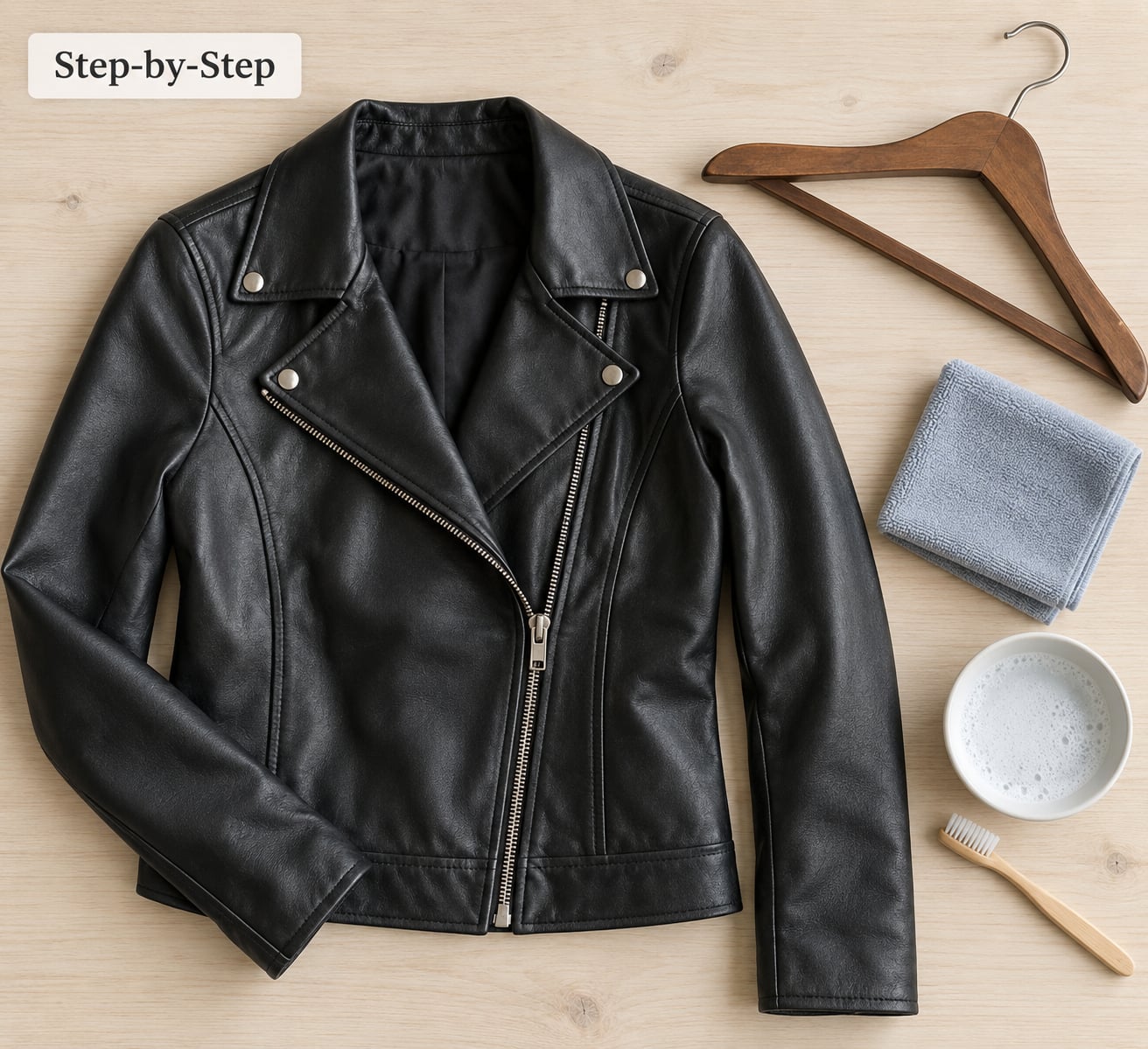
What You Need
You do not need a kit. A few things you probably already own cover almost everything.
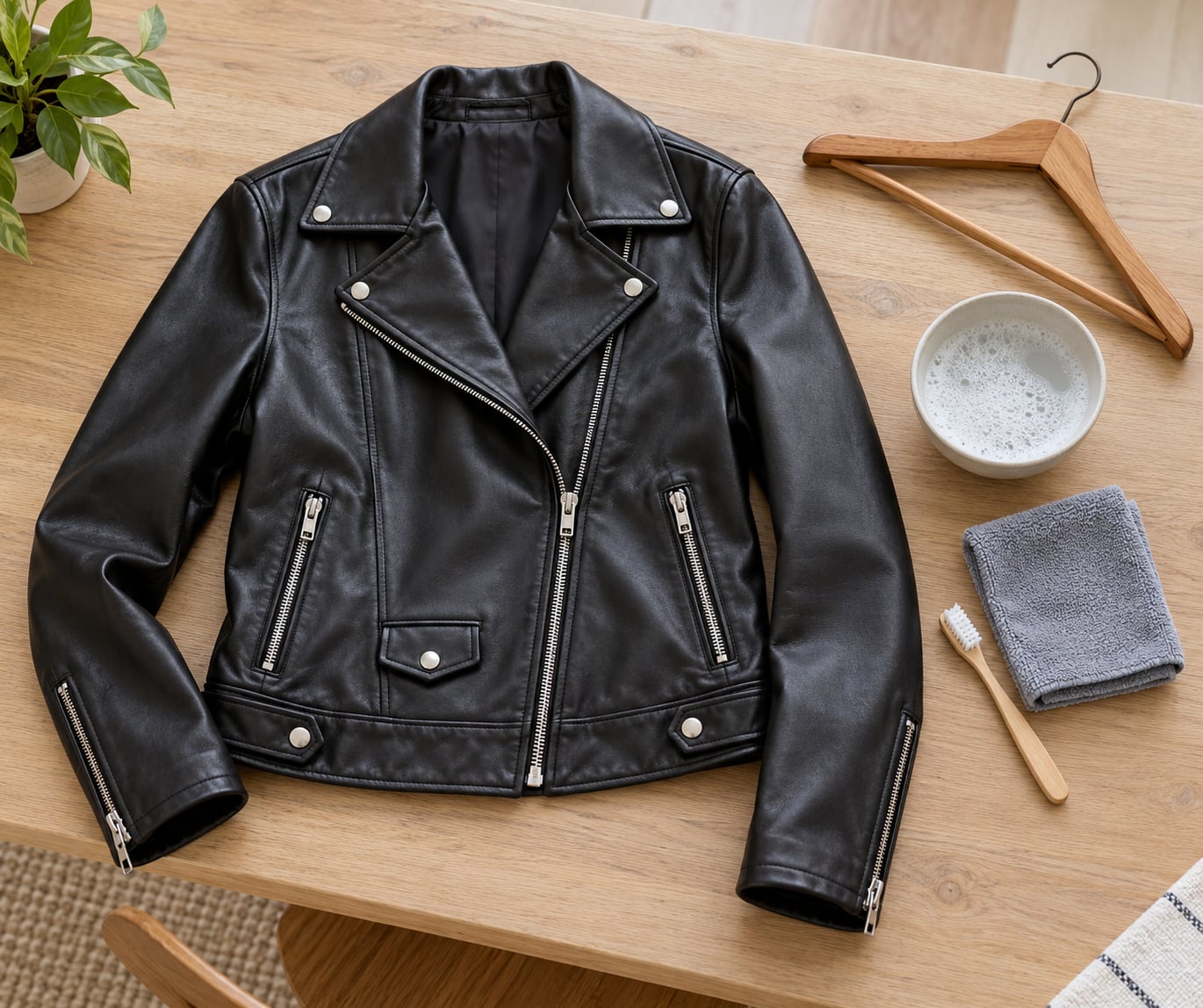
- A soft microfiber cloth. Two or three of them, so you can keep one damp and one dry. Paper towels scratch a coated surface.
- A soft-bristled brush. An old toothbrush works. This is for dust in seams and around hardware, not for scrubbing.
- Mild soap. A few drops of dish soap in a bowl of lukewarm water. Nothing perfumed, nothing with bleach or degreaser in it.
- Distilled or cool filtered water. Hard tap water leaves mineral marks on a coated surface as it dries.
- A vinyl or synthetic leather conditioner. This is the one product worth buying properly, and the label matters. It should say vinyl, synthetic leather, polyurethane, PVC, or faux leather. Real leather conditioner is the wrong product for the job.
- A breathable garment bag and a wide hanger. A curved or wide shoulder hanger keeps the shoulders from creasing into a permanent line. Cotton or non-woven fabric, never plastic.
On that conditioner distinction, since it causes more damage than anything else on this page: real leather conditioner is formulated to soak into tanned hide and feed it oils. A faux leather jacket has a sealed plastic surface, so those same oils just sit there, turn tacky, and attract dirt. A vinyl or synthetic conditioner is built to bond with the coating instead. If a product makes claims about penetrating pores, it is not for your jacket.
Have a baby wipe nearby for a fast refresh, but keep it as a travel item rather than a full clean. On some coatings the alcohol or solvent in a scented wipe will dull the sheen permanently.
Step-by-Step
How to Check the Care Label First
Care instructions vary by coating and manufacturer, so the label always beats general advice. Look inside the seam near the hem or under the collar flap, and look for two things: a material description and a cleaning symbol.
The letters you may find follow a common code. W means water-based cleaner only. S means a solvent or dry cleaner. P means dry cleaning with a petroleum solvent. S-W allows either. B is a bonus-rated mild process, usually a gentle cycle. X means do not clean at all, and that is a real answer, not a formality.
If the tag says the material is polyurethane or PVC with no wash symbol, treat it as hand-clean only. Many jackets sold by streetwear labels have no care label at all, and the absence of a label is not permission to machine wash.
How to Dust the Jacket Gently
Loose dirt is abrasive, and dragging grit across a coated surface is how you get the micro-scratches that read as a dull haze. So clear the dust before you clean anything.
Turn the jacket inside out and tap it gently over a soft surface, or hold it outdoors and brush it with the soft-bristled brush in one direction. Work from the collar down to the hem, and give extra attention to seams, cuffs, pockets, and the areas where studs or buckles sit, since dust collects where the surface changes angle.
Follow up with a dry microfiber cloth, moving in long, light strokes. If the cloth comes away grey, that is the grit you just avoided grinding in.
How to Clean Marks and Stains
Clean faux leather by dabbing, never by soaking. The coating is non-porous, so anything you pour on pools on the surface and can migrate into seams where you cannot reach it.
Mix a few drops of mild dish soap into a bowl of lukewarm water and stir until it is barely sudsy. Dip a clean microfiber cloth in it and wring it out until it is damp, not wet. Test it on an inside seam or under the cuff hem, wait a few minutes, and look for colour change or a mark before you go near a visible panel.
Then dab the mark. Press the cloth on, lift, press again. Do not scrub in circles, even small ones. When the mark lifts, wipe the whole panel with a second cloth barely dampened with plain water to lift the soap film, then pat that dry with a third, dry cloth.
For stubborn grease or a makeup mark, let a warm soapy cloth sit on the spot for a minute before you lift it, and repeat rather than increasing pressure. Ink is the exception: press a cloth dampened with isopropyl alcohol straight onto the mark, blotting outward from the centre, and stop the moment it clears. Alcohol works on ink and will also lift colour if you leave it, so keep the passes short and confined to the stain.
For a smell, whether the factory chemical tang or a damp-storage odour, leave the jacket on a wide hanger in open air for a day and sprinkle baking soda inside a cotton bag in the lining overnight. Skip scented sprays entirely; they leave a residue that attracts dust.
How to Dry and Condition the Finish
Air-dry is the only option. Hang the jacket on a wide hanger in a shaded, ventilated room, or lay it flat, and let it take as long as it takes. Warm air from a radiator or a room that heats up quickly will soften the coating and leave it permanently creased or tacky, and a hair dryer set to cool is not a compromise, it is a gamble.
Once the jacket is fully dry to the touch on the inside as well as the outside, check the finish. Matte coatings fade into a slightly dusty look, and a light conditioner brings the surface back. Glossy coatings pick up fingerprints and lose their depth, and the same conditioner restores the sheen. Suede-finish faux needs almost nothing; a dry soft brush is usually enough, since oils will darken and mat the nap.
Apply conditioner sparingly. Faux leather cannot absorb it, so every extra drop sits on top. Use a pea-sized amount on a microfiber cloth, not a spray bottle, and buff it in with light pressure until the surface looks even and dry. Excess oil shows up later as a sticky patch that attracts dust. Two or three times a year is plenty, and once a year if you live somewhere hot.
How to Store the Jacket Properly
Storage does more for a faux leather jacket than any cleaner, because the failures that matter most come from heat, crushing, and trapped moisture rather than from dirt.
Hang it on a wide or curved hanger with a shape close to the jacket’s own. A thin wire hanger will push the shoulders into a crease that never comes out. If you must fold it, fold loosely along existing seams and never leave weight on top, since a sharp crease becomes a crack line in a coated material.
Put it in a breathable cotton or non-woven garment bag and keep it somewhere cool, dry, and dark. Skip the plastic dry-cleaning cover; sealed plastic traps the small amount of moisture in the lining and the result is mildew at the seams. Leave air between it and the next garment so nothing presses against the coating, and do not put it in a loft, an attic, a garage, or a car boot, where temperature swings do most of the damage.
A jacket worn regularly needs none of this. It is the one that spends nine months in a closet that needs the wide hanger, the breathing bag, and the twice-yearly look at the cuffs.
Common Mistakes
Most ruined faux leather jackets were not worn out. They were cleaned wrong, stored wrong, or both. Here is what goes wrong and what to do instead.
Soaking the jacket. A wet sleeve, a running tap, a bucket. Water migrates under the coating and along the seams, and the plasticizer leaches out from the inside, which is precisely how peeling starts. Use a damp cloth, and never let the garment sit wet.
Using household cleaners. Bleach, ammonia, alcohol-based sprays, and degreaser dissolve or bleach the coating in a single pass, and the damage is immediate and uneven. Mild dish soap is enough for grease, and it is the ceiling, not the starting point.
Applying real leather products. Saddle soap, mink oil, and leather conditioner are all wrong for a coated surface. They leave a greasy film that goes tacky, and saddle soap in particular rinses out of real hide and does nothing useful here. Buy the vinyl or synthetic version or skip conditioning altogether.
Scrubbing. It feels like progress and it is not. Grit under a cloth plus circular motion is a recipe for a permanently dull, hazy finish. Dab, press, and lift instead, and use the brush for dust only.
Applying heat. Machine drying, a hair dryer, an iron, a radiator, a clotheshorse in a warm room. Heat softens the coating so the garment sags, shrinks, or welds to itself, and vinyl in particular can warp outright. Air-dry, always.
Storing in plastic or in a fold. Plastic traps moisture, and a stored fold leaves a crease that later opens into a crack. Use a breathable bag, a shaped hanger, and no weight on top.
Two smaller habits matter as much. Wipe a dusty jacket before you store it, because grit held against the coating for months will imprint. And if a jacket already has white cracking along the seams, stop trying to fix it with conditioner; the coating there is gone, and more product will only make the area darker and glossier than the rest.
Frequently Asked Questions
Can you put a faux leather jacket in the washing machine?
Only if the care label says so, and even then most faux leather performs better in the hand. If a machine wash is permitted, use a cold water gentle cycle, put the jacket inside a mesh delicates bag, use a small amount of mild detergent, and skip the dryer entirely. Never tumble dry faux leather; heat softens and warps the coating. When in doubt, hand cleaning with a damp cloth and mild soap will always be the safer option.
Does faux leather shrink in the dryer?
A polyurethane-coated jacket can shrink unevenly, and a PVC-coated one can warp, stiffen, or fuse to itself at the seam. Tumble heat is also what makes a coating peel later, so even a low setting is a bad trade. Air-dry the garment on a wide hanger or flat, out of direct sunlight, and give it a full day before wearing it.
Can I use Dawn dish soap on faux leather?
A small amount of mild dish soap diluted in lukewarm water is one of the safest cleaning options, and several drops per bowl is plenty. What causes damage is using it straight from the bottle, scrubbing hard, or leaving the jacket saturated. Always test on an inside seam first, and remember that perfumed or concentrated degreasers are not the same product as plain dish soap.
How do you keep faux leather from cracking?
Cracking starts when the plasticizer in the coating breaks down and the surface hardens, so prevention means slowing that process. Condition with a vinyl or synthetic leather conditioner two or three times a year using a pea-sized amount, keep the jacket out of direct sun and heat, and store it on a wide hanger in a breathable bag. Conditioning treats the surface; it cannot restore cracking that has already opened.
Can you condition faux leather?
Yes, but with a product made for vinyl, polyurethane, or synthetic leather rather than one made for real hide. Real leather conditioner is absorbed by tanned animal skin and has nowhere to go on a non-porous coating, where it leaves a tacky film that attracts dust. Apply a small amount to a microfiber cloth, buff lightly, and stop when the surface looks even and dry.
Why is my faux leather jacket peeling, and can it be fixed?
Faux leather peels when the coating separates from the textile base, usually after heat exposure, solvent contact, or simple age. If the flaking area still shows a continuous coated surface, a leather repair paint or colour-matched sealer can blend it visually, though the surrounding coating will keep going. If you can see woven fabric underneath, the coating has failed there and no product will restore it.
Start With a Small Test and Regular Care
If you do one thing this week, turn the jacket inside out, find the care label, and test your cleaning method on a seam nobody can see. That fifteen-minute habit prevents almost every problem on this page.
Then keep it light. Dust monthly, spot-clean when something spills, condition a couple of times a year, and hang it on a wide hanger in a breathable bag between wears. Faux leather will not last as long as a good hide jacket, but a well-kept one holds its finish for years, and the difference is almost entirely down to avoiding heat, harsh chemicals, and plastic covers.